Phosphatidylserine for Nighttime Cortisol and Sleep Quality
The supplement reduces nighttime cortisol spikes and improves sleep quality without sedation.
What phosphatidylserine is and why the brain contains so much of it
Phosphatidylserine is a phospholipid, one of the fatty building blocks that make up cell membranes throughout the body. Every cell holds some, but the brain hoards it: PS makes up roughly 13 to 14 percent of the brain's total phospholipid content, packed into neuron membranes at a concentration far beyond incidental buildup. Membrane fluidity determines how well a neuron fires, how it manufactures and clears neurotransmitters, and how efficiently it pulls in glucose to burn as fuel. PS is what keeps those membranes loose enough to do all three. The brain guards its supply so closely instead of treating it as a spare part.
The body makes some PS on its own, and diet fills in the rest: organ meats, mackerel, and soybeans all carry it in meaningful amounts. Food alone will not get anyone near the doses used in the trials that established PS's effects on memory, stress, and cortisol, though. That gap between what a normal diet supplies and what a clinical dose requires is the entire reason PS exists as a supplement rather than a line on a nutrition label.
Cortisol's behavior across a 24-hour cycle
Cortisol is not a panic hormone that appears only during emergencies. It runs on a clock, governed by the hypothalamic-pituitary-adrenal axis, and that clock lets the body shift between alert and restorative states without a fight every single day.
The clearest signal is the cortisol awakening response: levels spike within 30 to 45 minutes of waking, and that spike is what turns a groggy body into a functioning one. From there, cortisol slides downward hour by hour, bottoming out around midnight. Alert to restorative, and back again the next morning. That is the whole design, and it is a simpler system than most people give it credit for.
What disrupts the cortisol arc and its cognitive and emotional cost
Chronic stress flattens that arc. Poor sleep does the same, and so does shift work. Once flattened or inverted, cortisol stays elevated into the evening and through the night, sitting exactly where it should be lowest.
The mechanism turns into a loop, and a vicious one at that. Poor sleep raises nighttime cortisol, elevated cortisol delays sleep onset and degrades sleep quality, and that worse sleep raises cortisol again the next night. Standard sleep hygiene advice, going to bed earlier, cutting caffeine after noon, treats this as a behavioral problem. It is not one. The loop is endocrine. It keeps running even for someone who does everything else right.
The cost runs well past groggy mornings. Chronic cortisol elevation has been linked to hippocampal atrophy, and the hippocampus is the structure that handles memory formation and mood regulation. Dysregulated cortisol connects to cognitive decline and depressive symptoms over time, not as a bad night here and there but as a slow erosion of the tissue responsible for holding memories and keeping mood steady.
PS modulation of the HPA axis to blunt the cortisol spike
Researchers have studied PS's effect on the stress response since the early 1990s, and the finding has held up across three decades: PS blunts the adrenal response to physical and emotional stress by lowering the ACTH and cortisol spikes that stress normally triggers.
The mechanism is upstream, at the HPA axis, dialing down the signal that tells the adrenal glands to release cortisol. That puts PS in a different category from a downstream sedative, and it is the reason PS behaves nothing like melatonin or a GABA compound. It does not knock the system out. It turns the volume down on the signal that would otherwise wind the system up.
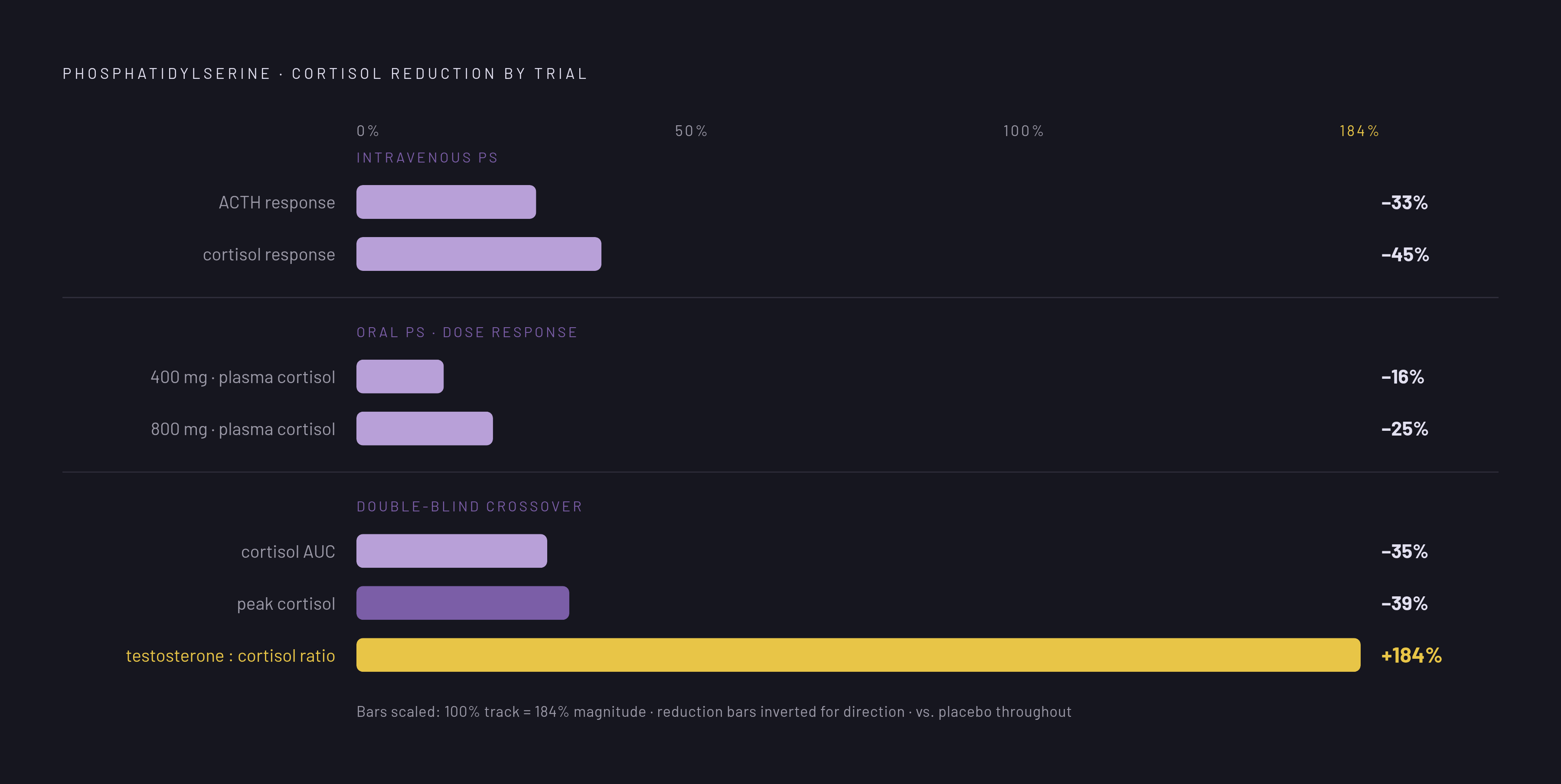
One double-blind, placebo-controlled crossover study found mean peak cortisol running 39 percent lower after PS compared to placebo, with total cortisol exposure over time (the area under the curve) coming in 35 percent lower (p < 0.05). The same study found PS raised the testosterone-to-cortisol ratio, a marker exercise physiologists use to track recovery versus breakdown, by 184 percent over placebo (p < 0.05).
An earlier double-blind, randomized study tested intravenous PS at 50 mg and 75 mg and found ACTH increases running about 33 percent lower than placebo and cortisol increases running about 45 percent lower than placebo. A follow-up using oral PS found plasma cortisol responses 16 percent lower at 400 mg and 25 percent lower at 800 mg. More PS, less cortisol reactivity, up to a point, and that pattern repeats across every trial in this line of research. It is the strongest piece of evidence PS has going for it, and everything downstream in this piece depends on taking that finding seriously.
What the sleep-specific evidence shows (and where it stops)
The cortisol evidence runs deep. The sleep-outcome evidence does not run deep, and pretending otherwise does a disservice to anyone deciding whether to bother with PS.
A patent filed by Yakult Honsha tested a fermented milk product combined with PS and found the biggest gains in people who started with the worst baseline sleep, measured by higher PSQI scores: fewer awakenings, shorter time to fall asleep, awakenings cut to half or less of placebo. Total sleep duration barely moved. Read directly, that means PS improves sleep quality and reduces fragmentation. It does not make anyone sleep longer, and anyone marketing it that way is overstating the finding.
Animal research in a Parkinson's disease model adds a directional clue: critically low brain PS levels tracked with sleep disturbance, and restoring PS through supplementation normalized sleep patterns. That is a mechanism hint in rodents, not proof in people. Stretching it further than that misrepresents what the study actually did.
A 2025 secondary analysis comes closer to closing the loop. It found the degree of cortisol reduction correlated significantly with improvements in sleep quality (PSQI), mood (DASS-21, PANAS), and general well-being (WEMWBS, WHOQoL-BREF) over three weeks of supplementation. Lower cortisol, better sleep, better mood, roughly in that causal order. That is the best evidence available connecting the mechanism to the outcome people actually care about, and it still falls short of a clean causal trial. Treat it as a strong lead.
Dose, timing, and what "working by lowering cortisol" means practically for a nighttime routine
The classic PS trials on memory and cognition used 300 mg a day, typically divided across doses. The cortisol and exercise-recovery trials used considerably more, 600 to 800 mg, well above what most retail bottles put in a single serving.
The exercise data turns dose from a footnote into the whole argument. 800 mg of bovine cortex PS cut the cortisol response to exercise by 30 percent, while the evidence on lower doses is far less compelling. Half the dose produced a meaningfully smaller effect. Separately, 800 mg of soy-derived PS cut the cortisol response to intensive resistance training by 20 percent. Anyone buying a 100 mg capsule expecting exercise-grade cortisol suppression has bought the wrong product for that goal, full stop.
Daily, ongoing use tells a gentler story. Most general-use research suggests that, over time, benefits may stabilize across doses, which has led some to propose a loading-then-maintenance approach: push higher early, taper once levels stabilize. That is a pattern visible in the data, not a settled clinical protocol, and it should be treated as exactly that and nothing more. Most general-use research is in the 100 to 300 mg daily range, and that range is the sane starting point for anyone using PS for sleep rather than for exercise recovery.
Soy vs. sunflower PS: source and absorption, and why bovine brain PS is no longer available
The strongest early clinical evidence for PS came from bovine brain-derived PS, labeled BC-PS in the older literature. BSE risk, mad cow disease, pulled it off the market decades ago, and it has not returned to widespread commercial availability since. That history matters because it explains why the current evidence base runs almost entirely on plant-derived PS instead.
Two plant sources filled that gap: soy-derived PS and sunflower-derived PS. Soy carries the far larger clinical dataset, and most of what is known today about PS and cognition or cortisol traces back to soy trials specifically. Sunflower PS is considered a comparable plant-derived alternative, with the active phospholipid structure preserved regardless of source. Allergen exposure, not performance, is what actually separates the two. Anyone avoiding soy reaches for sunflower PS and loses nothing in how the compound works once it hits the bloodstream.
How PS fits into a broader nighttime performance stack
PS solves one problem: an HPA axis that keeps firing cortisol into the blood when it should have gone quiet hours earlier. It does not touch every cause of bad sleep, and treating it as a universal fix misreads everything covered above.
Ashwagandha and rhodiola work on cortisol and stress resilience too, and stacking them with PS is often considered a reasonable bet rather than a redundant one. Melatonin handles an entirely different problem, circadian signaling rather than cortisol, so it complements PS instead of duplicating it for someone dealing with both a flattened cortisol curve and weak melatonin output. Magnesium supports relaxation through yet a third mechanism, and stacking all three without understanding which one is doing the work is how people end up unable to tell what actually helped.
Match the ingredient to the actual mechanism causing the bad sleep. That beats grabbing a generic sleep blend and hoping one of its twelve ingredients happens to hit the right target. PS earns its spot specifically for the wired-but-tired pattern: a body that is exhausted while the mind keeps running on cortisol that refuses to drop.
None of this is a minor quality-of-life question. The effects of sleep deprivation on executive function, working memory, and emotional regulation are well established and broadly recognized across the literature. Fixing sleep at night, in that light, is a daytime cognitive performance strategy as much as it is a recovery one.