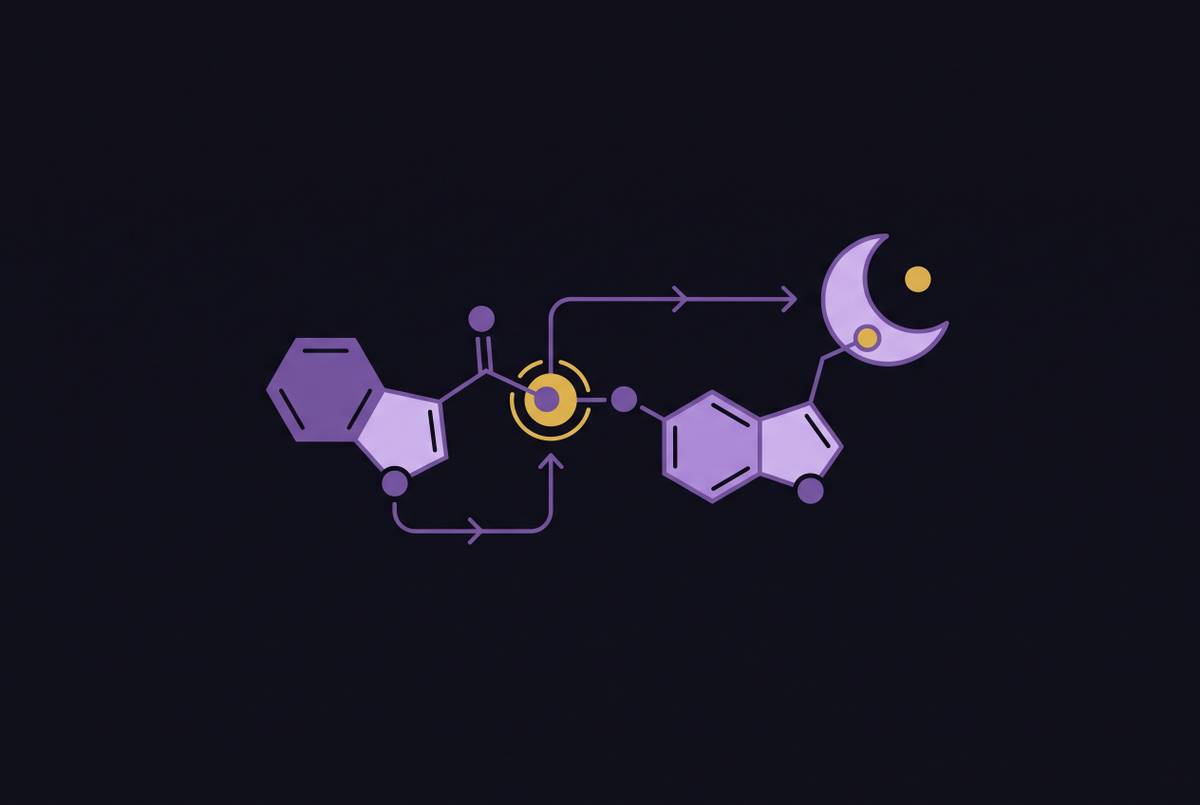
Magnesium Glycinate vs Magnesium Oxide for Sleep Quality
Glycinate absorbs twice as well as oxide, making label milligrams nearly meaningless for sleep.
Magnesium supplements pulled in $387 million over the 52 weeks ending October 5, 2025, according to SPINS Natural and Conventional Channel data powered by Circana, and most of that money is chasing sleep. Yet most shoppers reach for whichever bottle lists the highest milligram count on the front, and that instinct almost always lands on magnesium oxide, the worst-absorbed form on the shelf. The number printed on a label is not the dose a body receives. What matters is how much elemental magnesium actually reaches the bloodstream, and on that measure, magnesium glycinate beats magnesium oxide by a wide enough margin that picking the wrong bottle amounts to paying for a supplement that mostly passes through the gut undigested.
What magnesium does in the body, and why deficiency is so common
Magnesium is not a niche mineral riding a wellness trend. It acts as a cofactor in over 300 biochemical reactions, including nerve signaling, muscle contraction, blood sugar regulation, protein synthesis, and the electrical rhythm that keeps a heart beating on schedule. Removing magnesium from any one of those systems causes downstream effects that appear quickly.
Roughly half of adults fail to meet the Estimated Average Requirement for magnesium through diet alone. That is not a shortfall invented by supplement marketers hunting for a new product to sell. It is a real nutritional gap, and the daily recommended intake of 310 to 420 milligrams, depending on age and sex, gives a fixed benchmark against which any supplement dose can be measured honestly.
The people most likely to be running a deficit are also, unsurprisingly, the people most likely to complain about sleep, and that overlap is not a coincidence. Chronic stress burns through magnesium reserves faster than diet can replace them. Heavily processed food is magnesium-poor by design, since refining strips the mineral out of grains. Diuretics and proton pump inhibitors both interfere with magnesium retention, and heavy alcohol use does the same. The risk factors for magnesium depletion line up almost exactly with the risk factors for poor sleep, because the same physiological stress load is driving both symptoms at once.
How magnesium supports sleep, the four mechanisms that matter
Magnesium acts as a natural GABA agonist, potentiating the brain's primary inhibitory neurotransmitter, the one responsible for slowing neural firing and telling the nervous system it is safe to power down. That binding site is separate from the one pharmaceutical sleep aids target. This binding mechanism is distinct from the one pharmaceutical sleep aids target.
Melatonin synthesis also appears to depend on adequate magnesium status, so a shortfall may blunt the body's own sleep-onset signal before it ever reaches the brain's clock.
Cortisol is where the mechanism gets more interesting. When magnesium runs low, the HPA axis turns hyperresponsive, and cortisol that should be falling by evening stays elevated instead, locking the body in a physiological stress state that resists sleep onset. A trial by Abbasi and colleagues, published in the Journal of Research in Medical Sciences, measured this directly: serum cortisol came out measurably lower in the magnesium group than in the placebo group.
Then there's glycine, the amino acid that gives magnesium glycinate its name and carries its own documented sleep mechanism, independent of the mineral it's chelated to. It carries its own documented sleep-relevant mechanisms independent of the mineral it's chelated to. Bannai and colleagues found that 3 grams of oral glycine before bed reduced morning fatigue and improved daytime cognitive function in adults whose sleep had been restricted. That gives magnesium glycinate a second, independent mechanism that magnesium oxide simply does not carry, and it's the strongest reason to treat the two forms as different products rather than interchangeable sources of the same mineral.
The bioavailability gap: what "500 mg" delivers from each form
Do the label math and the gap becomes obvious fast. A 500 mg dose of magnesium glycinate delivers roughly 70 mg of elemental magnesium, because glycinate runs only 14.1% elemental magnesium by weight. A 500 mg dose of magnesium oxide delivers roughly 300 mg of elemental magnesium, because oxide runs 60.3% elemental by weight. Same number on the front of the bottle, wildly different amount of actual mineral inside the capsule.
But elemental content on paper and elemental magnesium absorbed into the bloodstream are two different numbers, and this is where oxide falls apart. It absorbs at somewhere between 4% and 15%. It has poor solubility, it tends to form insoluble complexes with other compounds in the gut, and it needs adequate stomach acid to break down, something a meaningful share of adults, especially anyone on acid-reducing medication, simply don't have enough of. Glycinate absorbs at 23% to 30%, nearly double the ceiling of oxide, because the chelation bond shields the magnesium from reacting with phytates and fiber in the gut, and because it can piggyback on amino acid transporters in addition to the standard mineral absorption pathway. Research in patients with compromised gut absorption has found that chelated forms like glycinate retain a meaningful absorption advantage over oxide even under demanding conditions.
Running the two forms side by side shows the front label does not mean what it seems to mean. The oxide tablet looks like the better deal: high elemental number, low price. Only a sliver of it reaches systemic circulation. The glycinate serving looks smaller on paper, yet a far larger share of what's there actually gets used. Ranade and Somberg classified oxide's bioavailability as "extremely low" and grouped chelated organic salts, glycinate included, among the better-absorbed forms, a classification that has informed practitioner guidance on magnesium form selection. Anyone buying on milligram count alone is optimizing for the wrong number, full stop.
What the clinical evidence shows for sleep, trial by trial
Abbasi and colleagues ran the most-cited magnesium sleep trial: 46 elderly subjects with chronic primary insomnia, randomized to 500 mg magnesium oxide or placebo for eight weeks. The magnesium group showed significant improvement in sleep efficiency and sleep onset latency compared to placebo. Early morning waking and total sleep duration did not separate from placebo at statistical significance (p=0.08 and p=0.37), and serum magnesium levels, while they rose, missed significance too (p=0.06). Serum cortisol, though, dropped significantly in the treatment group.
Read the trial for what it is rather than what it's cited as. It used oxide, the lowest-bioavailability form under discussion here, on elderly subjects who were almost certainly running a substantial magnesium deficit already. Correcting a real deficiency with nearly any form of magnesium tends to produce a response, so the results likely overstate what oxide would do for a younger, adequately nourished adult who isn't depleted to begin with. What the trial demonstrates looks like deficiency correction, not some pharmacological effect specific to oxide, and treating it as proof that oxide works for sleep in general is a misreading of the data.
The Schuster trial, published in Nature and Science of Sleep, is the cleaner test. It enrolled 155 healthy adults reporting poor sleep quality, ran double-blind and placebo-controlled, and came out of Leibniz University Hannover with no supplement industry funding attached. Participants took 250 mg of elemental magnesium as bisglycinate daily for four weeks. Insomnia Severity Index scores improved significantly versus placebo, though the effect size was modest, a Cohen's d of 0.2. An exploratory subgroup analysis found the improvement ran larger among participants who started with lower dietary magnesium intake, which lines up with the deficiency-correction story rather than a universal sedative effect. Fatigue, perceived stress, and mood did not differ significantly from placebo, and that gap matters as much as the headline result. This is, as far as the current record shows, the only sleep RCT on any magnesium form funded by an independent academic institution rather than industry money, and in a research space where industry funding is the norm, that distinction carries real weight.
The evidence gap for other popular forms matters just as much for anyone comparing labels. Magnesium taurate, malate, orotate, and chloride are heavily marketed for sleep but have no sleep-specific clinical trials behind them; their claims rest entirely on magnesium's general mechanisms, borrowed credibility rather than earned evidence. Magnesium L-threonate has sleep studies, but at least one required a 2025 correction notice after initially undisclosed funding from a company holding or licensing the Magtein patent came to light. Marketing that presents threonate's evidence base as equivalent across both cognition and sleep is stretching the data past what it supports.
None of this should be oversold in the other direction either. Someone already eating a diet loaded with leafy greens, nuts, seeds, and whole grains is probably close to adequate on magnesium already, and a supplement adds only a modest benefit on top of that. The real payoff appears for the roughly half of adults falling short on dietary magnesium, particularly around falling asleep and staying asleep through the night.
The cortisol feedback loop that links magnesium status to both sleep and daytime cognition
Cortisol is supposed to follow a predictable arc: peak shortly after waking, decline steadily through the day, bottom out by evening so the body can downshift into sleep. Magnesium deficiency throws that arc off by making the HPA axis hyperresponsive, which keeps cortisol elevated into the hours when it should be dropping.
The loop runs in both directions, and that is what makes it a loop rather than a one-time effect. Poor sleep raises cortisol the following day. Elevated cortisol accelerates magnesium excretion, deepening the deficit. A deeper deficit increases HPA reactivity further, which disrupts the next night's sleep, and each turn reinforces the next.
The Abbasi trial captured half of this loop directly: after eight weeks, the magnesium group showed improved sleep outcomes compared to placebo, in line with the trial's primary measures. The daytime cost isn't just feeling tired, either. Elevated evening cortisol degrades sleep architecture, and degraded sleep causes slower reaction time, weaker working memory, and harder-to-sustain focus the next day. These are the exact cognitive symptoms that high performers tend to notice first and blame on something else.
How to apply this to a supplement decision
Magnesium glycinate (also sold as bisglycinate) is the best-supported choice when sleep is the specific goal, and the case for it isn't close. It is the only form backed by an independently funded, institutionally run sleep RCT, it produces fewer digestive side effects than most other forms, and it carries a dual mechanism, magnesium plus glycine, that maps directly onto the stress-and-cortisol pathway driving a lot of modern sleep disruption. Magnesium citrate is a reasonable budget alternative: it absorbs well, runs 16.2% elemental magnesium by weight, and has indirect support from general magnesium RCTs, even without a sleep-specific trial of its own. Magnesium oxide makes sense mainly as a low-cost way to correct outright deficiency, particularly in older adults who mirror the Abbasi cohort. For sleep quality as the primary goal, though, the absorption gap knocks it to the bottom of the list, not the top, no matter what the milligram count on the front suggests.
On dose, clinical sleep trials have used a range of doses, the Schuster trial used 250 mg elemental magnesium daily, while the Abbasi trial used 500 mg of magnesium oxide compound, and most research points to 200 to 400 mg elemental daily as a reasonable working range. Because glycinate runs only 14.1% elemental by weight, hitting 200 mg elemental means taking a real number of capsules, not just one. Read the elemental figure on the supplement facts panel. The total compound weight printed in large type on the front is not the number that matters.
Timing matters less than consistency does. Taking it 30 to 60 minutes before bed is a commonly recommended window, and you should not expect results on night one. The benefit builds over roughly four weeks of steady use, in line with the trial data, not overnight.
Confirm the panel lists elemental magnesium, not just total compound weight, and look for the form listed explicitly as magnesium glycinate, bisglycinate, or magnesium diglycinate, three names for the same compound. Skip proprietary blends that hide the dose of each ingredient behind a single combined number. Treat "magnesium complex" products, which mix several forms without disclosing how much of each is in there, as a label to walk past rather than a formulation to trust. Oral supplementation is the route with clinical evidence behind it; topical magnesium sprays and gels have low, uncertain absorption and nothing close to the trial data covered here.