Tryptophan and Serotonin Pathway Effects on Sleep Timing
Stress diverts tryptophan away from the serotonin-melatonin pathway that controls sleep.
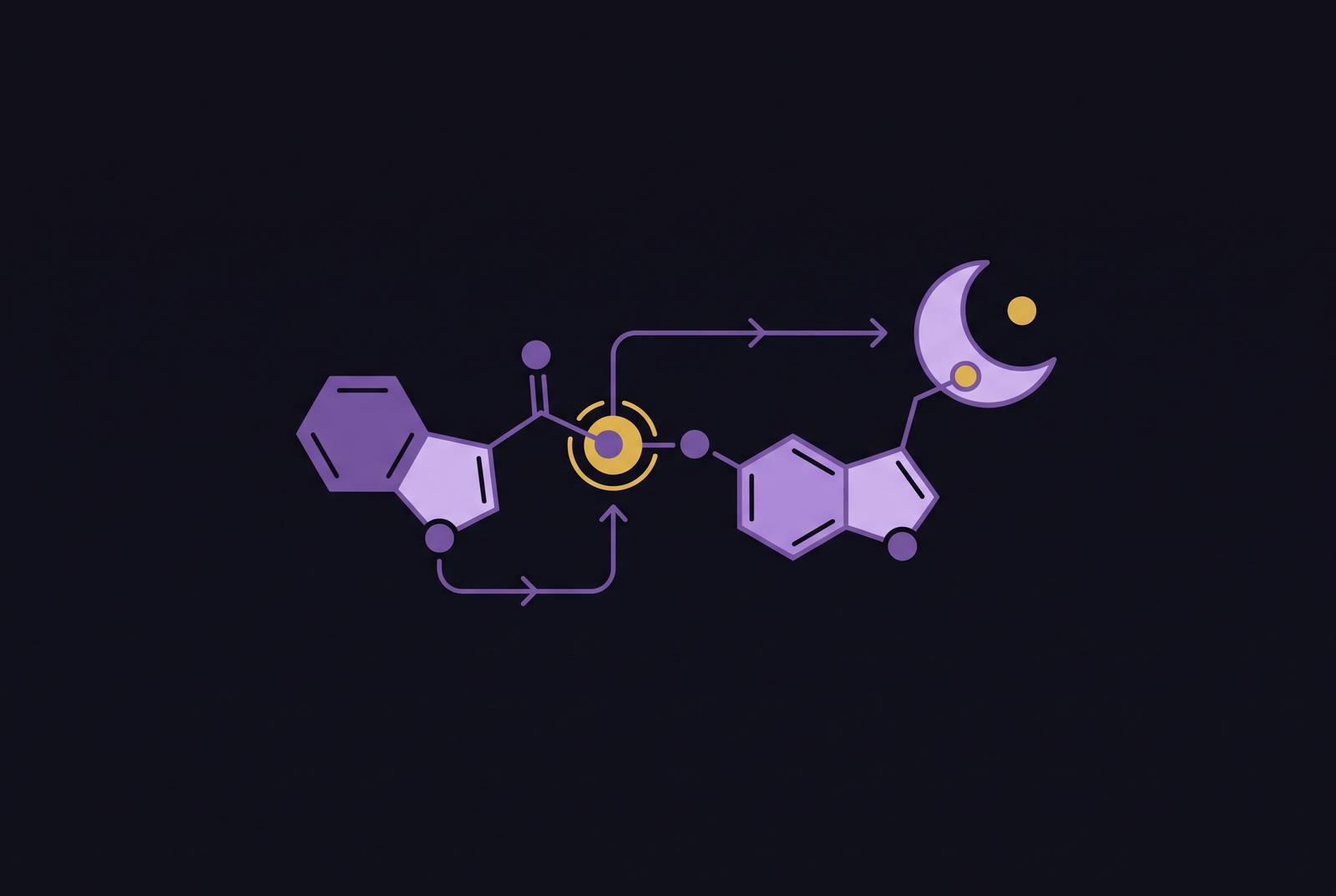
Sleep doesn't begin at bedtime. It begins hours earlier, in a metabolic chain that starts with an amino acid from dinner and ends with a hormone released in darkness: tryptophan becomes serotonin, serotonin becomes melatonin, and each conversion depends on an enzyme that either has what it needs or doesn't. Most sleep advice fixates on the bedroom, focusing on the thermostat, the mattress, and the white noise machine. None of that matters much if the upstream chemistry never clears the bar, and that's the part almost nobody names correctly.
The two-step enzymatic conversion from tryptophan to serotonin
Tryptophan is an essential amino acid. The body can't build it from scratch, so every molecule comes from protein in food. Once absorbed, it hits a fork almost immediately: it can head into the serotonin pathway, or it can get pulled into the kynurenine pathway. Under ordinary conditions, roughly 95% of it goes toward kynurenine, leaving about 5% for the route that eventually matters for sleep. That imbalance is the single most important fact in this entire chain, and most sleep advice ignores it completely. The pathway responsible for sleep timing was never the majority pathway to begin with, so anything that draws more tryptophan toward kynurenine has an outsized effect on what's left over.
For that small fraction, conversion to serotonin happens in two enzymatic steps. Tryptophan hydroxylase converts tryptophan into 5-hydroxytryptophan (5-HTP) first, and this is the rate-limiting step in the whole sequence. The speed of that one reaction sets the pace for everything downstream. Enzyme activity matters as much as raw tryptophan supply. Plenty of substrate doesn't help much if the enzyme itself isn't working at capacity. Second, 5-HTP gets decarboxylated into serotonin, known formally as 5-hydroxytryptamine or 5-HT.
Serotonin at this stage isn't a sleep chemical yet. During the day it works as a mood regulator, a cognitive modulator, a check on impulsivity, and it promotes wakefulness. Its daytime job and its nighttime job are opposite functions carried out by the same molecule at different points in a 24-hour cycle.
How serotonin becomes melatonin once darkness arrives
Once darkness falls, the pineal gland takes the serotonin that has accumulated and pushes it through two more enzymatic reactions, first to N-acetylserotonin, then to melatonin. The switch that triggers this is light, or rather the absence of it.
During daylight, the retinohypothalamic tract carries photic signals from the retina to the suprachiasmatic nucleus (SCN), the brain's master clock. That signal keeps the SCN active, and an active SCN suppresses the pineal gland's ability to make melatonin. As light fades and retinal input drops off, SCN activity falls, its inhibitory grip on the pineal gland loosens, and the conversion from serotonin to melatonin proceeds. Melatonin then circles back to the SCN itself, binding MT1 and MT2 receptors there to induce sleepiness and keep the circadian clock synced to the day-night cycle. Light controls the SCN, the SCN controls the pineal gland, and the pineal gland's output eventually reports back to the SCN. That's a closed loop, not a one-way switch, and it's why fixing "light exposure" in isolation only ever gets you partway there.
Sleep deprivation's effects on circulating tryptophan and melatonin, measured directly
This pathway appears in blood work, not just in theory. Sochal and colleagues at the Medical University of Lodz, publishing in the International Journal of Molecular Sciences, put 80 healthy adults through polysomnography and actigraphy-monitored sleep deprivation, drawing blood before and after.
Circulating tryptophan dropped from 44.9 to 30.8 μmol/L (p=0.024). Melatonin dropped too, from 457.0 to 423.6 pg/mL (p=0.043). Sleep deprivation didn't just leave melatonin flat, it pulled down the raw material upstream as well. The disruption reaches back into substrate availability itself, and that raises the obvious next question: what's intercepting that tryptophan before it ever gets used.
The kynurenine pathway: how stress and inflammation intercept tryptophan before it reaches serotonin
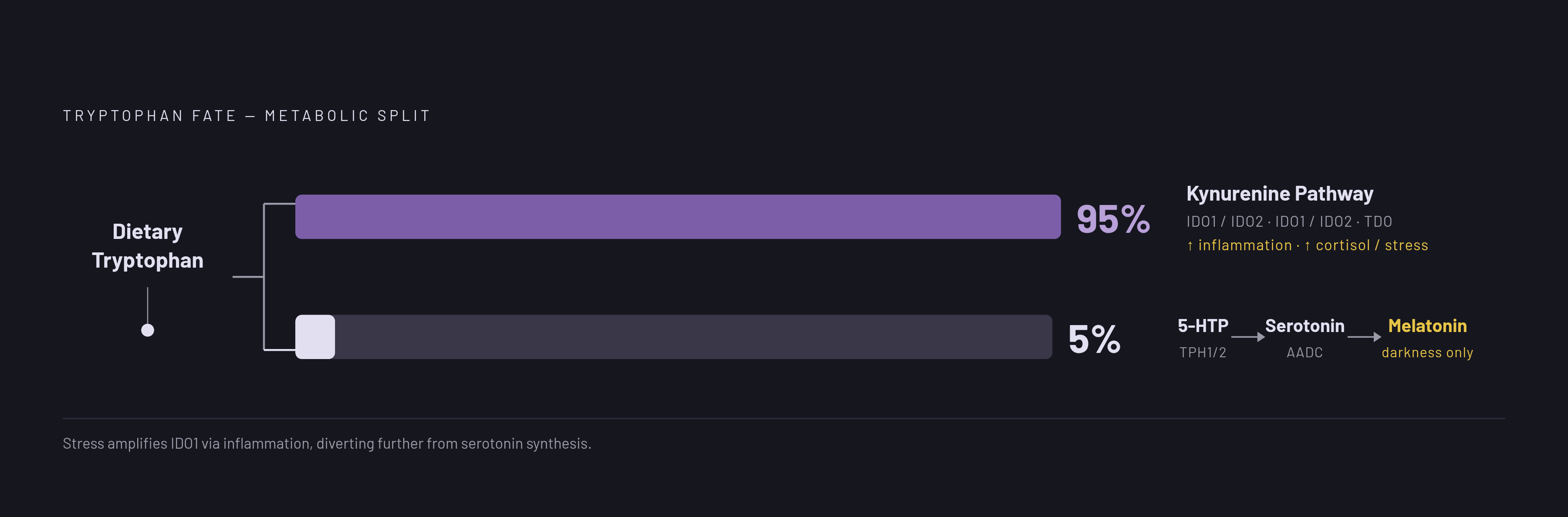
Kynurenine already claims about 95% of tryptophan under normal conditions. Stress and inflammation don't divert tryptophan from some evenly split budget, they tilt an already lopsided ratio further in kynurenine's favor, at the direct expense of the small serotonin-bound fraction. Most explanations of "stress hurts sleep" stop at the vague version and skip the mechanism.
Three enzymes gate entry into the kynurenine pathway: IDO1, IDO2, and TDO. TDO sits mostly in the liver and gets switched on by cortisol. IDO1 and IDO2 respond to a different trigger: pro-inflammatory cytokines, including IFN-γ, TNF-α, and IL-6. That's two separate on-ramps into the same diversion, one driven by the hormonal stress response, one by immune activation. Chronic stress and chronic low-grade inflammation, conditions that are nowhere near rare, both push tryptophan toward kynurenine and away from serotonin, and by extension, away from melatonin. Measurable enzymes respond to measurable stress hormones and cytokines, and the downstream effect is squarely on the serotonin-melatonin axis. This is biochemistry.
Serotonin timing: the same molecule drives wakefulness in the morning and sleep onset at night
Serotonin runs higher during daylight, supporting wakefulness, alertness, and mental clarity. As evening approaches and the SCN registers falling light, that same serotonin gets converted into melatonin, flipping from a wake-promoting substrate into the raw material for sleep onset. One molecule, two opposite functions, depending entirely on the hour.
If serotonin runs low by evening, there isn't enough of it to convert, and melatonin production falls short. That appears as delayed sleep onset, lighter sleep, or waking repeatedly through the night, and it traces back to something that happened metabolically hours earlier, sometimes a full day earlier. Calling that a sleep-hygiene failure misdiagnoses the problem. The actual failure happened at 3pm, in serotonin levels, not at 11pm in the bedroom.
What tryptophan and 5-HTP supplementation evidence shows about sleep timing
Tryptophan supplementation has real data behind it, not folklore. A meta-analysis covering 18 articles found that tryptophan supplementation shortened wake after sleep onset by 81.03 minutes per gram (p=0.017; standardized mean difference of -1.08, 95% CI -1.89 to -0.28). That's the strongest single data point in this entire pathway, and it deserves more weight than it usually gets.
Dose is where most people get it wrong. The evidence points to a threshold, not a gradient: doses of 1 gram or more show consistent improvement in wake after sleep onset and sleep latency, while lower doses produce far less consistent results. A little does a little and a lot does a lot only above a threshold: it behaves like a floor that has to be cleared before any effect appears. Sprinkling in a few hundred milligrams and calling it a sleep aid falls short of that floor, which makes it close to pointless.
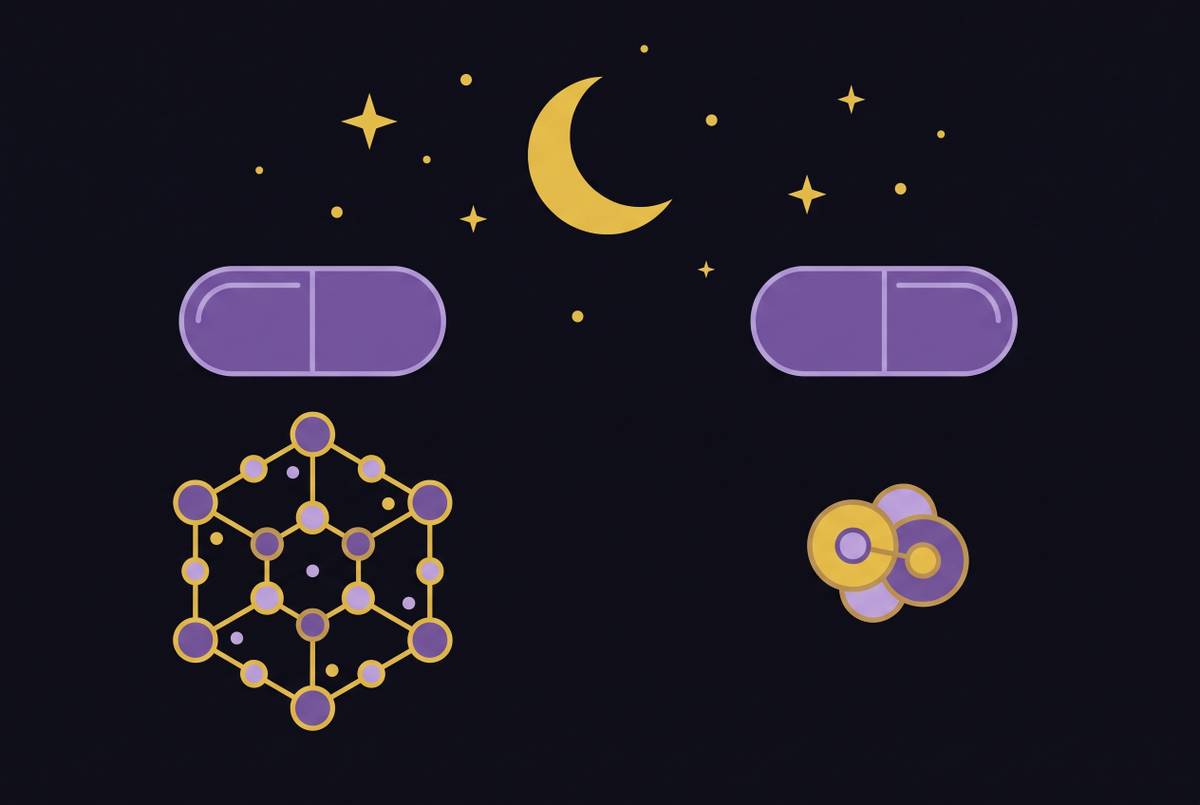
5-HTP offers a different entry point into the same pathway, one step downstream of tryptophan. Because it's already past the tryptophan-to-5-HTP conversion, it doesn't have to compete as heavily with other large neutral amino acids for transport across the blood-brain barrier, a competition that limits how much dietary tryptophan actually reaches the brain. Oral bioavailability backs this up: roughly 70% of ingested 5-HTP reaches the bloodstream, a strong absorption profile that complements its reduced competition at the blood-brain barrier transport bottleneck.
Practical levers across the full pathway: diet, light, stress, and the absorption question
Four points in this chain can be acted on, and none of them work in isolation.
The substrate gate comes first. Dietary protein supplies tryptophan, but total protein intake isn't the whole story. What matters more is the ratio of tryptophan to the other large neutral amino acids in a given meal, since they all compete for the same transport system into the brain. A meal heavy in competing amino acids can blunt how much tryptophan gets through even when the tryptophan content itself looks fine on paper.
The kynurenine interception gate comes second. Managing chronic stress and systemic inflammation reduces activation of IDO and TDO, which keeps more tryptophan available for the serotonin branch instead of losing it to kynurenine. That draws a direct, enzymatic line between stress management and the biology of when someone actually falls asleep. Not a vague wellness connection, a measurable one.
The darkness gate comes third, and no supplement touches it. The pineal gland's conversion of serotonin to melatonin depends on reduced light input reaching the SCN. Blue light exposure in the hours before bed works against that exact conversion step, the same one tryptophan and 5-HTP are trying to feed. Supplementing the substrate while flooding the eyes with light in the evening cancels out the supplement before it does anything, and most people skip this step because it's inconvenient rather than because it's unclear.
Absorption comes fourth. 5-HTP's roughly 70% oral bioavailability and its reduced competition at the blood-brain barrier make it a more direct route into the serotonin-melatonin pathway than tryptophan on its own. Further delivery improvements remain an active area of research rather than a settled matter. None of these four levers substitutes for another. Diet supplies the raw material, stress management protects it from diversion, darkness triggers its final conversion, and absorption determines how much of any supplemental dose the body actually uses. Treating any single lever as the fix misreads how the whole chain behaves, and it's why so many single-variable fixes quietly fail.
Sources
- Tryptophan–Serotonin–Melatonin Pathway and It Contribution to Mood and Cognitive Changes During Sleep Deprivation? | European Psychiatry | Cambridge Core
- Tryptophan–Serotonin–Melatonin Pathway and It Contribution to Mood and Cognitive Changes During Sleep Deprivation?
- Nutritional Interventions for Enhancing Sleep Quality: The Role of Diet and Key Nutrients in Regulating Sleep Patterns and Disorders
- Tryptophan-Serotonin-Melatonin Pathway as a Contributor to Changes in Mood and Cognitive Functions Induced by Sleep Deprivation
- Tryptophan-Serotonin-Melatonin Pathway as a Contributor to Changes in Mood and Cognitive Functions Induced by Sleep Deprivation
- researchgate.net
- psychiatrictimes.com
- pmc.ncbi.nlm.nih.gov