Melatonin Dosing Mistakes High Performers Make
Melatonin works as a timing signal, so dose, hour and frequency matter.

High performers reach for melatonin the way they reach for any performance tool: more input, more output. That assumption fails here. Melatonin does not work on a dose-response logic where a larger quantity produces a proportionally better result. It works as a timing signal to the circadian system, and the three most common habits around it, taking too much, taking it at the wrong hour, and taking it every single night, each interfere with that signal in a distinct way. The cognitive drag performers report the next morning, the grogginess, the dull focus, the sense that sleep didn't actually restore anything, is frequently the direct consequence of how the supplement was used rather than a sign that more of it is needed. The sections that follow break down each mistake on its own terms, starting with the physiology that explains why precision, not quantity, governs melatonin's effect.
What melatonin actually does in the body, and why dose precision matters
Melatonin is a hormone secreted by the pineal gland, and its job is narrow: it tells the circadian system that biological night has begun. It sedates differently from a benzodiazepine or an antihistamine, and it builds sleep pressure differently from the way adenosine accumulation does across a waking day. Its function is informational, a signal that shifts the body's internal clock toward sleep-readiness, and signals of this kind depend on precision, not volume.
The pineal gland's own nightly output operates in a narrow physiological range, a small, carefully regulated rise in circulating melatonin that marks the transition into night. Over-the-counter tablets frequently deliver doses well above that physiological range, sometimes by a wide margin. Flooding the receptor system with a pharmacological dose does not make the "lights out" signal clearer. It can instead blur the system's ability to read the signal at all, since the receptors involved respond to pattern and timing more than to raw concentration.
Bioavailability compounds the problem. Oral absorption of melatonin varies substantially from one person to another, and it also varies across delivery formats, tablets, gummies, sublingual drops, liquid capsules. A performer who switches from one format to another while keeping the same nominal milligram amount on the label may be taking in a meaningfully different, often larger, dose than before. Nothing on the packaging warns of this. Switching brands can quietly introduce an overdose risk.
The overdose mistake: why the standard tablet dose is too high for most healthy performers
The single most common error with melatonin is simply taking more of it than the body's own nighttime physiology ever produces. This mistake alone accounts for a large share of the complaints performers bring to melatonin in the first place: morning grogginess, unusually vivid or disruptive dreams, and sleep that feels lower in quality despite falling asleep faster.
Higher doses saturate the relevant receptors without extending or deepening sleep beyond what a much smaller dose already achieves. Past a certain point, additional melatonin adds side effects without adding benefit, headaches, lingering sedation into the morning, and the kind of cognitive fog that a performer is specifically trying to avoid. The dose range that meaningfully influences circadian signaling in healthy adults sits well below what most retail products are formulated to deliver, and the gap between the two is not a minor rounding difference.
The clinical literature is instructive here by contrast. Valiensi et al. (2025) examine melatonin dosing at higher-than-usual levels, but specifically in aged patients managing sleep disturbances alongside other medical comorbidities, a population and a clinical context far removed from a healthy adult trying to protect next-day output. Even in that supervised, medically monitored setting, higher dosing is treated as a deliberate clinical decision rather than a routine default. That should tell a healthy performer something: no credible evidence base treats high-dose melatonin as the sensible starting point for an otherwise healthy sleep system.
The corrective instinct that usually follows, increasing the dose because the lower one "didn't work," runs backward. Melatonin does not behave like a stimulant where more produces more. The sounder approach starts at the lowest available dose and treats upward titration as the exception, not the plan, with any adjustment made in consultation with individual response rather than a fixed formula.
The timing mistake: taking melatonin at the wrong point in the circadian cycle
Dose and timing are separate variables, and getting the dose right does not protect a performer from mistiming the signal. The circadian system cares about when melatonin arrives at the receptor, not only how much arrives.
The physiological reference point for correct timing is dim-light melatonin onset, or DLMO, the point in the evening when the body's own melatonin naturally begins to rise. Exogenous melatonin taken close to that natural rise reinforces it. Taken too early or too late relative to DLMO, it stops reinforcing the body's own signal and instead creates a second, competing one, shifting the clock in a direction the performer did not intend.
Most people take melatonin immediately before getting into bed, following the convention printed on the label. That convention reflects a packaging habit rather than a circadian recommendation. Taken at that late point, melatonin arrives after the natural window has already opened, which blunts its phase-shifting effect and raises the odds of next-morning carryover, the grogginess performers associate with the supplement generally.
Taken too early, the opposite problem appears: the sleep phase advances further than intended, pulling both sleep onset and wake time earlier and compressing total sleep duration, a particularly costly trade for someone whose job depends on full, high-quality sleep rather than merely falling asleep quickly. Used consistently at the wrong point relative to DLMO, this phase-advancing effect does not announce itself in one night. It accumulates across repeated nights, quietly shortening sleep duration even as the performer feels they're falling asleep faster than before.
The practical difficulty is that DLMO cannot be read off a clock. It requires a lab assay to measure directly, so no performer has a simple way to know their own personal window without some degree of trial and observation. That uncertainty is itself an argument for conservative dosing: a low dose limits the damage done by an inevitable timing error, while a high dose magnifies it.
The nightly-use mistake: how regular supplementation suppresses the body's own production
The third mistake is frequency, and it is the hardest one to notice because its damage builds slowly and without obvious warning signs. Melatonin is a hormone, and elevated melatonin levels act on receptors within the pineal gland itself and on the suprachiasmatic nucleus, the body's master clock, to modulate how much the body produces on its own. That is the same negative feedback logic that governs other exogenous hormones: supply the body with an external source consistently enough, and its own production system adjusts downward in response.
Current evidence does not point to a classical negative feedback loop that sharply suppresses endogenous melatonin with nightly use, and discontinuation has not been associated with a defined withdrawal syndrome or a clear worsening of baseline sleep. That nuance matters, but it doesn't erase the underlying mechanism: a performer relying on nightly supplementation is still asking an external hormone source to do work the body's own system would otherwise do, and the regulatory posture around melatonin products reflects caution about sustained, unsupervised use rather than endorsement of it.
Ipsiroglu and Gober (2025) note that the EMA has approved three controlled-release melatonin products, Circadin®, Slenyto®, and Melatonin Neurim®, each authorized for a specific clinical population rather than for general use: Circadin® and Melatonin Neurim® for adults 55 and older, Slenyto® for children with autism spectrum disorder and related neurodevelopmental conditions. Circadin® and Melatonin Neurim® carry an explicit short-term use authorization. That regulatory scoping reflects caution specific to those products and populations, and it stands in sharp contrast to the North American retail environment, where melatonin sits on an open shelf next to vitamins and nightly use carries no built-in signal that it might be anything other than routine.
Performers who stop taking melatonin after a long stretch of nightly use often report sleeping worse in the days that follow, and they tend to read that as proof the supplement was working and should be resumed. A more accurate reading treats that pattern as a sign that a dependency on the external signal has formed. The way out is not indefinite continuation but intermittent use, reserved for situations that actually call for a circadian nudge: travel across time zones, an abrupt schedule shift, or a specific night when poor sleep needs active recovery. Used this way, melatonin keeps its signal value precisely because it isn't asked to carry that signal every night.
How These Mistakes Compound
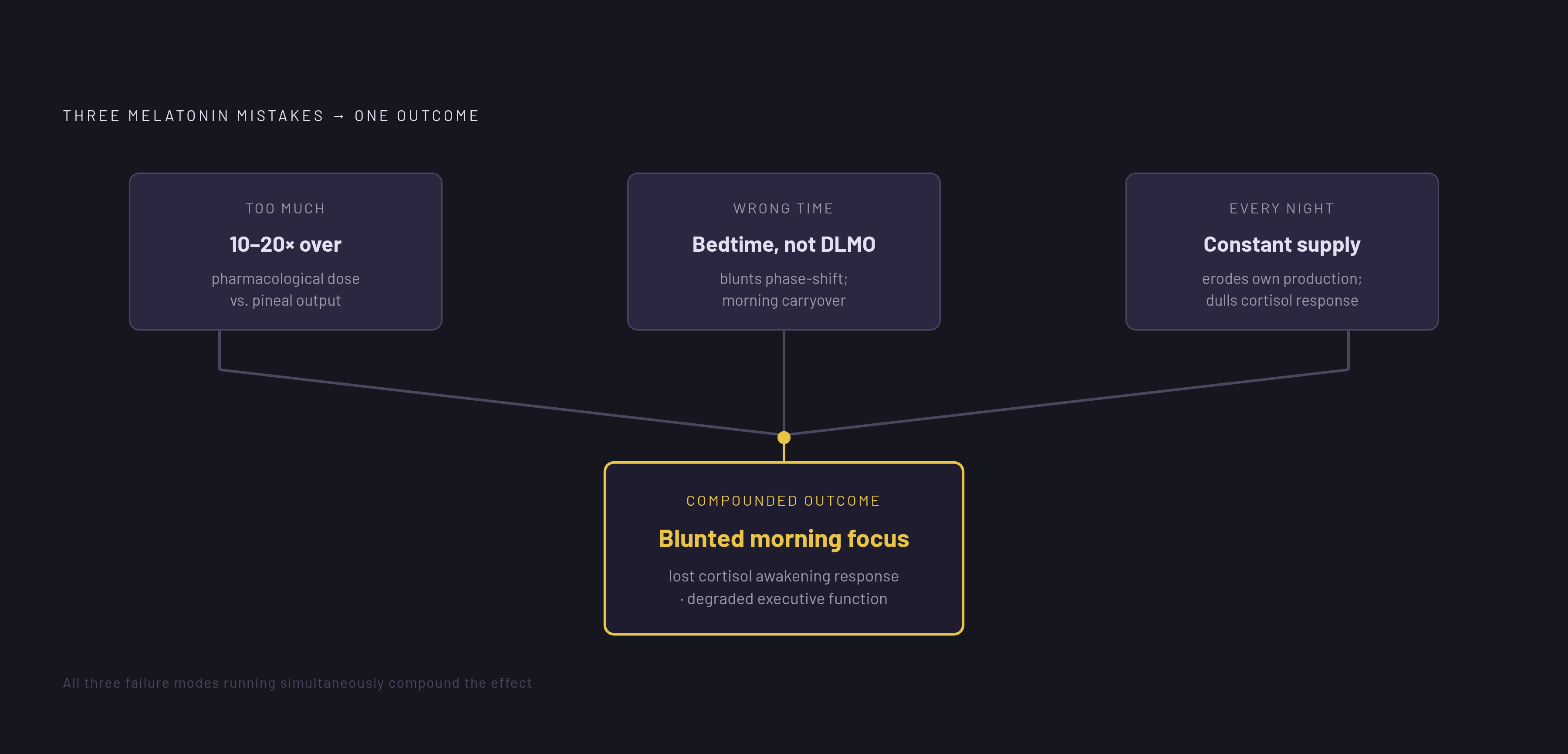
A performer who takes a high dose, late at night, every night, is running all three failure modes simultaneously: degrading sleep architecture through receptor saturation, suppressing the body's own production through constant external supply, and interfering with the hormonal signaling that prepares the body for the next day. Each mechanism makes the others worse, and the combined effect is larger than any single mistake would produce on its own.
The clearest casualty of this compounding is the cortisol awakening response, the sharp rise in cortisol that occurs in the first half-hour or so after waking and that functions as the body's biological preparation for the cognitive demands of the day ahead. That response depends on the circadian system having completed its nighttime work cleanly, with melatonin levels having cleared the system on schedule. Artificially inflated evening melatonin, left over from an oversized or mistimed dose, interferes with the precision of that cortisol rise. The result is blunted morning focus and weaker executive function, exactly the deficit performers are trying to avoid, and one they typically blame on sleep quality in general rather than tracing back to the supplement meant to protect it.
The contrast case matters here. Mahdi et al. (2025), in a placebo-controlled crossover study in trained male athletes, found that melatonin supplementation enhanced next-day high-intensity exercise performance and recovery. That finding demonstrates that melatonin, used correctly, can support next-day output rather than undermine it. It also throws into relief what gets lost when dose, timing, and frequency are each off: the same molecule capable of supporting performance becomes the thing quietly degrading it.
There's a useful diagnostic buried in this pattern. A performer who takes melatonin and consistently wakes feeling unrefreshed, groggy, or mentally slow is very likely looking at the compounding effect of these three mistakes working together. That pattern is a signal to re-examine all three variables at once, since fixing one in isolation, say, lowering the dose while still taking it nightly and still taking it too late, will not fully resolve a problem that three mechanisms created together.
What correcting these mistakes looks like in practice
Each mistake has a correction that follows directly from the physiology already described, and the three corrections work together rather than independently.
On dose, start at the lowest available amount and resist the instinct to raise it if sleep doesn't improve immediately. The relationship between melatonin dose and sleep benefit is not linear, so increasing the dose when the first attempt disappoints is the move most likely to reproduce the overdose mistake the performer is trying to escape rather than a valid troubleshooting step. Individual response varies enough that any adjustment belongs in conversation with a clinician rather than in a pattern of self-escalation.
On timing, take melatonin earlier in the evening than feels intuitive. The instinct to take it right at the moment of lying down treats it like a sedative, but its actual job is to reinforce a natural melatonin rise that typically begins well before bedtime. Timing it closer to that earlier natural onset, rather than to the moment of attempting sleep, respects what the hormone is actually signaling rather than what the label's packaging convention suggests.
On frequency, reserve melatonin for specific disruptions, jet lag, an inverted schedule, or a particular night where stress has wrecked the normal sleep pattern, rather than folding it into a nightly routine. This preserves the body's own production and keeps the supplement's signal meaningful on the nights it's actually needed, instead of letting constant use erode the very system it's meant to support.
Delivery format deserves its own caution. Switching to a higher-bioavailability format, a sublingual drop or a liquid capsule, while keeping the same nominal milligram number on the label, functions as an effective dose increase even though nothing on the packaging indicates that. Treat a format switch as a reason to start over at a lower dose rather than as a like-for-like substitution.
The corrections work because protecting the cortisol awakening response and the body's own melatonin production is itself a cognitive performance strategy, as central to sharper focus and better output as any other. Sleep is not a precondition sitting outside cognitive performance; it is part of the same system. Compounds that support calm stress regulation and sustained attention, ashwagandha for cortisol modulation, or L-theanine for steady focus without the cortisol spike that comes with high-dose caffeine, work in concert with a melatonin system that's functioning as designed. They don't compensate for a disrupted one. The same precision that makes melatonin valuable as a circadian signal is the precision a performer owes it in how they use it.
Sources
- Reply to Gringras et al. Comment on “Paditz et al. The Pharmacokinetics, Dosage, Preparation Forms, and Efficacy of Orally Administered Melatonin for Non-Organic Sleep Disorders in Autism Spectrum Disorder During Childhood and Adolescence: A Systematic Review. Children 2025, 12, 648”
- Chronic Administration of Melatonin: Physiological and Clinical Considerations - PMC
- Melatonin Supplementation Enhances Next-Day High-Intensity Exercise Performance and Recovery in Trained Males: A Placebo-Controlled Crossover Study
- Rethinking Melatonin Dosing: Safety and Efficacy at Higher-than-Usual Levels in Aged Patients with Sleep Disturbances and Comorbidities
- Optimizing the Time and Dose of Melatonin as a Sleep‐Promoting Drug: A Systematic Review of Randomized Controlled Trials and Dose−Response Meta‐Analysis - Cruz‐Sanabria - 2024 - Journal of Pineal Research - Wiley Online Library
- Melatonin phase shifts human circadian rhythms in a placebo-controlled simulated night-work study - PMC
- 0075 Melatonin impairs morning cognition in healthy young adults without any benefit to sleep