Melatonin Dose Calibration for Sleep Onset vs Circadian Shifting
Melatonin's effect depends on when you take it, not how much.
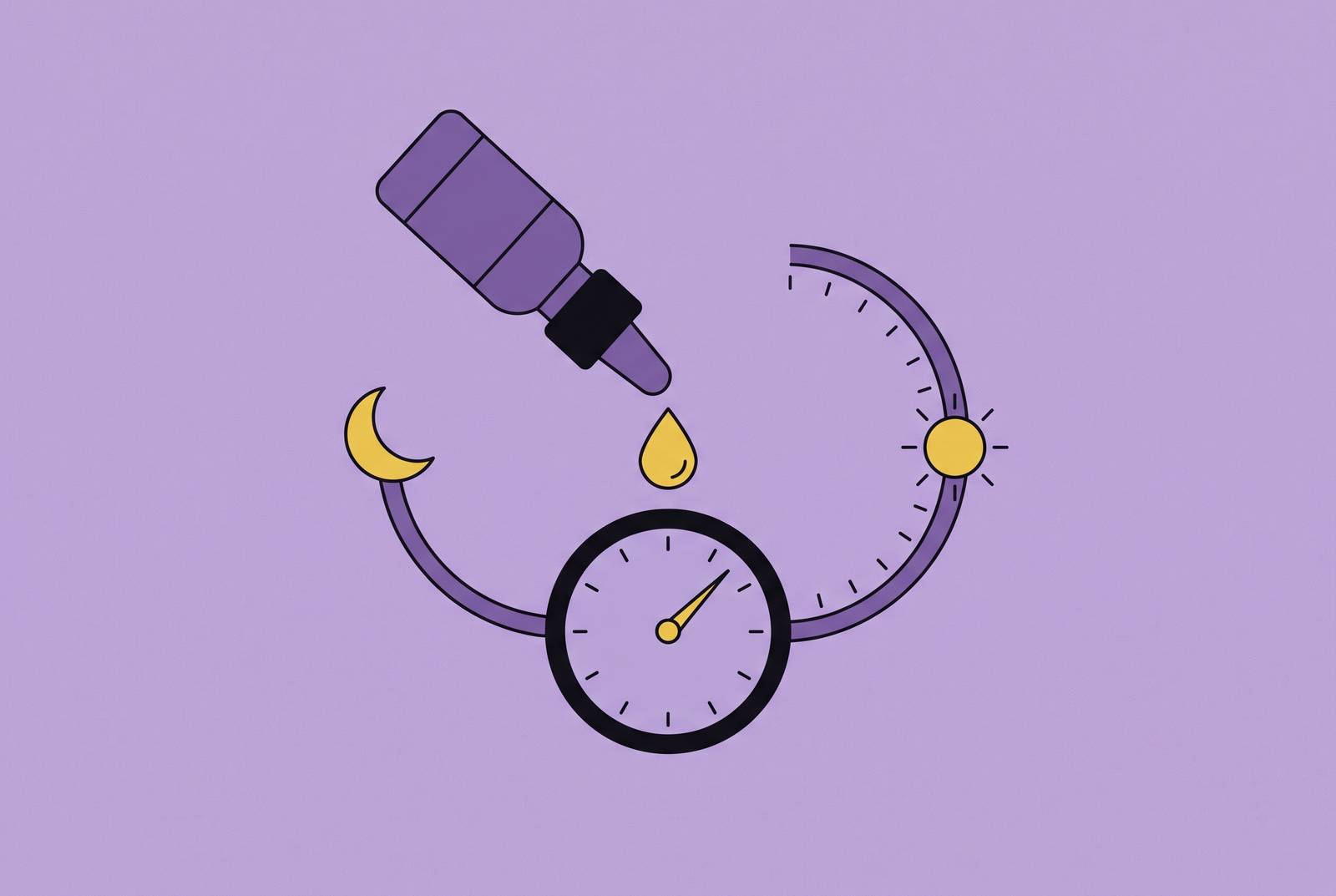
Most people take melatonin the way they'd take a sleeping pill: a few milligrams, swallowed somewhere close to bedtime, with the dose treated as the only variable worth adjusting if it doesn't work. That approach misreads what the hormone actually does. Melatonin works through a signaling pathway distinct from pharmacological sedatives. It doesn't touch GABA receptors, and it doesn't depress your central nervous system the way a benzodiazepine or a z-drug does. It's a timing signal, produced by the pineal gland in response to darkness, that reaches the suprachiasmatic nucleus, the brain's master clock, through MT1 and MT2 receptors and tells it that biological night has started. The job is informational, not chemical suppression. That difference is why the question of how much melatonin to take is secondary to the question of when to take it, and why so much self-dosing fails to produce a predictable result: the same tablet, taken at two different clock times, is doing two different jobs in the body. One of those jobs nudges the timing of sleep within a night that's already roughly where it should be. The other shifts the clock itself, and the hormone's capacity to do that depends entirely on where, in a person's own circadian cycle, it lands. Everything that follows in this piece, the dosing recommendations, the risk of escalation, the frontier research on much higher doses, only makes sense once that governing structure, called the phase-response curve, is on the table. Dose matters. Timing determines which effect that dose produces.
What DLMO is and why it is the reference point every dose-timing decision turns on
The reference point that makes any of this calibration possible is called the dim-light melatonin onset, or DLMO: the moment, measured under dim lighting conditions, when salivary or plasma melatonin starts to rise. In healthy adults, DLMO typically falls somewhere around two to three hours before habitual bedtime. It matters because sleep susceptibility and circadian susceptibility come apart around this exact point, and a dose of melatonin that arrives before DLMO is doing something fundamentally different from a dose that arrives at or after it. Right at DLMO, and for a stretch just after, the phase-response curve enters what researchers call the silent zone: melatonin taken here can help a person fall asleep, but it has little power to shift the clock's actual phase. But if you move earlier, into the biological evening before DLMO arrives, the clock's advancing zone opens up. That's where melatonin's capacity to shift circadian phase is strongest. Taken at or after DLMO, exogenous melatonin is mostly adding to a signal the body is already generating on its own.
Getting this wrong costs more than a slow night's sleep. Melatonin's onset is half of a reciprocal hormonal relationship with the cortisol awakening response, the surge that signals wakefulness. A 2025 systematic review identified disruption to this melatonin-cortisol relationship as a mechanism behind burnout, finding that suppressed melatonin secretion correlated with higher burnout scores. Chronic circadian misalignment doesn't just cost sleep quality. It appears to degrade the hormonal rhythm that underlies sustained daytime functioning, which is part of why some people treat the timing of sleep-related hormones as something closer to infrastructure for mental performance than a bedtime routine. Magic Mind's product line reflects that same premise in its design: the company's Sleep variant is built around melatonin-supporting compounds because its formulation treats sleep as part of cognitive output.
But this reference point is hard to put to everyday use. DLMO isn't something a consumer can check before deciding when to take a supplement. You need repeated salivary samples collected under dim light over several hours to measure it, a process built for a research setting, not a nightstand. Lim et al., writing in the Journal of Biological Rhythms, proposed a protocol that pairs wearable sleep-wake data with a shortened five-hour sampling window, cutting the time needed to estimate DLMO for shift workers. It's a meaningful step toward faster circadian phase tracking, but it remains research-stage. No validated, individual-level version of this exists yet for someone deciding what time to take a melatonin tablet tonight. Until that changes, every population-level timing guideline, including the ones in this piece, has to describe an average. Individual DLMO varies by hours between people with different chronotypes, so a rule built for the average early sleeper may sit two or three hours off from someone with a naturally late clock.
Circadian Shifting and Sleep-Onset Acceleration: Different Timing Windows Around DLMO
Melatonin does two distinct jobs, and the timing window for each is in a different place relative to DLMO. If you confuse the two, that's the single biggest reason self-dosing produces inconsistent results. The first job is accelerating sleep onset: helping someone who already falls asleep around the right time of night get there faster. That job operates at or near DLMO, inside the silent zone, where the clock isn't being moved but the rising pressure toward sleep can be reinforced. The second job is advancing the circadian clock itself, which requires melatonin to be taken well before DLMO, out in the biological evening, while the clock sits in its advancing zone. These are different mechanisms triggered by different timing, using the same molecule.
A simple contrast makes the distinction concrete. Someone whose DLMO falls around 9 p.m. and who takes melatonin at 10:30 p.m., close to bedtime, is operating inside the silent zone: reinforcing a sleep signal that's already rising, not moving the clock. But if that same person takes the same dose at 8 p.m., ahead of DLMO, they act on the clock's advancing zone, doing the work of phase-shifting. If you have a stable, well-aligned circadian rhythm but just take too long to drift off, the first case suits you. The second suits delayed sleep-wake phase disorder, jet lag recovery, or shift-work realignment, cases where the entire clock needs to move, not just the moment of falling asleep that night.
This distinction also explains why the standard advice, take melatonin shortly before bed, seems to work for some people and not others. For someone whose personal DLMO is significantly delayed relative to the population average, a dose taken "near bedtime" by the clock on the wall can still land before that person's own DLMO, in their biological evening. They get a genuine phase-advancing effect and report that the supplement works, without realizing the mechanism responsible has nothing to do with sedation. For someone whose DLMO lines up with convention, the same near-bedtime dose is landing inside the silent zone, where it offers a modest additive boost to an already-rising endogenous signal, if it does anything measurable. Two users, identical dose, identical clock time, two different physiological events taking place, and two very different explanations for whatever each one experiences.
What the Dose Evidence Shows for Each Job
Once the two jobs are separated, the dose evidence for each turns out to be narrower and more specific than the instinct to take more would suggest. For sleep-onset acceleration, timing two to three hours before the intended sleep episode is what the evidence supports. Cruz-Sanabria and colleagues, in a meta-analysis published in the Journal of Pineal Research, found that taking melatonin one hour before bed produced no efficacy advantage over taking it right at sleep onset, while taking it two to three hours earlier did improve outcomes. The mechanism is additive: exogenous melatonin builds on top of the endogenous signal that's already climbing, pulling the sleep cascade earlier within the same night. That same meta-analysis found the sleep-promoting effect peaking around 4 mg per day, a considerably higher figure than the 0.5 to 1 mg many starting guides recommend, suggesting that common low starting doses may genuinely underperform for this specific purpose. It also bears noting where melatonin's evidence is strongest to begin with: it holds up better for circadian rhythm disorders, jet lag, and delayed sleep phase disorder than it does for chronic insomnia rooted in anxiety or behavioral patterns, where cognitive behavioral therapy for insomnia carries sturdier, more durable support.
For circadian phase-shifting, the picture runs in the opposite direction: lower doses, precisely timed, outperform higher ones. A Cochrane review by Herxheimer and Petrie found that for jet lag, 0.5 mg and 5 mg produced similar results, doses above 5 mg added nothing further, and a 2 mg slow-release formulation actually underperformed an immediate-release dose of the same size. The implication is mechanistic: what drives the phase shift is a short, relatively sharp peak in plasma melatonin, not a sustained elevated level held over hours. Delayed sleep-wake phase disorder follows a similar pattern, with doses studied clustering in that same low range, and the real variable is how many hours before the person's own, often late, natural sleep onset the dose is timed. Age changes the picture somewhat. In older adults, whose nighttime melatonin production declines naturally, a replacement dose of roughly 0.3 mg has been shown to restore nighttime plasma levels back to what's typical in younger adults. But a 3 mg dose in that same population kept plasma melatonin elevated into daylight hours, and that comes at a direct practical cost.
That cost is the core argument against reaching for more. If plasma melatonin is still elevated after sunrise, the circadian system is receiving a "night" signal during the hours it should be receiving a wake signal, and that overshoot can undermine the exact daytime cognitive performance the person took the supplement to protect. Extended-release formats and high doses carry documented downstream effects beyond grogginess: residual sedation the next morning, amnesia-like effects, and middle-of-the-night awakenings followed by an inability to fall back asleep. Three conclusions fall out of the dose evidence taken together. The sleep-onset sweet spot is a moderate range, around 4 mg, timed two to three hours before sleep. The phase-shifting sweet spot sits much lower, often under a milligram, timed precisely in the biological evening. And escalating the dose past either of these ranges adds measurable risk, including next-day cognitive costs, without adding benefit toward either goal. This same principle, that delivery timing and mechanism determine effect far more than raw quantity, is why clinically formulated products are often engineered around absorption windows. Magic Mind's patented nanoencapsulation technology is built on that same logic: what matters is whether an ingredient's bioavailability lines up with the window where the body can use it, not simply whether it's present in the formula.
How the High-Dose Neuroprotection Literature Complicates the Picture
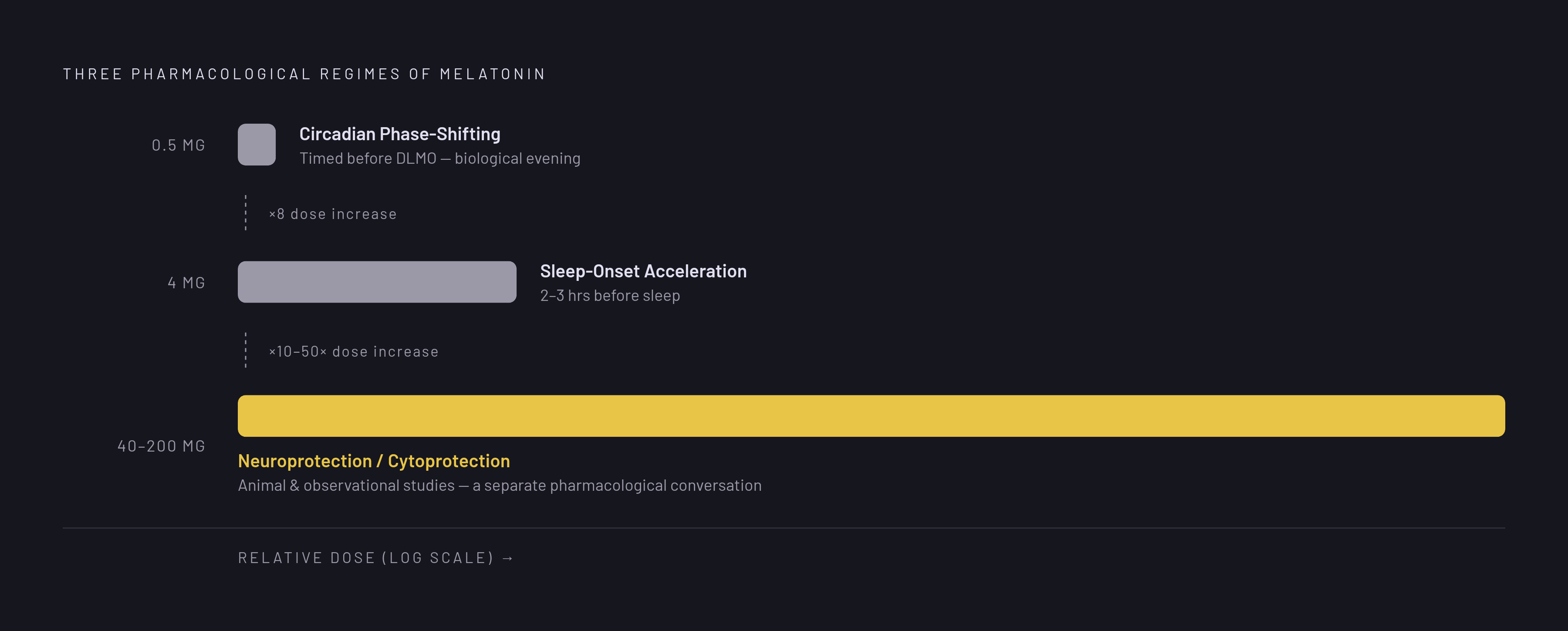
A separate body of research, operating at doses an order of magnitude or more above anything discussed so far, raises a legitimate challenge to the idea that melatonin behaves as a single, modest-dose hormone with one narrow job. In animal models of Alzheimer's and Parkinson's disease, melatonin has been shown to reduce neuronal loss, preserve synaptic structure, and slow cognitive decline, working through antioxidant, anti-excitotoxic, and anti-amyloid mechanisms. Some clinical evidence points toward a possible role in preserving cognitive function in mild cognitive impairment, but the large-scale controlled trials needed to confirm that haven't been completed. A September 2025 paper in Brain Sciences by Valiensi and colleagues described treating elderly patients with sleep disorders and comorbidities using doses ranging from 40 to 200 mg daily, well beyond anything used for sleep onset or circadian realignment. Their argument rests on melatonin's broader biology: its antioxidant activity, its role in mitochondrial regulation, its immunomodulatory and anti-inflammatory functions, framing it as a candidate cytoprotective agent at these much higher doses.
This research is observational and uncontrolled, and it should be read for what it establishes: biological plausibility and clinical interest, not the kind of efficacy signal a randomized controlled trial produces. It matters, but not because it should change anyone's bedtime routine. It genuinely complicates the assumption that melatonin is a single-function hormone with one dose-response curve. A molecule that promotes sleep onset at 4 mg, shifts circadian phase at a fraction of a milligram when timed correctly, and shows neuroprotective signals at 40 to 200 mg is behaving according to at least three separate pharmacological logics depending on the target tissue and mechanism involved. That's a real challenge to the theoretical picture of melatonin as a simple, unified signal. It is not a challenge to the practical guidance built in the sections above. If you're trying to fall asleep faster or reset a jet-lagged clock, nothing in the neuroprotection literature suggests you benefit from taking a gram-scale dose meant for a different biological target. The two conversations, sleep and circadian timing on one side, cytoprotection at pharmacological scale on the other, are addressing different questions, and conflating them would be the same error this piece has been arguing against from the start: treating melatonin as though dose were the variable that matters, when the evidence keeps pointing back to mechanism and timing as the ones that actually do.
Sources
- Optimizing the Time and Dose of Melatonin as a Sleep‐Promoting Drug: A Systematic Review of Randomized Controlled Trials and Dose−Response Meta‐Analysis - Cruz‐Sanabria - 2024 - Journal of Pineal Research - Wiley Online Library
- Low Doses of Melatonin Promote Sleep Onset and Maintenance in Older People—An Update - touchNEUROLOGY