Rotating Shift Work Sleep Disorder Management
How to reset a clock that rotating schedules keep scrambling.
Rotating shift work disorder begins with a mismatch the body cannot resolve on its own: the internal circadian clock re-entrains slowly, while a rotating schedule demands fast, repeated changes in when a person is supposed to be awake, alert, and functional.
What rotating shift work does to the circadian clock
The circadian clock does more than decide when someone feels sleepy. It times the release of the hormones that produce alertness, and during night shifts, that internal push for wakefulness is at its weakest point in the daily cycle. That timing mismatch means night-shift impairment is a coordinated drop across attention, memory, and physical coordination, all driven by the same underlying clock failure. Rotating schedules make this worse by design, because the clock never gets the chance to settle on one phase before it gets pushed toward another. Rotation direction itself is a measurable, changeable factor: a Sleep Health systematic review found that counterclockwise and rapidly rotating schedules produce substantially less sleep, far greater attentional problems, and much greater interference with life outside work than clockwise rotation does. The sequence of days to evenings to nights isn't a preference some schedulers happen to favor. It follows the direction the clock can actually move in.
Cognitive and occupational harm from circadian misalignment
The costs of shift work sleep disorder appear as specific, countable deficits in attention, reaction time, memory, and error rate, the same capacities that safety-critical workers depend on most. The Sleep Health systematic review found that poor sleep quality affected the large majority of rotating night-shift healthcare workers, and tied that poor sleep to impaired attention at night compared with day, higher odds of memory impairment, higher odds of medical errors, and reaction times after six or seven consecutive night shifts that matched a blood alcohol level that would be illegal to drive at. A separate cross-sectional study of hospital employees found that workers classified with shift work sleep disorder showed the steepest cognitive decline and the most sleepiness during night shifts: reaction times slowed, minor lapses increased, and memory span, digit recall, and total correct responses on cognitive tests all fell after an eight-hour night shift, compared with workers whose circadian rhythms stayed normal. The damage doesn't level off with time on the job. MedLink's review of the evidence found shift work linked to elevated risk of depression, anxiety, and dementia over the long term, based on UK Biobank data. The disorder builds across shifts as a lasting neurological toll. Workers who seem to handle nights well aren't exempt either: even those who appear to tolerate the schedule show subtler metabolic and mood disturbances, and people with delayed sleep phase syndrome, who would seem best suited to night work, still show cognitive decline after a shift, just at a smaller scale, and it responds to specific, well-tested interventions.
The cortisol dysregulation that sits beneath the sleep deficit
Circadian misalignment does more than compress how much sleep a rotating worker gets. It flips the normal cortisol rhythm, and that reversal produces a hormonal state that blocks recovery, keeps cognitive fog in place, and raises cardiovascular risk at the same time. A PMC review on cortisol and shift work found that night-shift work changes the natural pattern of cortisol secretion and disrupts the HPA axis, contributing to metabolic disorders, cardiovascular disease, and impaired cognition. A 2026 prospective study of Croatian nurses found that rotating shift nurses had significantly higher morning cortisol than their day-shift colleagues, an inversion of the normal pattern, in which cortisol should peak high in the morning and decline across the day. Evening cortisol that stays elevated suppresses the onset of melatonin and breaks up the sleep architecture rotating workers need most, so elevated cortisol and disrupted sleep are symptoms of a single underlying mechanism. They run as one loop: disrupted rhythm raises cortisol, elevated cortisol suppresses melatonin, suppressed melatonin worsens sleep, and worse sleep adds more circadian stress, which starts the cycle again. The same Frontiers in Public Health review also points to autonomic imbalance, measured as reduced heart rate variability that reflects ongoing sympathetic activation, as a factor that compounds poor sleep architecture and weaker cognitive performance. That loop is also why reaching for more caffeine doesn't fix the underlying problem. Caffeine treats the feeling of sleepiness while leaving the cortisol-melatonin cycle just as disrupted, or more so.
Light exposure and sleep scheduling as the primary circadian anchors
Because light and behavioral timing cues are the main signals the circadian clock responds to, controlling light exposure and sleep scheduling forms the foundation that every other intervention in this protocol builds on. For a rotating worker, that means bright light during the hours meant to be the wake phase, blue-light-blocking glasses on the commute home after a night shift so the trip itself doesn't delay the sleep attempt that follows, and blackout conditions during daytime sleep. Scheduling direction carries real weight here too: clockwise rotation, moving from days to evenings to nights, lets the clock advance gradually rather than forcing it to delay sharply, and the Sleep Health systematic review tied that direction to more total sleep and fewer attention disturbances. It costs employers nothing to implement, which makes it one of the few structural fixes available without new budget. Shift length is a related lever: the same review found that capping shifts at sixteen hours or fewer cut attentional failures substantially. Sleep timing consistency works alongside light management as the behavioral half of this approach: sleeping at roughly the same relative hour after each shift, even when that hour looks strange by ordinary social standards, keeps an already irregular schedule from becoming still more unstable. Behavioral tools like these recalibrate the clock, but they don't fully correct the hormonal loop described above. Targeted supplementation addresses what remains.
Melatonin as a circadian anchor, not a sleeping pill
Melatonin helps rotating shift workers not by sedating them but by re-sending the circadian system a signal about when sleep is supposed to begin, which makes the timing of the dose, not the size of it, the variable that actually matters. A randomized controlled trial of shift workers found that melatonin taken at bedtime improved both sleep and cognitive performance. Exogenous melatonin, given at the right moment, reinforces the phase signal the body has stopped producing reliably on its own, telling the clock that night has arrived. Because chronically elevated evening cortisol suppresses the body's own melatonin production, taking melatonin from outside partially compensates for the hormonal loop that would otherwise block sleep onset. Dosing complicates the picture somewhat: higher doses don't produce proportionally better results, and the phase-shifting effect depends on timing melatonin correctly against the target sleep window rather than taking it at some fixed clock hour regardless of shift.
Adaptogens that directly address the cortisol-fatigue loop in shift workers
Ashwagandha and Rhodiola Rosea target the two opposite ends of a rotating worker's functional problem, elevated stress hormones on one side and acute fatigue on the other, and their different speeds of action make them useful together. Ashwagandha, or Withania somnifera, works on hormonal recovery: taken in the evening before a daytime sleep window, it supports the body's need to bring cortisol down so melatonin onset can proceed. Its effects build slowly and need consistent daily use. It functions as a baseline corrective rather than an emergency measure for a single bad shift. Rhodiola Rosea works differently and faster: a single dose can produce a measurable reduction in fatigue within a few hours, and it has shown reduced mental fatigue specifically in doctors working night shifts, one of the few adaptogens tested directly in a shift-work setting. In practice, Rhodiola fits best when taken before a shift for acute support, while ashwagandha fits after a shift for recovery, so the two cover different windows of time.
Long-term neuroprotection with Lion's Mane and Bacopa
Lion's Mane and Bacopa monnieri carry the strongest evidence among supplements for long-term neuroprotection in people facing chronic circadian disruption, but conventional supplement forms of both suffer from poor bioavailability, which makes how they're delivered to the body nearly as important as which ingredient is chosen. The evidence on Lion's Mane, or Hericium erinaceus, is honest but limited: one RCT in people with mild cognitive impairment found improved performance on cognitive tests over a sixteen-week treatment period, but that improvement faded once treatment stopped, according to the Alzheimer's Drug Discovery Foundation's review of the research. Lion's Mane's real case in a shift-worker context rests on its NGF-stimulating mechanism, which defends over the long term against the neuroinflammation and oxidative stress tied to repeated circadian disturbance, the same process a Frontiers review of exercise trials names as a driver of cognitive decline over time. Treat it as a long-term investment rather than something that sharpens focus on a given shift.
Bacopa monnieri works through its bacosides, which stimulate BDNF production and support neuron growth, survival, and new synaptic connections. In older adults with mild cognitive impairment, that translated into improvements in attention and verbal fluency after roughly two months of use. Bacosides are only slightly soluble in water, taste bitter, and break down under heat and acid, a PMC review of Bacopa's bioavailability found, so a conventional Bacopa supplement may deliver far less of the active compound to the bloodstream than the studied dose would suggest. A phospholipid complex has been shown to maintain higher concentrations of active bacosides for longer, with a prolonged half-life compared with conventional extract. The bioavailability issue runs across the supplement category broadly, not just Bacopa, and it's the main reason delivery technology deserves as much attention as which ingredient goes on the label.
Smarter caffeine: why matcha and L-theanine outperform coffee for shift workers specifically
Coffee's issue for shift workers isn't caffeine itself but caffeine with nothing to modulate it, and the L-theanine naturally present in matcha supplies exactly that modulation, which is the difference between steady alertness and a jittery spike followed by a crash. Caffeine produces alertness by blocking adenosine receptors. L-theanine, an amino acid found almost exclusively in the tea plant Camellia sinensis, tempers that stimulation and produces a state that's relaxed but still alert. For shift workers specifically, the stakes are higher than for a typical coffee drinker: unmodulated caffeine raises cortisol, the same hormone already thrown out of its normal pattern by circadian misalignment, while the combination with L-theanine moderates sympathetic nervous system activation, a better match for a body already under HPA axis stress. A standard 2-gram serving of matcha delivers roughly 50 to 60 mg of L-theanine alongside 60 to 70 mg of caffeine, which lands close to the lower end of the dose range studied for this combination in a single preparation.
Exercise and strategic napping as the highest-return behavioral interventions
Structured exercise and scheduled naps rank among the interventions with the best return for shift workers because they act on the same circadian mechanisms the rest of this protocol is built around. A 2026 Frontiers systematic review of randomized controlled trials found that most of the included studies reported significant gains in sleep quality, total sleep time, sleep efficiency, or time spent awake after sleep onset, and three trials specifically showed improvements in alertness, reaction time, and short-term memory, particularly when exercise was scheduled after a shift or delivered as a supervised session at work. The mechanistic evidence from six of the included studies pointed to circadian phase shifting, better autonomic balance as measured by heart rate variability, and lower inflammatory markers, the same biomarkers tied earlier to cognitive decline. The evidence also comes with an honest limitation: adherence is the central obstacle, with fatigue and irregular schedules cited as the most common barriers, and most included studies carried some concerns or a high risk of bias. Supervised workplace sessions produced better adherence than programs left to individuals to manage on their own. Timing also matters: exercise scheduled after a shift, rather than immediately before a daytime sleep attempt, produced the most consistent cognitive benefits.
Scheduled naps show similarly strong results for similarly low cost. The Sleep Health systematic review found that thirty-minute scheduled naps reduced sleepiness and improved cognition, making naps one of the highest-return, zero-cost tools available to both workers and employers. Thirty minutes is a deliberate window: long enough to reach restorative light sleep, short enough to avoid the sleep inertia that would undercut performance right afterward. Napping before a shift, as prevention against the performance dip that hits during nights, serves a different purpose than napping after a shift for recovery, and the evidence supports both as distinct strategies rather than one standing in for the other.
Putting the protocol together
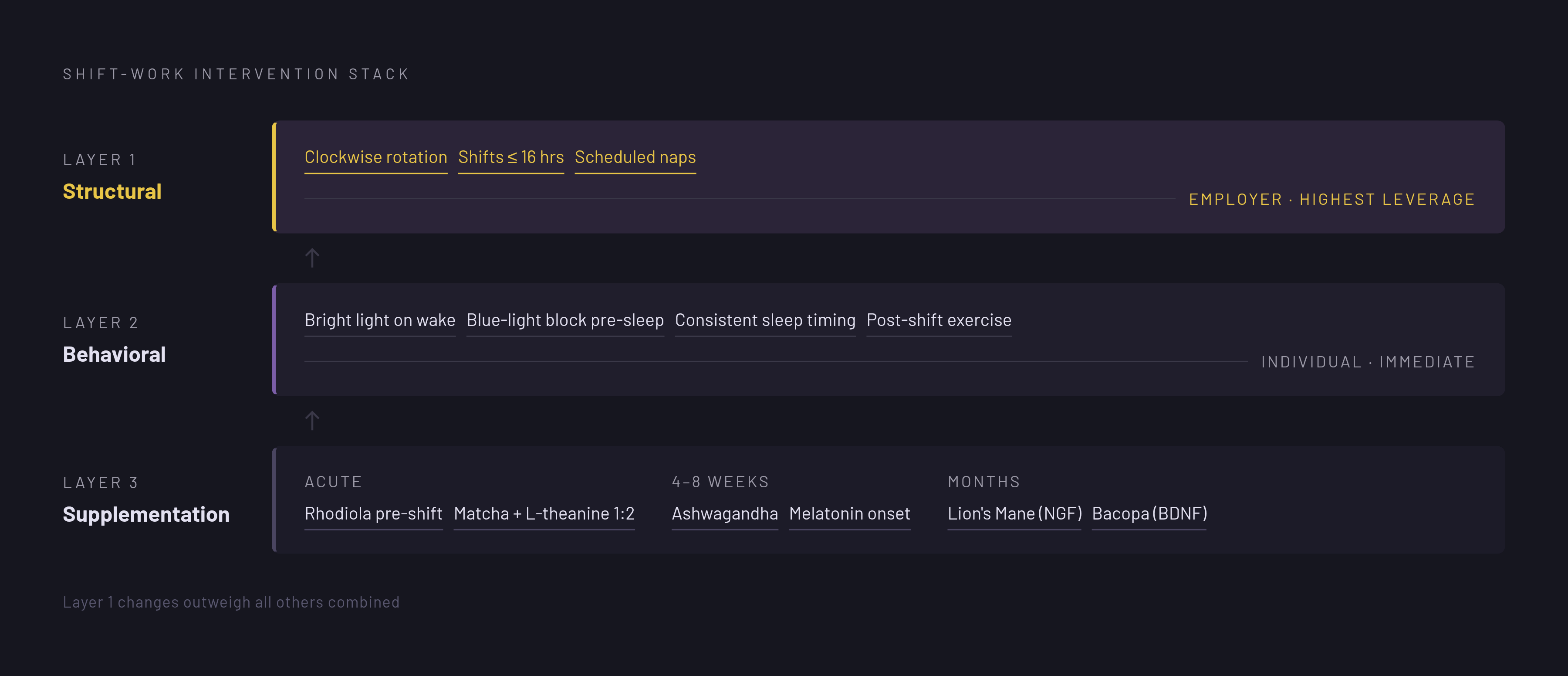
Managing rotating shift work sleep disorder well takes a layered approach because the disorder itself operates on multiple levels at once. No single fix addresses the scheduling environment, the cortisol-melatonin hormonal loop, and the long-term neuroprotective deficit all at the same time.
The first layer is structural, and it carries the highest leverage, though it depends on employer cooperation: clockwise rotation direction, shift length limits, and scheduled nap opportunities built into the workday. These require institutional buy-in, but they deliver the largest absolute benefit because they operate upstream of every other intervention on this list.
The second layer is behavioral and sits within an individual's own control, with benefits that start immediately: managing light exposure (bright light during the intended wake phase, blue-light blocking before the target sleep window), keeping sleep timing consistent after each shift, and scheduling exercise after a shift rather than right before sleep, timed to support the phase-shifting effect.
The third layer is supplementation, also within individual control, but its benefits arrive on different timelines depending on what's taken. For acute, within-shift needs: Rhodiola for its fast anti-fatigue effect before a shift, and matcha or a caffeine-and-L-theanine combination at roughly a 1:2 ratio for alertness without a cortisol spike. For medium-term recovery: ashwagandha taken after a shift or at the start of the sleep window, built up over four to eight weeks to bring down the elevated evening cortisol that fragments daytime sleep, alongside melatonin timed to the target sleep onset as a circadian signal. For long-term neuroprotection: Lion's Mane for its NGF-stimulating defense against the neuroinflammation tied to chronic circadian disruption, and Bacopa for its BDNF-driven attention benefits over weeks and months, both of which depend on delivery formats that solve the bioavailability problem, since conventional extracts of either are poorly absorbed.
The instinct to focus only on getting through the next shift is understandable, but the evidence points to two distinct problems running in parallel: an acute performance problem and a cumulative neuroprotective one. Short-term tools like Rhodiola and the caffeine-L-theanine combination work on one timeline, while ashwagandha, Lion's Mane, and Bacopa work on another, and neither set substitutes for the other. For anyone finding the full protocol too much to take on at once, scheduling direction is the single highest-leverage change, if an employer allows it. Where that's not an option, light management costs nothing and starts recalibrating the clock right away, and building a supplement routine around ashwagandha and correctly timed melatonin addresses the cortisol-melatonin loop that behavioral changes alone cannot fully resolve.
Sources
- Frontiers
- Shift work disorder
- Associations between sleep, cognitive function, and work performance among rotating shift and night-shift healthcare workers: A systematic review - ScienceDirect
- Exercise interventions for sleep and cognitive dysfunction in shift workers: a systematic review of randomized trials
- Circadian rhythm sleep disorders and changes in cognitive function and sleepiness among healthcare workers
- Background and objectives