Post-Travel Sleep Reset Protocol for International Athletes
A timed light-first sequence resets athletes' clocks by direction.
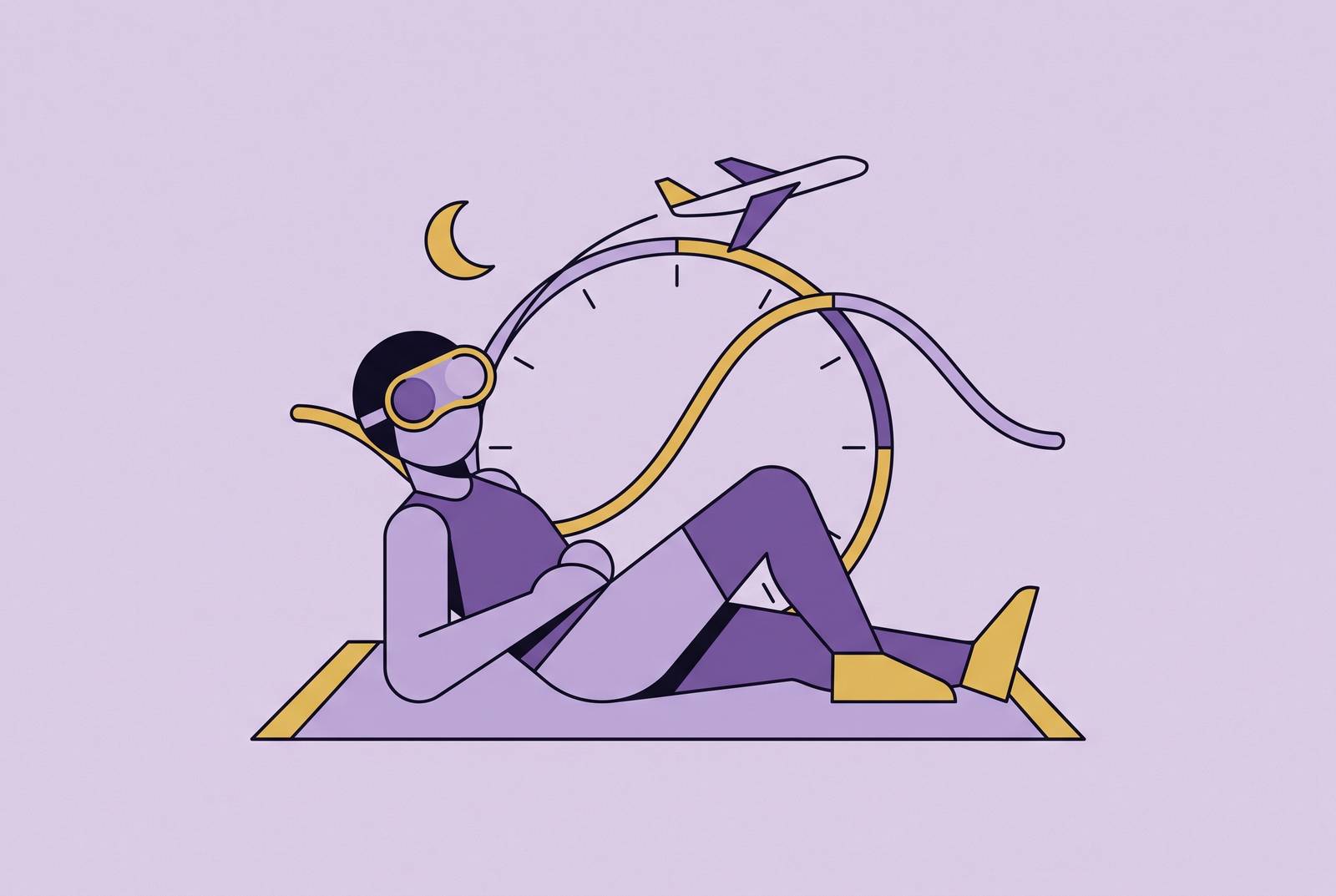
International travel does not produce ordinary tiredness. It produces a misalignment between an internal biological clock and the external environment, and that misalignment persists even after a full night of sleep. The reset protocol that follows treats jet lag as a circadian problem, not a fatigue problem, and it sequences interventions accordingly.
Why international travel disrupts sleep differently than ordinary fatigue
Jet lag is circadian misalignment, not exhaustion. The body's internal clock stays anchored to the departure time zone while environmental cues at the destination pull in the opposite direction. This produces a sustained physiological conflict that rest alone cannot resolve.
Travel fatigue and jet lag are related but distinct conditions. Jet lag requires crossing at least three time zones and persists until the circadian clock re-entrains to local time. The 2026 Springer narrative review on travel and jet lag in athletes draws this distinction clearly, and it matters because the interventions differ: a tired athlete needs sleep, but a jet-lagged athlete needs a timed sequence of signals that tell the clock where it now stands.
The circadian rhythm is an intrinsic biological cycle lasting approximately 24 hours. It regulates physiological and homeostatic processes without external time-givers, maintaining its own internal tempo. Transmeridian travel breaks the alignment between your internal clock and the local cues of light, meals, and social schedules. The body keeps time to a place it has already left. This is the mechanism that makes jet lag a distinct clinical problem rather than a subset of ordinary sleep disruption. An athlete who crosses eight time zones is not merely underslept. They are operating on a schedule that no longer corresponds to the sun.
The human circadian clock runs slightly longer than 24 hours. The clock can delay more easily than it can advance, which is the biological root of why eastward and westward travel feel so different and must be managed differently. A clock that naturally wants to drift later resists being pulled earlier, and it cooperates when asked to extend its day. That asymmetry determines which interventions work, when they must be applied, and how long the full reset takes.
Why flying east is harder than flying west, and why that asymmetry shapes the whole protocol
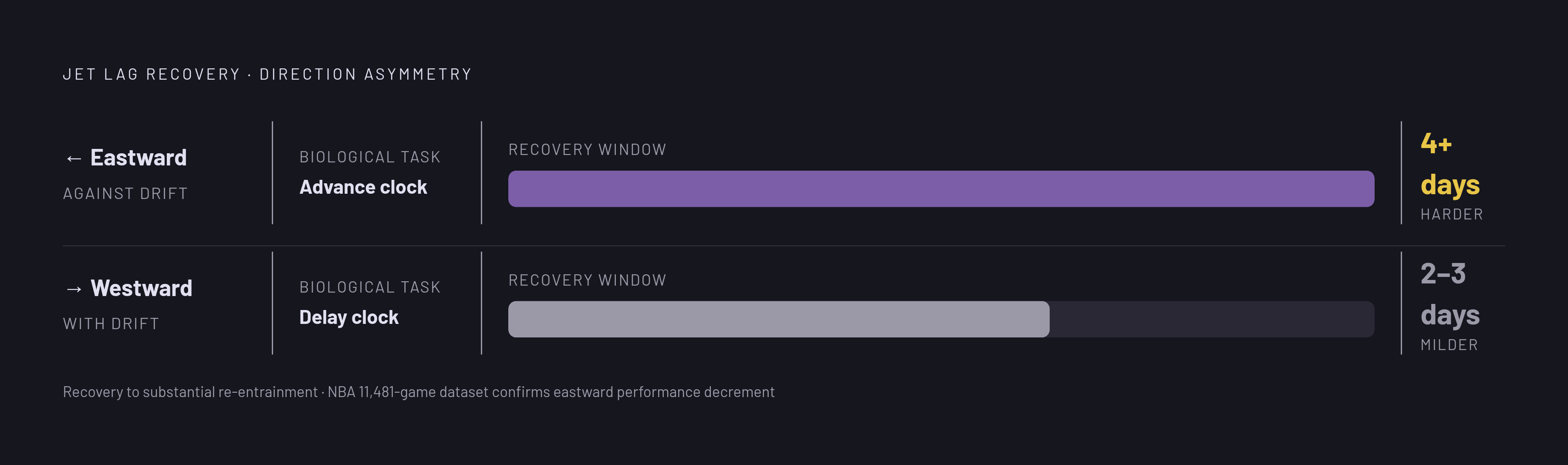
Eastward travel imposes a harder biological task. The body must advance its clock to an earlier local time, working against its natural tendency to run long. Westward travel aligns with that tendency, asking the clock only to delay. The same protocol cannot serve both directions.
Real-world performance data confirms the asymmetry. An analysis of 11,481 NBA games across ten seasons found that eastward travel was associated with impaired on-court performance for home but not for away games, after adjusting for relevant covariates. Westward travel did not produce the same pattern.
The clinical literature reinforces the point. The 2026 Springer narrative review confirms that jet lag symptoms are worse during eastward flights. Distance alone is not the problem. The number of time zones crossed, and the direction of the crossing, is what matters.
A 2026 case report on a world-class Paralympic shot-putter following eastward long-haul transmeridian travel documents the compounding effect of jet lag and travel fatigue on an elite individual athlete's output after eastward flight. Westward travelers need clock-delaying ones. Direction of travel is the first branch point in any reset protocol.
What disrupted sleep actually costs an athlete on the field
Sleep loss after transmeridian travel degrades the specific cognitive and physical capacities that determine athletic outcomes. Your reaction time, decision-making, working memory, and fine motor accuracy all get worse. These are not vague complaints about feeling tired. They are measurable decrements in the exact functions that separate winning from losing in high-level competition.
You see it most clearly in sports that need fine motor control and sustained cognitive function. Tennis serving, handball goalkeeping, and soccer shooting all demonstrate measurable accuracy decrements following disrupted sleep, per the 2026 Springer narrative review. When sleep disruption erodes the underlying neural machinery, these skills degrade in ways a coach can observe in training and a statistician can measure in competition.
The neural mechanism is direct. These are the brain regions an athlete depends on most heavily during competition. Impairing their metabolism is not a peripheral inconvenience. It is a direct hit to the systems that execute athletic skill.
Elite athletes are not immune to this degradation. The belief that training or talent overrides sleep loss is not supported by evidence. The degradation operates at a biological level that no amount of motivation can override.
The recovery evidence is symmetrical, and it makes the stakes concrete. The same mechanism that degrades performance when sleep is disrupted restores it when sleep is protected. This symmetry is the cost-benefit case for the protocol: the losses are real, and they are recoverable through systematic intervention rather than passive rest.
Light exposure is the master control — why every other intervention is secondary to it
Appropriate light exposure and light avoidance are the highest-leverage single intervention for re-entraining the circadian clock to a destination time zone. Light is the principal external signal, the zeitgeber that synchronizes the internal clock to the world outside. Every other intervention in the protocol supports this one, because light does what no supplement or meal can: it tells the master clock exactly where it now stands.
The direction of travel determines not just whether to seek or avoid light, but when. For eastward travelers, morning bright light at the destination advances the clock. For westward travelers, evening light delays it. This is not a matter of more light being better. It is a matter of light arriving at the correct moment in the body's internal cycle.
The 2026 Springer scientific blueprint for athlete travel names managing light exposure as a core circadian alignment strategy alongside sleep behavior and supplementation. Wear blue-light-blocking glasses in the hours before your target destination bedtime, avoid bright screens, and keep the sleep environment dark. These all prevent inadvertent clock-resetting signals from firing at the wrong time. A screen checked at midnight local time, when the body still reads it as late afternoon, can undo hours of careful alignment work.
Practical sequencing should begin in-flight when possible. An athlete who starts the light protocol at the departure gate rather than the arrival gate has given the reset process a head start of several hours. For eastward travel especially, where every hour of clock advancement must be won against the body's natural resistance, those in-flight hours can make the difference between a difficult first day and a manageable one.
Meal timing and hydration as secondary zeitgebers that accelerate clock re-entrainment
Food intake acts as a peripheral zeitgeber. When you align meals with local time, the whole body transitions together instead of leaving peripheral systems lagging behind the brain. The 2026 scientific blueprint identifies ensuring proper hydration and fueling as discrete travel management strategies alongside circadian alignment. Alcohol and excess caffeine should be minimized, as both blunt sleep quality and worsen dehydration. Meal composition matters at destination arrival. The carbohydrate-rich evening meal amplifies the body's readiness to sleep at a time that still feels biologically early.
Athletes with gastrointestinal sensitivity face an additional consideration. If a meal timing schedule triggers digestive distress, it undermines the very alignment you were aiming for, because poor GI function interferes with sleep onset and daytime comfort. The principle is fixed. The implementation is individual.
The supplementation layer: what the evidence actually supports for sleep reset, stress, and cognitive recovery
Supplementation for post-travel recovery is most effective when it targets the actual stressors present: circadian displacement, elevated cortisol, and cognitive fatigue. If you simply add stimulants or general enhancers, you don't address the mechanism. The protocol's supplement tier is sequenced and specific rather than comprehensive, with each ingredient matched to a defined problem in the reset process.
Melatonin functions as a clock timing signal, not a sedative. Transmeridian travel displaces this rhythm, and exogenous melatonin taken at destination bedtime helps re-anchor it. In a randomized controlled trial in international flight crew, 5 mg of melatonin improved self-reported jet lag symptoms and sleep quality. Melatonin at destination bedtime tells the body the night has begun. Melatonin at other times tells it something false.
Ashwagandha addresses the cortisol-sleep feedback loop. The mechanism is modulation of the HPA axis, which directly addresses the cortisol-driven sleep disruption that follows travel stress. In a 2025 controlled trial in professional female footballers, 28-day supplementation with 600 mg ashwagandha root extract significantly improved total quality of recovery compared to placebo, with improvements in perceived sleep quality at 14 days. The onset is gradual: athletes should begin supplementation before or during travel, not just upon arrival, to build effect by the days that matter most.
Rhodiola rosea builds fatigue resistance gradually over several days rather than producing an acute stimulant effect. A 2025 randomized crossover double-blind placebo-controlled trial from Jacksonville State University, published in November 2025, found that short-term Rhodiola rosea consumption, regardless of dose or gender, significantly enhanced Stroop outcomes. The evidence for benefit in rested, unstressed populations is thinner, which means it belongs in the acute reset window rather than as a permanent performance enhancer.
L-theanine promotes alpha brainwave frequencies in the 8 to 14 Hz range, the state associated with calm, focused attention. Onset is rapid, in the range of 30 to 45 minutes, making it suitable for daytime use during the re-entrainment window when an athlete must remain cognitively sharp at a local time their body still reads as night. A well-formulated, absorption-optimized daily formulation that combines several of these compounds at clinically relevant doses gives athletes a practical way to stay consistent across disruptive travel schedules.
Lion's Mane and Bacopa monnieri belong in a different category: longer-horizon ingredients, not acute reset tools. Lion's Mane, Hericium erinaceus, shows acute data of faster Stroop task performance at 60 minutes post-dose of 1.8 g in a randomized double-blind placebo-controlled study of 41 healthy adults aged 18 to 45. Bacopa monnieri's cognitive payoff is cumulative: significant improvements in verbal learning, memory consolidation, and delayed recall required twelve weeks of continuous use at 300 mg per day in a double-blind placebo-controlled trial published in Psychopharmacology. That timeline places Bacopa firmly in preparation territory. Both ingredients belong in the athlete's year-round cognitive maintenance stack. They support neuroplasticity and long-term brain health, rather than working as acute post-travel interventions.
Why absorption technology determines whether a supplement protocol actually works under travel stress
A supplement is only as effective as the fraction that reaches systemic circulation. Under travel conditions, with disrupted digestion, irregular meals, and altered gut motility, absorption efficiency can fall further than baseline. Delivery technology becomes a first-order concern for traveling athletes who depend on their supplements to work precisely when travel has made their bodies less cooperative.
Two mechanisms determine absorption meaningfully. This is particularly relevant for fat-soluble active compounds like Lion's Mane erinacines and Bacopa bacosides, which require co-ingestion with dietary fat under standard delivery methods. The encapsulated form removes that dependency, which matters when travel has made meal composition unreliable.
Ingredient dose matters only when the ingredient is in a bioavailable form. An athlete who reads a label and sees 600 mg of ashwagandha is not necessarily receiving 600 mg in circulation. If you evaluate supplementation protocols for traveling athletes, treat absorption as a first-line question, not an afterthought.
Sequencing the protocol by travel direction: the eastward reset and the westward reset as distinct schedules
The protocol is not a single checklist but two sequenced schedules. But they apply those principles in opposite directions, because eastward travel requires advancing the clock and westward travel requires delaying it. If you follow the correct schedule for the wrong direction, you are actively working against your own reset. The eastward reset is the harder direction and demands more deliberate preparation. The 2026 narrative review documents that even with intervention, recovery from severe disruption can require multiple days.
The westward reset is the biologically easier direction and proceeds faster. Before you travel, begin shifting your sleep onset later by 30 to 60 minutes per day. Days 2 through 4 will consolidate faster than eastward advancement. A westward traveler who has prepared properly should expect to be substantially re-entrained within two to three days, while the eastward counterpart may need four or more.
Where the evidence is uncertain and what athletes should not expect from the protocol
The strongest objection to the adaptogen and nootropic tier of the protocol is a real one. The protocol aims to restore function under disruption, not to elevate performance above an athlete's baseline. Lion's Mane is the clearest example of mixed evidence. The acute Stroop finding in 41 healthy adults is promising, but the evidence base overall is not conclusive, and the 2026 review and research brief both acknowledge that larger, longer-duration trials are needed. Its role is to protect function during the re-entrainment window, not to add something new.
Some studies report neutral or even positive effects of travel on athletic performance. That often comes from prior travel experience, targeted interventions, or favorable conditions such as business class seating. The supplement tier should be reviewed by team medical staff in the context of an individual athlete's full protocol.
Building the reset habit before the next trip: pre-travel preparation as the highest-return investment
The athletes who recover fastest from transmeridian travel are those who treat the reset protocol as a practiced system begun before departure. Experience is not magic. It is the accumulated benefit of having run the protocol before and knowing what to expect.
Year-round cognitive maintenance compounds these gains. A consistent daily stack that includes compounds like Bacopa monnieri, whose memory consolidation benefits require twelve weeks of continuous use, plus ashwagandha for HPA-axis regulation and Lion's Mane within a bioavailable delivery system, means the athlete arrives at travel already operating from a higher baseline. The athlete who starts ashwagandha three days before departure is playing catch-up. The athlete who maintains it year-round starts the trip in a different physiological state. A consistent daily mental performance habit, taken at the same time each day and built on clinically dosed, highly bioavailable ingredients, is the structural complement to the behavioral protocol. The reset protocol, built before the trip and executed by direction, determines whether that stressor costs days of performance or becomes a manageable step in the season.
Sources
- Unpacking the Impact of Travel and Jet Lag on Sleep and Performance of Athletes: A Narrative Review
- Optimizing Athlete Travel for Performance: A Scientific Blueprint for Athletes, Coaches, and Sports Medicine Staff
- Editorial: Translational and clinical chronobiology
- Case Report: Jet lag and travel fatigue effects on performance in a world-class paralympic shot-putter after eastward long-haul transmeridian travel
- Eastward Jet Lag is Associated with Impaired Performance and Game Outcome in the National Basketball Association
- (PDF) Unpacking the Impact of Travel and Jet Lag on Sleep and Performance of Athletes: A Narrative Review
- Improvement of Jet Lag and Travel Fatigue Symptoms and Their Association with Prior International Travel Experience in Junior Athletes
- Lion’s Mane & Your Brain