Caffeine Half-Life and Sleep Architecture Disruption
Caffeine quietly cuts deep sleep, and you can't feel it happen.
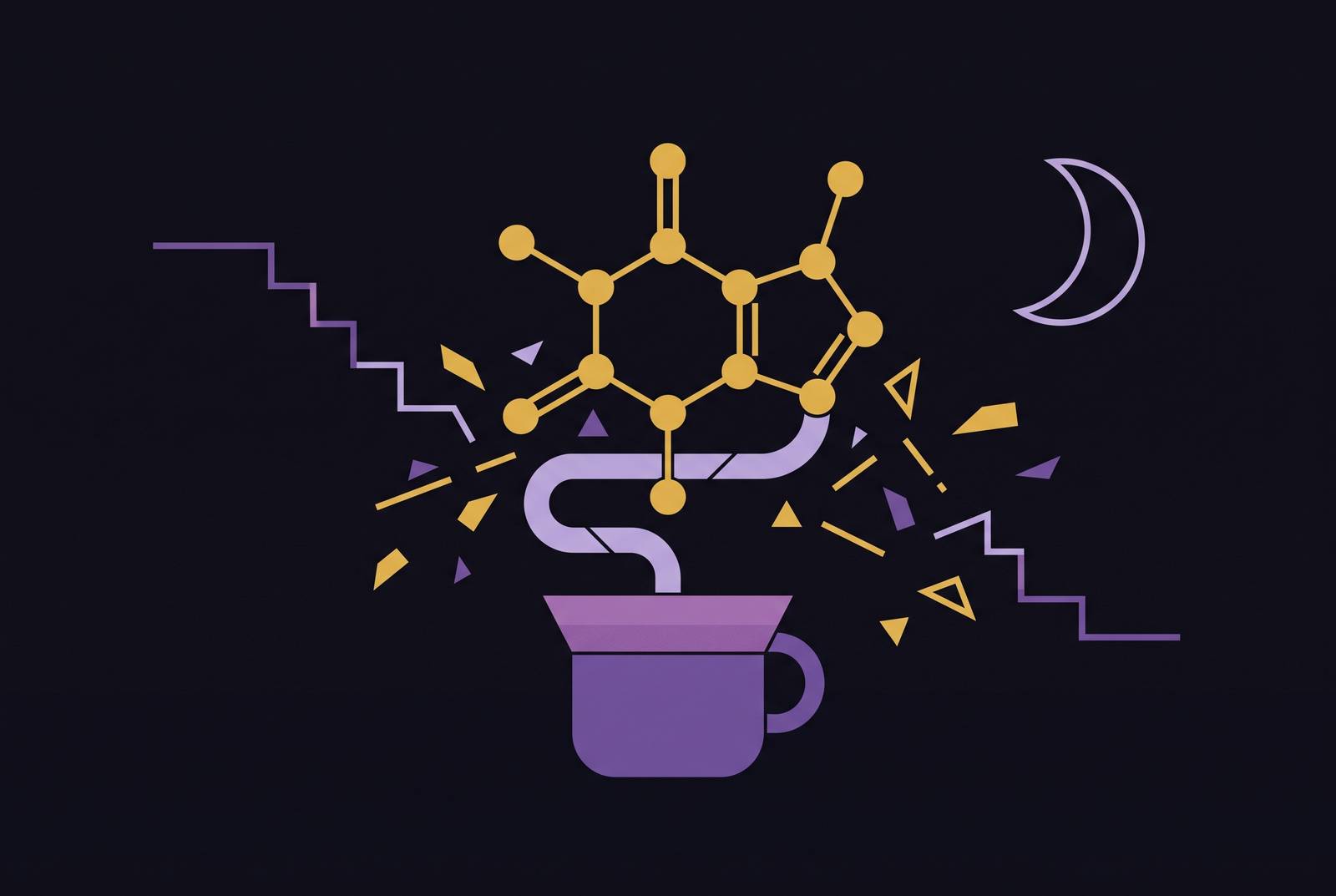
Caffeine does not manufacture alertness. It blocks the brain's ability to register how tired it already is. The molecule responsible for that tiredness signal is adenosine, a neuromodulator that builds steadily across every hour of wakefulness and binds to A1 and A2A receptors, pushing the brain toward sleepiness and toward the deep, slow-wave sleep that follows. Caffeine fits into those same receptor sites without switching them on. The brain, unable to read the adenosine that's actually there, behaves as though sleep pressure is low, even while the underlying chemistry keeps piling up in the background. Nothing about this process reduces the amount of adenosine present. It just delays the moment the brain notices it. Once caffeine clears out of the system, whatever adenosine has queued up during that window binds all at once, and the resulting wave of sleepiness lands harder than ordinary fatigue, arriving as a backlog rather than a gradual buildup. It's a backlog arriving in a single release. That release, and how long it takes to arrive, depends entirely on how fast an individual body clears caffeine out, which turns out to be a far less predictable process than most people assume.
Caffeine's half-life is not a fixed number anyone can rely on
The number people repeat about caffeine, that it takes roughly five or six hours to leave your system, describes an average that conceals more than it reveals. Clearance depends almost entirely on a single liver enzyme, CYP1A2, which handles the breakdown of more than nineteen out of twenty caffeine molecules a person consumes. Genetic variation in that one enzyme alone produces a wide spread in how quickly different people metabolize the same dose. A systematic review in Sleep Medicine Reviews confirmed that caffeine's half-life across healthy adults spans a wide range, wide enough that a blanket rule like "stop caffeine after noon" ends up too strict for some people and far too permissive for others. Several everyday factors widen that range further: oral contraceptive use and pregnancy slow clearance, tobacco smoking roughly doubles the rate at which caffeine breaks down, and liver function and age shift the curve in both directions.
Run the numbers on an ordinary afternoon. A 200 mg coffee at 2 p.m. still leaves roughly 50 mg circulating at midnight in someone with average metabolism, a quarter of the original dose still active while that person is supposedly asleep. None of this is meant to turn caffeine intake into a math problem requiring a spreadsheet. Falling asleep without trouble tells you nothing about how much caffeine is still occupying adenosine receptors during the hours your brain is supposed to be running its deepest repair cycles. Sleep onset and sleep architecture are two different measurements, and only one of them is visible to the person experiencing it.
Caffeine's effect inside sleep: slow-wave loss, REM intact
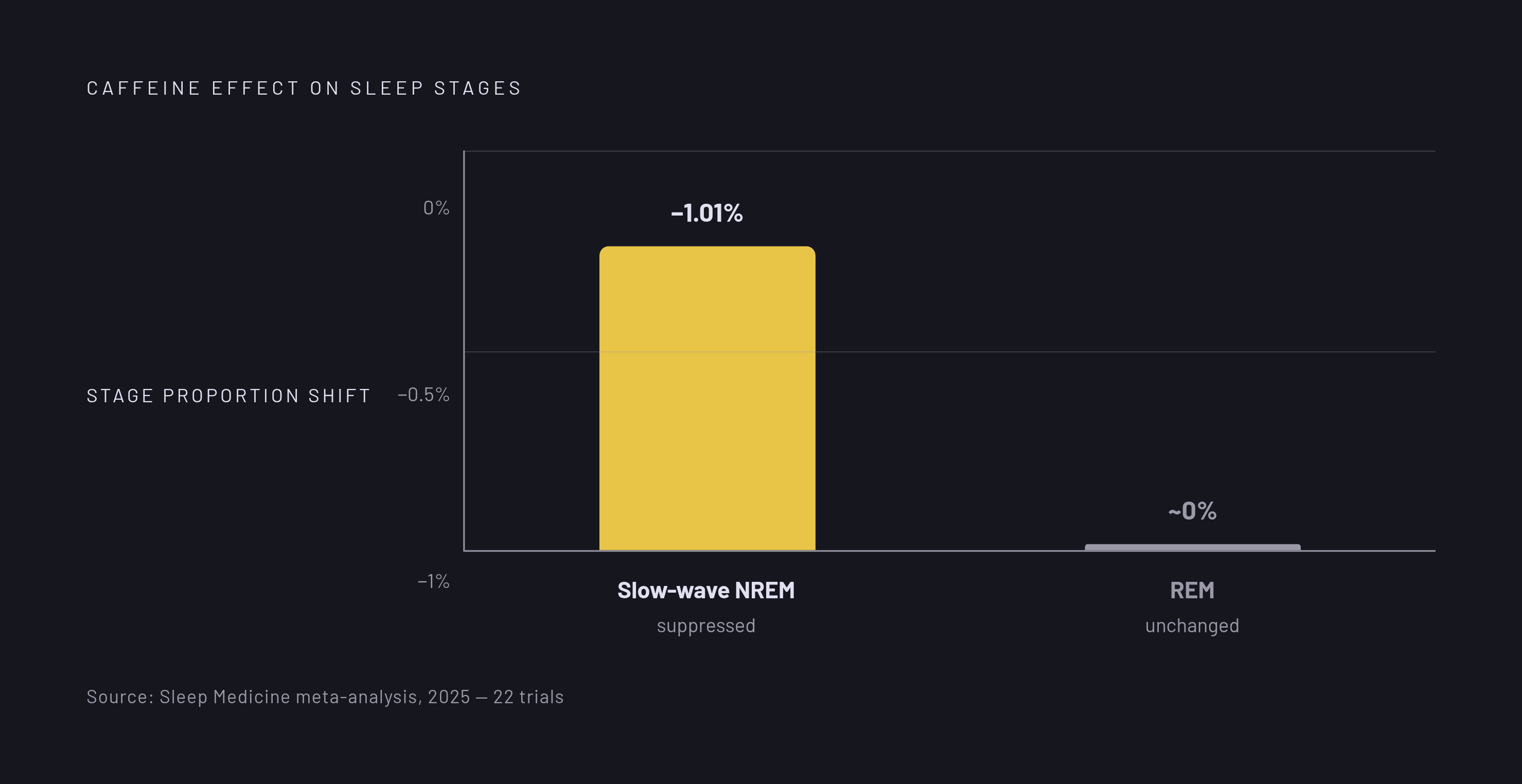
Caffeine's interference with sleep is not a uniform dimming of rest. It targets one stage specifically. It suppresses slow-wave NREM sleep, the deepest and most physically restorative phase of the sleep cycle, while leaving REM sleep largely undisturbed, and that selective suppression is the actual mechanism behind caffeine's next-day cognitive costs. A review spanning thirty-two human studies found the same result across a wide range of experimental designs: caffeine consistently suppressed low-frequency NREM EEG activity, meaning slow-wave activity and the lowest delta frequencies, with the effect strongest in early-night NREM and in the recovery sleep that follows sleep deprivation, where caffeine blunted the rebound the brain would otherwise mount. The selectivity makes biological sense once you trace it back to the adenosine mechanism. Adenosine is the primary driver of NREM sleep pressure specifically, so blocking it hits NREM sleep the hardest, while REM sleep runs on separate regulatory pathways that caffeine barely touches.
The clinical data back this up at scale. A 2025 meta-analysis in Sleep Medicine, covering twenty-two controlled crossover trials, found caffeine reduced slow-wave sleep proportions by 1.01% along with sleep efficiency, with the effect concentrated in younger adults and at higher doses, while REM sleep showed no meaningful change across the full sample. A 2025 randomized crossover trial published in SLEEP found that 100 mg produced no detectable sleep effect, but 400 mg consumed in the hours before bedtime significantly delayed sleep onset and altered sleep architecture, with fragmentation worsening by the eight-hour mark and perceived sleep quality dropping substantially by four hours. The Sleep Medicine Reviews systematic review reported the same directional pattern: caffeine reduced both the duration and proportion of deep sleep while increasing light sleep, though the review did not find that the timing of intake significantly changed the size of that effect. These figures describe how the damage scales with dose and exposure, not where a safe cutoff sits. Given how much individual clearance rates vary, no single dose or deadline applies evenly across different people.
The perceptual blindspot: users sleep through the damage and never know
The most consequential fact about caffeine's effect on sleep architecture is that the people experiencing it cannot feel it happening. The 2025 SLEEP trial made this the centerpiece of its findings: subjects consistently struggled to accurately judge how caffeine had affected their own sleep quality, and the gap between what polysomnography recorded objectively and what subjects reported subjectively was one of the study's primary conclusions. Eight hours in bed can still produce an unrefreshed morning if slow-wave sleep was compressed during that window, because total time asleep is not a reliable stand-in for the quality of that sleep. The Sleep Medicine meta-analysis reinforced the same pattern from a different angle: even moderate afternoon caffeine intake was linked to measurable reductions in both total sleep time and slow-wave sleep under controlled conditions, and those reductions occurred even among subjects who reported no disturbance.
This is not a footnote to the broader argument. It explains why the problem persists at population scale rather than correcting itself. Public health advice built around self-reporting, along the lines of monitoring how you feel and adjusting accordingly, cannot work against a substance whose damage is specifically engineered to be undetectable from the inside. People don't ignore a signal here. There's no signal to ignore. A person can be diligent, self-aware, and attentive to their own habits, and still have no internal indicator that their slow-wave sleep was cut down the night before. The only way to see the effect is with instruments that measure the brain directly, not with how someone happens to feel at 7 a.m.
Disrupted slow-wave sleep erodes the cognitive performance users are taking caffeine to protect
Slow-wave sleep is the stage in which the brain performs the maintenance that makes the next day's thinking possible: consolidating memory, downscaling synapses that were overloaded during waking hours, and restoring the capacity to absorb new information. Across a normal waking day, cortical synapses potentiate with continuous activity, which raises overall excitability and progressively degrades the signal-to-noise ratio the brain depends on to process anything cleanly. Slow-wave activity during NREM sleep is the mechanism that renormalizes those synaptic weights overnight, clearing space for the next day's learning to register properly. When that downscaling process gets interrupted, cortical excitability stays elevated, the pruning of irrelevant neural connections doesn't happen, and new information gets processed poorly.
The consequences reach down to the molecular level. Even brief periods of sleep disruption produce measurable shifts in synaptic plasticity and memory function. The structural irony sits at the center of the entire argument: caffeine is consumed specifically to sustain alertness and protect cognitive output, but by suppressing slow-wave sleep it degrades the exact neurological infrastructure that learning, memory consolidation, and executive function depend on. The tool and the target work against each other.
The cycle of fatigue, escalating consumption, and diminishing returns
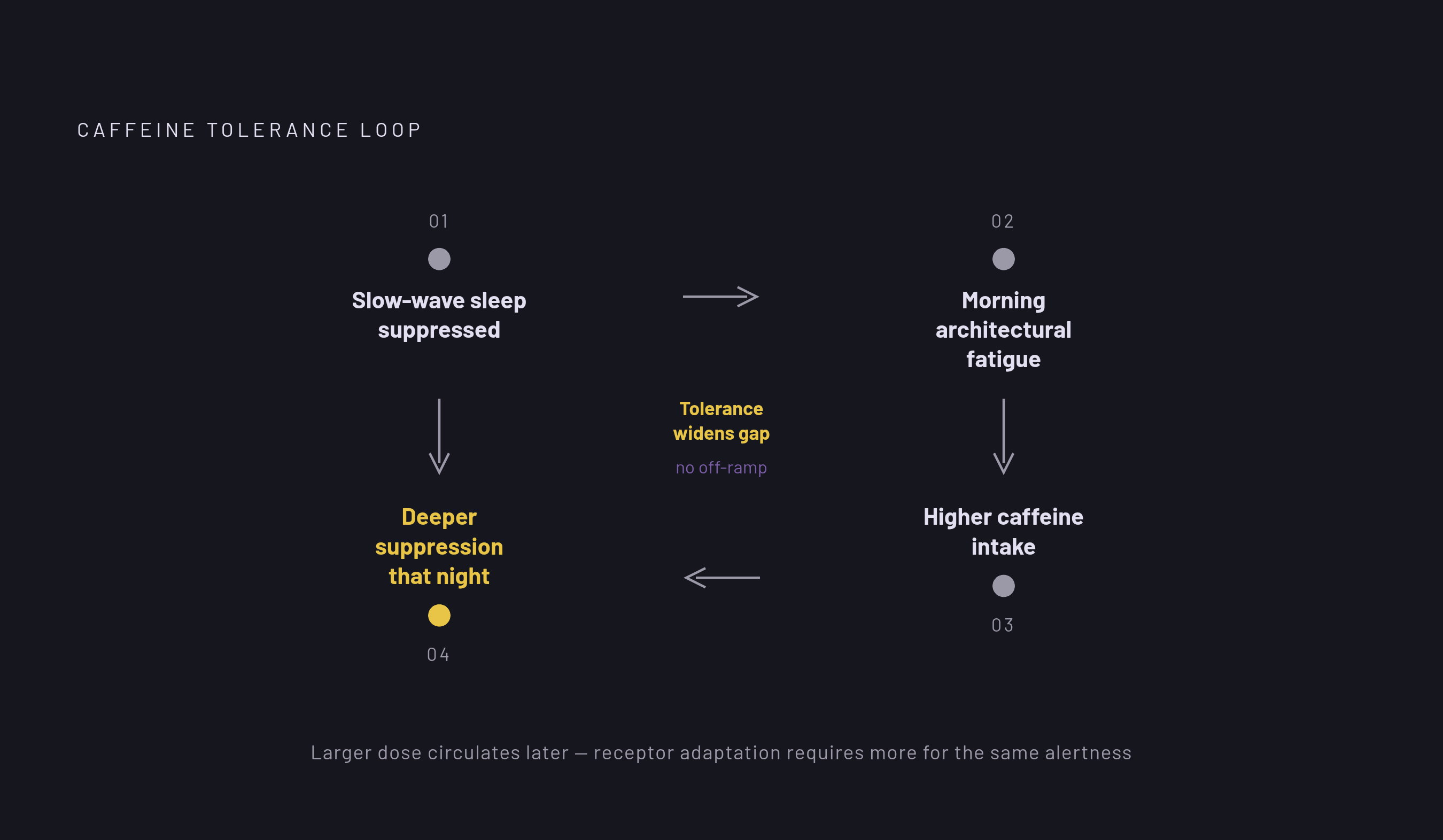
Once slow-wave sleep is compromised, the next morning brings a specific kind of fatigue, one that feels indistinguishable from ordinary tiredness but stems from architectural damage rather than insufficient hours in bed. That fatigue drives higher caffeine intake, which drives deeper suppression of slow-wave sleep the following night, which produces more fatigue the morning after. Days and weeks pass without a single dramatic event marking the transition, so the loop compounds quietly, with no clear point where anyone would think to intervene.
Tolerance makes the trap worse rather than self-limiting. With regular high-dose use, the brain adapts to chronic adenosine receptor blockade, and it takes a larger dose to produce the same subjective alertness. That larger dose is then circulating later into the evening and driving deeper suppression of slow-wave activity than the smaller dose once did. The Sleep Medicine Reviews systematic review found that chronic caffeine exposure may increase tolerance specifically to the subjective experience of sleep disruption, meaning regular users may have even more trouble accurately judging caffeine's effect on their own sleep than occasional users do. The perceptual gap described earlier doesn't stay fixed. It appears to widen with habitual use.
Athletic performance data illustrate the trade-off starkly. A 2025 study examining evening caffeine ingestion in trained rowers found that moderate and high evening doses improved athletic performance, but at the cost of significantly impaired sleep quality and elevated daytime sleepiness afterward, a direct exchange of overnight recovery for a short-term performance gain. Most people experiencing rising caffeine needs attribute it to demanding schedules or their own biology. Some of that rise, at least in part, traces back to caffeine's own effect on the recovery it's supposed to help protect.
Smarter energy strategies that don't erode slow-wave sleep
None of this amounts to an argument against caffeine itself. It's an argument against consuming caffeine without accounting for absorption speed, timing, and the compounds that can offset what unmodified caffeine does to sleep architecture. The research on alternatives points to three separate problems worth solving together: caffeine's sharp absorption curve, the cortisol-driven fatigue that caffeine masks rather than resolves, and the neuroplasticity that slow-wave sleep is meant to restore.
The most thoroughly documented approach pairs caffeine with L-theanine. Multiple randomized controlled trials have found that a combination of roughly 50 mg caffeine with 100 mg L-theanine improves attention-switching accuracy, reaction time, and subjective alertness more consistently than caffeine taken alone, an effect researchers have described as "calm alertness". L-theanine increases alpha brain wave activity, which is associated with relaxation and focused attention, and this moderates the jittery edge that caffeine alone tends to produce. Matcha delivers this pairing naturally, since the caffeine in matcha is bound to catechin molecules that slow its absorption through the digestive tract, producing a steadier energy curve with a gentler onset and reducing the sharp peak-and-crash pattern typical of brewed coffee. Human pharmacokinetic data show L-theanine absorbs quickly after ingestion, reaching measurable plasma concentrations in under an hour. The calming effect arrives in roughly the same window as caffeine's stimulant effect rather than trailing behind it.
Ashwagandha addresses a related but distinct problem. Chronic cortisol elevation impairs hippocampal function and working memory, producing a brain-fog pattern that caffeine can mask temporarily without fixing anything underneath it. Ashwagandha works through the HPA axis rather than through stimulation, and multiple independent randomized trials have documented measurable reductions in cortisol from its use. Sleep-related benefits can appear within one to two weeks at a 300 mg dose taken before bed, while stress and anxiety reduction typically requires four to eight weeks of consistent daily use. It works in the background, raising the baseline rather than producing a spike.
Rhodiola rosea serves a related but mechanistically distinct role. Rhodiola has been shown to reduce mental fatigue and support cognitive performance specifically under stress conditions.
A 2025 randomized controlled trial in healthy younger adults found measurable cognitive and mood effects within hours of a single dose of a standardized extract, with the effects tied specifically to its hericenone and erinacine content, which stimulate nerve growth factor (NGF) synthesis and directly support the neuroplasticity that slow-wave sleep is supposed to enable. Current reviews classify the evidence for Lion's Mane as moderate for cognition and neuroprotection, promising but not yet as extensively documented as the caffeine and L-theanine pairing.
Bacopa monnieri works on a longer timeline, supporting memory and neurotransmitter balance over eight to twelve weeks of consistent use rather than delivering an acute effect. It functions better as a long-term complement to faster-acting compounds than as something taken for same-day performance.
Formulations that combine several of these compounds, matcha-sourced caffeine paired with L-theanine, ashwagandha, Rhodiola, Lion's Mane, and Bacopa, reflect where the underlying research actually points: not toward eliminating caffeine but toward pairing it with compounds that slow its absorption, address the cortisol load caffeine tends to mask, and support the neuroplasticity that slow-wave sleep exists to restore. A single mental performance shot built along these lines is one concrete expression of that framework, not a departure from the science but a packaging of it.
Auditing caffeine timing when half-life is personal, not universal
Given how much CYP1A2 activity varies from person to person, the only reliable way to find an individual cutoff time is to test it directly rather than adopt a rule written for an average metabolizer. A useful starting point is tracking how many hours pass between a normal afternoon dose and bedtime, then paying attention to how groggy the following morning feels relative to nights with no afternoon caffeine at all, since morning grogginess is one of the few indirect signals available when perception of sleep quality itself is unreliable. Factors already established as slowing clearance, including oral contraceptive use, pregnancy, and older age, warrant a wider buffer between the last dose and bedtime, while smoking roughly doubles clearance speed and may permit a shorter one. Anyone titrating dose and timing should also account for the fact that self-reported sleep satisfaction will not reliably flag the problem, so the audit has to rely on behavioral proxies, like next-day focus and energy, rather than trusting how quickly sleep arrived the night before. None of this replaces a sleep study, but it gives a working method for treating half-life as a personal variable rather than a number borrowed from someone else's biology.
Sources
- Dose and timing effects of caffeine on subsequent sleep: a randomized clinical crossover trial
- Age- and dose-specific effects of caffeine on sleep: A meta-analysis of controlled crossover trials - ScienceDirect
- Caffeine and Sleep Review Suggests Consumption Guidelines
- The Caffeinated Brain Part 2: The Effect of Caffeine on Sleep-Related Electroencephalography (EEG)—A Systematic and Mechanistic Review - PMC
- SLEEP, 2025, 48, 1–14 https://doi.org/10.1093/sleep/zsae230
- Caffeine Dose: Performance and Recovery
- The effect of caffeine on subsequent sleep: A systematic review and