Tart Cherry Juice Melatonin Content and Sleep Research
Tart cherry juice has little melatonin, so something else helps.
A day's worth of tart cherry juice delivers around 0.085 mg of melatonin. A standard melatonin pill delivers 1 to 5 mg. That gap, somewhere between six and sixty times, is the starting fact for understanding why tart cherry juice helps people sleep, and why the simple "it's a melatonin food" story told on so many labels doesn't hold up.
Why Tart Cherry Juice's Melatonin Content Is Too Small to Explain Its Sleep Effects
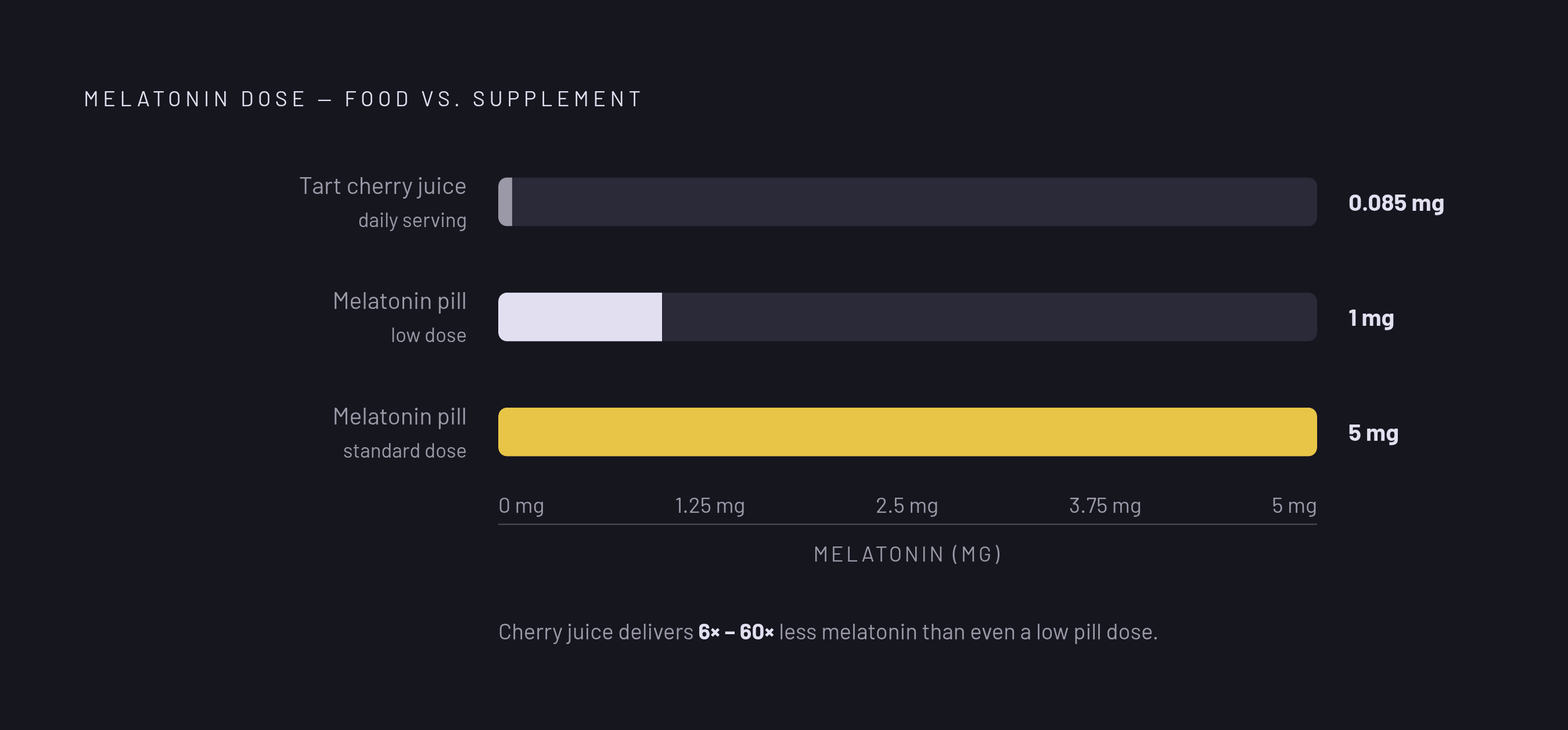
The milligram-range dose used in sleep trials is far larger than what tart cherry juice delivers. Sleep researchers use milligram-range melatonin because trials show that at that dose, it shifts sleep onset and sleep architecture. Tart cherry juice sits two orders of magnitude below that dose, and no pharmacological argument can explain how a microgram-level dose produces the sleep improvements trials have recorded. If melatonin were the active ingredient, the juice would need to be far more concentrated than it is, or the body would need to respond to melatonin at doses it ordinarily ignores. Neither holds up under scrutiny.
The measurements are inconsistent, which makes things worse. A separate measurement by Kirakosyan couldn't detect any melatonin at all in concentrated cherry juice, and the likely explanation is degradation during processing and storage. That finding matters beyond the specific sample it came from: it means melatonin content in tart cherry products isn't a stable, guaranteed quantity. It depends on how the fruit was handled, how long it sat, and what form it ended up in. A juice that tested positive for melatonin last year might test near zero this year, with nothing about the product's branding or packaging telling you the difference.
Varietal differences add a further layer. Burkhardt's 2001 work found Montmorency cherries carrying substantially more melatonin than the Balaton variety, which might suggest a clear answer, except that a 2009 study by Kirakosyan reversed that ranking. Two credible measurements, taken years apart, don't agree on which cherry variety has more melatonin. No variety earns the label "the melatonin cherry" on the strength of that record, and anyone selling tart cherry juice on its melatonin content is building a case on a number that shifts depending on the harvest, the processing, and the lab doing the measuring.
What tart cherry juice actually does to the body's own melatonin production
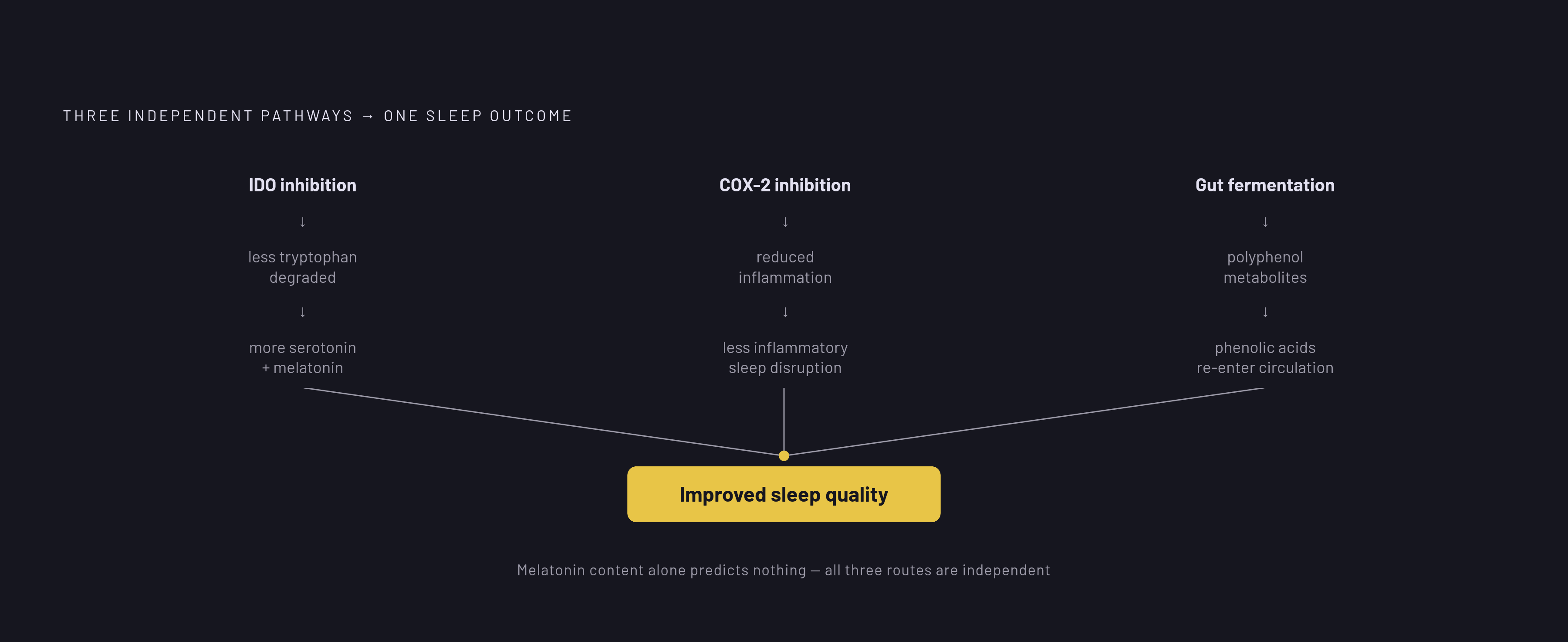
Research has turned toward a different question: not how much melatonin the juice contains, but what it does to the body's own capacity to make melatonin and serotonin. The most compelling current hypothesis centers on tryptophan, the amino acid found in foods like turkey and dairy that the body converts into both serotonin and, downstream, melatonin. The enzyme IDO (indoleamine 2,3-dioxygenase) breaks tryptophan down along a separate pathway, so it competes for the same raw material the body needs to make its own sleep-regulating chemicals. Tart cherry compounds, including procyanidin B-2, appear to inhibit IDO activity. Less tryptophan gets diverted and degraded, leaving more available for serotonin and melatonin synthesis.
That's a fundamentally different mode of action than simply drinking melatonin. Rather than importing a fixed, variable dose of the hormone, the juice would be preserving the raw material the body uses to make its own supply, on its own schedule, at whatever level its internal regulation calls for. That distinction matters for anyone trying to understand why the sleep effects of tart cherry juice don't track cleanly with its measured melatonin content: the two numbers aren't supposed to correlate if this is the real mechanism.
A limitation needs to sit right alongside that explanation: this IDO-inhibition hypothesis has been proposed and tested largely by a single research group, and it hasn't yet been independently replicated by separate labs. That doesn't make it wrong. It makes it an early, well-constructed hypothesis rather than settled science, and the distinction is worth holding onto as more findings come in.
The anti-inflammatory properties of tart cherry reinforce why this mechanism is plausible. IDO is upregulated by inflammation, so reducing inflammation reduces IDO activity, and reduced IDO activity means less tryptophan degradation. The anti-inflammatory effects widely attributed to tart cherry and the tryptophan-preservation mechanism aren't two separate selling points.
Anthocyanins, COX-2 Inhibition, and the Second Layer of the Sleep Story
Tart cherry's sleep-relevant activity doesn't stop at tryptophan metabolism. The fruit is dense in anthocyanins, the pigments that give it its deep red color, and these compounds inhibit cyclooxygenase-2 (COX-2), an enzyme central to the body's inflammatory signaling cascade. COX-2 inhibition is the same general mechanism exploited by several classes of anti-inflammatory drugs, and tart cherry appears to produce a milder, food-based version of that effect.
This matters for sleep because inflammation and sleep disruption run in both directions: poor sleep raises inflammatory markers, and elevated inflammation makes good sleep harder to sustain. A compound that dampens COX-2 activity is working on the inflammatory side of that loop directly, independent of anything happening with tryptophan or melatonin. That's a second, structurally distinct pathway contributing to the same outcome, not a restatement of the first one.
The anthocyanins have been linked to neuroprotective and neuroplasticity-supporting effects, a detail that won't be developed fully until the discussion turns to cognitive performance later on, but it belongs in the mechanistic picture now, because it shows that tart cherry's bioactivity doesn't confine itself to one organ system or one hormone. The sleep benefit observed in trials is the product of several compounds acting through several distinct routes at once. Judging the fruit by its melatonin count alone means missing most of what it's actually doing.
What the Clinical Evidence Shows and Where It Breaks Down
The most frequently cited trial in this literature is a randomized, double-blind, placebo-controlled study of adults with insomnia. Among the 8 completers, sleep time rose on polysomnography, the gold-standard objective sleep measurement, and sleep efficiency scores improved on the Pittsburgh Sleep Quality Index. The result was striking on its face. It was also generated from 8 people, and a sample that small limits what anyone can responsibly conclude about how reliably the effect generalizes. The finding deserves to be taken seriously as a signal, not treated as proof.
A broader systematic review adds some weight to the mechanistic story. Two studies in that review found inflammatory markers, CRP and MDA specifically, dropped as sleep improved for participants. That pairing lines up with the COX-2 and anti-inflammatory mechanism described above, and it's the kind of corroborating detail that makes a multi-mechanism explanation more credible than a single blockbuster trial would on its own.
A 2022 randomized controlled trial in elite female field hockey players complicates the picture in an informative way. Researchers found no significant effect on melatonin or cortisol levels, yet actigraphy measures showed improved sleep quality. That result supports the broader argument here: sleep can improve without any detectable shift in systemic melatonin, which is what a tryptophan-preservation or anti-inflammatory mechanism would predict. Read another way, it raises a real question about which populations and which sleep outcomes respond to tart cherry supplementation, since elite athletes with presumably good baseline sleep hygiene may not respond the same way insomnia patients do.
Taken together, the trial record supports a specific, bounded claim: tart cherry juice shows genuine promise for people with compromised sleep quality, older adults in particular, when delivered as juice or concentrate. It does not yet support a broader claim: that tart cherry juice improves sleep for everyone, no matter their baseline sleep quality or age. The evidence base is narrow, even if genuine, and the honest reading of it respects both facts at once.
Why bioavailability and gut metabolism shape who actually benefits
Part of why the clinical results vary so much by format traces back to what actually happens to tart cherry's polyphenols once swallowed. These compounds aren't simply absorbed intact in the small intestine the way a simple sugar or a standard vitamin might be. Much of it passes through the small intestine untouched and reaches the colon instead, where gut bacteria ferment it into phenolic acids and short-chain fatty acids. Some of these metabolites re-enter systemic circulation in a transformed state, but others stay local, where they modulate the gut's own microbial environment. That's a dual-pathway model of absorption, and it means "bioavailability" for tart cherry polyphenols isn't a single number the way it might be for a more straightforward compound. It depends on what bacteria happen to be present in a given person's gut, and in what proportions.
This is why clinical trials of tart cherry supplements have produced such mixed results, depending on the delivery format used. A 2025 Ohio University study characterized five Montmorency tart cherry product formulations (frozen raw fruit, juice concentrate, freeze-dried powder, and dried fruit) and found that they differ meaningfully in composition. Juice and concentrate appear to deliver polyphenols in forms more likely to reach the colon intact and undergo the fermentation process that produces the active metabolites; encapsulated powder may not survive the same way through digestion. That compositional difference offers a plausible explanation for a pattern already visible in the clinical literature: juice and concentrate formats have produced positive sleep results in older adults with insomnia, while capsule formulations largely have not.
The deeper implication reframes how non-response to tart cherry supplementation should be understood. If someone takes a tart cherry capsule for eight weeks and sees no change in sleep, that doesn't prove the compound doesn't work. The mismatch could run between the product format they chose, the particular composition of their gut microbiome, and the polyphenol profile that format actually delivers. That's a precision-nutrition question the field hasn't yet systematically mapped, and it's a more useful way to think about individual variation than writing off the fruit's effects.
How Better Sleep From Tart Cherry Connects to Daytime Cognitive Performance
Sleep quality sits upstream of nearly every measurable daytime cognitive function: attention, executive function, verbal learning and memory, cognitive flexibility. Anything that durably improves how well a person sleeps is, by extension, an indirect intervention on how well that person thinks the next day. This is why the tart cherry sleep story matters beyond sleep itself.
Cortisol regulation offers one clear mechanistic bridge between the two. Sleep deprivation disrupts cortisol's normal diurnal rhythm, keeping levels elevated through the day instead of allowing the usual decline, and that disruption both makes falling asleep harder and degrades cognitive performance while awake. A 2025 Penn State study of older adults found that when more exercise and better sleep quality combined, the diurnal cortisol slope declined more steeply than it did for either factor alone. The finding suggests that sleep quality, on a day-to-day basis, modulates the cortisol awakening response, and that improving sleep functions as one practical lever for restoring a healthier cortisol pattern.
One research team pushes the argument further, with direct data on cognitive outcomes. In a 12-week randomized controlled trial at the University of Delaware, people who drank tart cherry juice felt more content with their own memory and did better on paired associates learning, a standard memory assessment. The researchers traced the effect to three mechanisms that plausibly support brain function independent of sleep itself: the compound's anti-oxidative and anti-inflammatory properties, and its ability to lower blood pressure.
One detail from this body of work carries a practical warning against expecting quick results: acute, single-dose tart cherry intake hasn't been shown to improve cognitive performance, even though a single dose can measurably affect blood flow. Trials recorded cognitive benefits only after weeks to months of consistent supplementation. Anyone expecting a same-day cognitive boost from a single glass is measuring the compound against a timeline it was never shown to work on.
Using Tart Cherry Juice in Practice: What the Evidence Means
The full picture, mechanism and trial data together, supports a specific and fairly conservative recommendation. For adults with compromised sleep quality, older adults especially, tart cherry juice or concentrate, taken consistently over weeks rather than days, is a reasonable, low-risk addition to a sleep-support routine. The same confidence doesn't extend to healthy young adults with already-normal sleep, a population the current trials haven't meaningfully tested.
Format and timing matter based on what the trials actually used. Some studies dosed participants with two 240 mL (8-ounce) glasses of tart cherry juice daily, one in the morning and one taken 1 to 2 hours before bedtime. Others used 30 mL of concentrate twice daily. Powdered and capsule forms have also been tested, typically around 480 mg per day, but the bioavailability research on gut fermentation and polyphenol composition suggests juice and concentrate are more likely to deliver a consistent, effective dose than encapsulated powder.
None of this adds up to a claim that tart cherry juice is a sleep drug or a substitute for addressing underlying sleep disorders through medical care. It adds up to something narrower and better supported: a food-based compound with multiple, independently plausible mechanisms, tryptophan preservation through enzyme inhibition, anti-inflammatory activity, and polyphenol metabolites generated through gut fermentation, each contributing to a modest but real effect on sleep, particularly for people whose sleep quality has room to improve. The melatonin content was never the active ingredient. The rest of the story is where the actual evidence lives.
Sources
- The Effect of Tart Cherry on Sleep Quality and Sleep Disorders: A Systematic Review - Barforoush - 2025 - Food Science & Nutrition - Wiley Online Library
- The Effect of Tart Cherry on Sleep Quality and Sleep Disorders: A Systematic Review
- Effects of Short-Term Intake of Montmorency Tart Cherry Juice on Sleep Quality after Intermittent Exercise in Elite Female Field Hockey Players: A Randomized Controlled Trial
- Tart Cherry Juice for Sleep
- Pilot Study of the Tart Cherry Juice for the Treatment of... : American Journal of Therapeutics
- TYPE Original Research PUBLISHED 26 May 2025 DOI 10.3389/frsle.2025.1537997
- Pilot Study of the Tart Cherry Juice for the Treatment of Insomnia and Investigation of Mechanisms
- Effect of tart cherry juice (Prunus cerasus) on melatonin levels and enhanced sleep quality