Guide
How to Get More Deep Sleep
Deep sleep is not something you can force. You can build the pressure that produces it and stop doing the things that break it up.
What deep sleep is
Deep sleep is stage N3 of non-REM sleep, usually called slow-wave sleep after the large, slow brain waves that define it on an EEG. It is the stage the body spends most of its recovery effort in, and it matters for next-day performance in two ways this site covers in depth: slow waves coordinate the memory consolidation that turns a day's learning into something you keep, and deep sleep is when the brain's glymphatic clearance does most of its work.
Two facts shape everything below:
- Deep sleep is front-loaded. Most of it comes in the first sleep cycles of the night. Later cycles shift toward lighter sleep and REM. Anything that delays, shortens or fragments the first few hours of sleep costs deep sleep first.
- It falls with age. A meta-analysis of 65 polysomnography studies (Ohayon et al., 2004) found the share of slow-wave sleep falls as adults get older. A lower number at 45 than at 25 is expected, not a fault to fix.
So "more deep sleep" in practice means two things: build the drive that produces it, and stop spending or breaking it.
Build sleep pressure, then don't spend it
The best-established model of sleep regulation (Borbély's two-process model) describes a homeostatic drive, often called sleep pressure, that builds the longer you are awake and is discharged during sleep as slow-wave activity. The more pressure you carry into the night, the more intense your early deep sleep. After sleep loss, slow-wave activity rebounds.
What that means day to day:
- Keep your wake time fixed. A consistent wake time anchors when pressure starts building, so bedtime arrives with a predictable load.
- Nap early and short, or not at all. A long or late nap discharges pressure you would otherwise spend in deep sleep that night. Our guide to nap timing and duration covers the trade-off.
- Don't deprive yourself on purpose. The rebound after a short night is real, but it is the body recovering a debt, not a gain. Total sleep lost costs more than the extra slow waves return.
Protect the first half of the night
Because deep sleep is concentrated early, the hours just before and after you fall asleep carry the most weight.
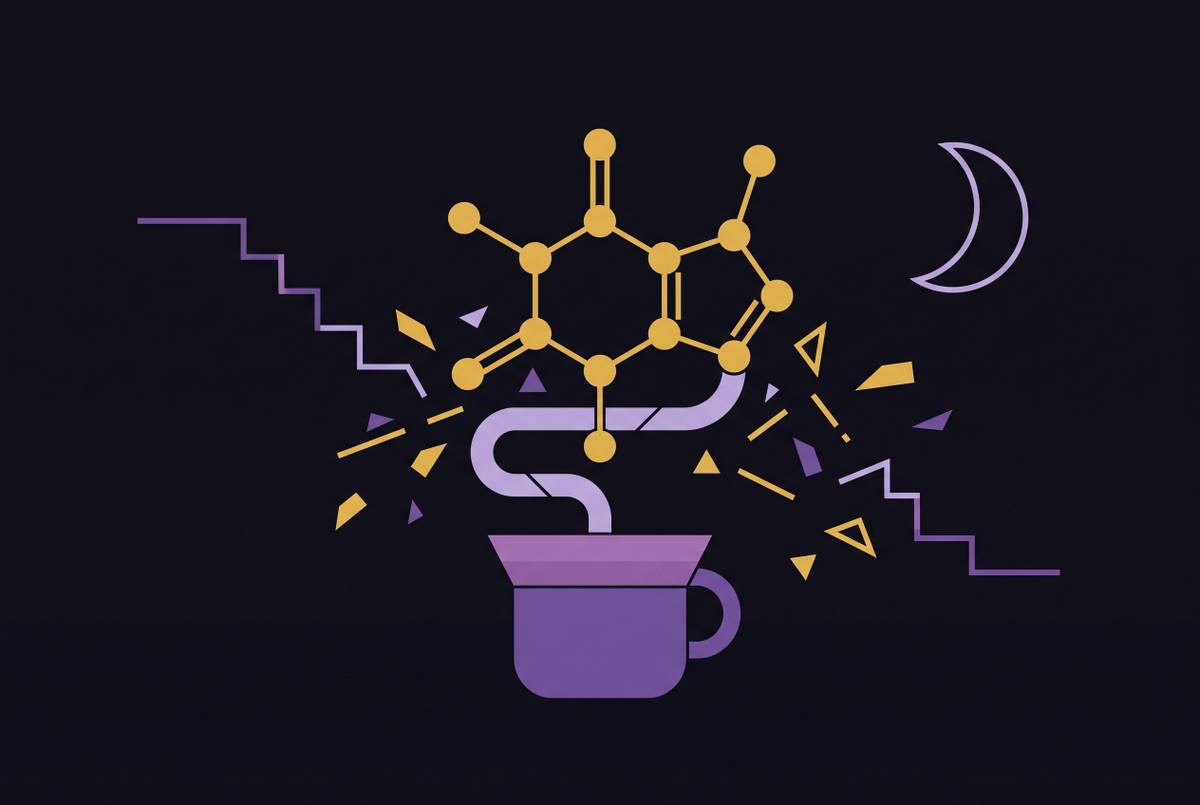
Caffeine. In a home-based trial, 400 mg of caffeine taken at bedtime, three hours before bed or six hours before bed all disturbed sleep compared with placebo, and the authors recommend avoiding substantial caffeine for at least six hours before bed (Drake et al., 2013). Caffeine works by blocking adenosine, one of the signals behind sleep pressure, which is why it hits deep sleep in particular. We cover the timing in detail in caffeine half-life and sleep architecture.
Alcohol. Alcohol is the trap here. A review of the studies in healthy volunteers found it shortens time to sleep and, in most studies, increases slow-wave sleep in the first half of the night, while increasing sleep disruption in the second half and reducing REM sleep at moderate and high doses (Ebrahim et al., 2013). A tracker may show more deep sleep after drinks; the night as a whole is worse. It is not a deep-sleep tool.
Late, heavy stress or work. There is no single trial to point to, but anything that keeps you alert past your usual bedtime pushes the deep-sleep window later and shorter. A fixed wind-down time protects the same hours the two points above do.
Use heat: a warm shower before bed, a cool room for sleep
Falling asleep goes with a drop in core body temperature, helped by heat leaving through the hands and feet. A meta-analysis of warm showers and baths before bed found that water at 40–42.5 °C, taken one to two hours before bedtime for as little as 10 minutes, shortened the time it took to fall asleep and improved self-rated sleep quality and sleep efficiency (Haghayegh et al., 2019). The review also looked at slow-wave sleep, and its authors say the evidence is still limited. Treat the warm shower as a reliable way to fall asleep faster, which protects the early cycles where deep sleep happens.
A cool, dark, quiet bedroom supports the same temperature drop through the night. What counts as cool varies between people and bedding; adjust until you stop waking warm.
Exercise, and when to do it
A meta-analysis of 66 studies found that a single bout of exercise has small beneficial effects on slow-wave sleep and total sleep time, and that regular exercise has moderate benefits for sleep quality (Kredlow et al., 2015). Effects depended on, among other things, the time of day and how consistently people exercised. Daily movement you can sustain beats an occasional hard session. If late training leaves you wired at bedtime, move it earlier and see whether your sleep changes.
Athletes in heavy training blocks should read overtraining and sleep quality: past a point, more training degrades sleep rather than deepening it.
Supplements: what the evidence shows and what it doesn't
No supplement reliably manufactures deep sleep. A few have evidence for helping you reach it sooner or sleep better overall:
- Glycine. In a polysomnography study, 3 g of glycine before bed shortened the time to fall asleep and to reach slow-wave sleep (Yamadera et al., 2007). It is the best-studied option for this question specifically. See glycine and slow-wave sleep.
- Magnesium. Evidence is mostly for self-reported sleep quality, and the form matters for absorption. See magnesium glycinate vs magnesium oxide.
- Melatonin. Mainly a timing signal: it helps shift when you sleep and can shorten time to sleep onset. It is not a deep-sleep enhancer, and more is not better. See melatonin dose calibration.
- Sedating sleep aids. Drugs that sedate broadly can induce sleep while flattening its normal structure, which is the opposite of the goal here.
If you combine supplements, stacking for sleep without sedation explains how to keep each one to a separate job. Check doses against the studies rather than the label's claims, look for third-party testing, and talk to a doctor or pharmacist first if you take prescription medication or are pregnant.
Sound stimulation: promising in the lab
In a lab study, short sounds played in time with the brain's own slow oscillations during deep sleep strengthened those oscillations and improved overnight memory retention. Sounds played out of time with the rhythm did nothing (Ngo et al., 2013). The key detail is that the timing was locked to each sleeper's live EEG. A device or app that plays steady pink noise all night is not doing the same thing. Before buying one that claims to boost deep sleep, look for published, independent trials of that specific device.
Measure trends, not single nights
Deep sleep is defined by EEG in a sleep lab (polysomnography). Rings, watches and bed sensors estimate sleep stages indirectly, from movement and heart signals. Before you trust your tracker's deep-sleep number, check whether the manufacturer or independent researchers have published validation of that device against polysomnography, and how well it detected stages, not just sleep versus wake.
Then use it the way its accuracy allows:
- Change one thing at a time and keep it for at least a week or two.
- Compare averages across weeks. One night means very little.
- Weigh how you feel and perform the next day alongside the number.
When low deep sleep is a medical question
Some causes of poor deep sleep are not habits. Sleep apnea repeatedly interrupts breathing and fragments sleep. The National Heart, Lung, and Blood Institute lists breathing that starts and stops, frequent loud snoring and gasping for air as symptoms, and notes you may not know you have them until someone tells you. If that sounds familiar, or you wake unrefreshed despite enough time in bed and good habits, see a doctor about a sleep study. No supplement or routine fixes an airway problem.
A one-week starting plan
- Fix your wake time, including weekends.
- Set a caffeine cut-off at least six hours before bed, and earlier if you are sensitive.
- Don't use alcohol to get to sleep.
- Take a warm shower or bath one to two hours before bed. Keep the bedroom cool, dark and quiet.
- Move every day, earlier rather than late if evening exercise keeps you up.
- Keep naps short and early, or skip them.
- Watch your tracker's weekly average and how you feel, not last night's score.
This guide is general information, not medical advice. If you have a sleep disorder or take medication, check changes with a clinician.
Sources
- Borbély et al. (2016), The two-process model of sleep regulation: a reappraisal. J Sleep Res
- Ohayon et al. (2004), Meta-analysis of quantitative sleep parameters from childhood to old age in healthy individuals. Sleep
- Drake et al. (2013), Caffeine effects on sleep taken 0, 3, or 6 hours before going to bed. J Clin Sleep Med
- Ebrahim et al. (2013), Alcohol and sleep I: effects on normal sleep. Alcohol Clin Exp Res
- Haghayegh et al. (2019), Before-bedtime passive body heating by warm shower or bath to improve sleep. Sleep Med Rev
- Kredlow et al. (2015), The effects of physical activity on sleep: a meta-analytic review. J Behav Med
- Yamadera et al. (2007), Glycine ingestion improves subjective sleep quality in human volunteers. Sleep Biol Rhythms
- Ngo et al. (2013), Auditory closed-loop stimulation of the sleep slow oscillation enhances memory. Neuron
- National Heart, Lung, and Blood Institute: Sleep apnea symptoms