Nap Timing and Duration for Afternoon Cognitive Recovery
Take a 20-minute nap between 1 and 3 PM to avoid grogginess.
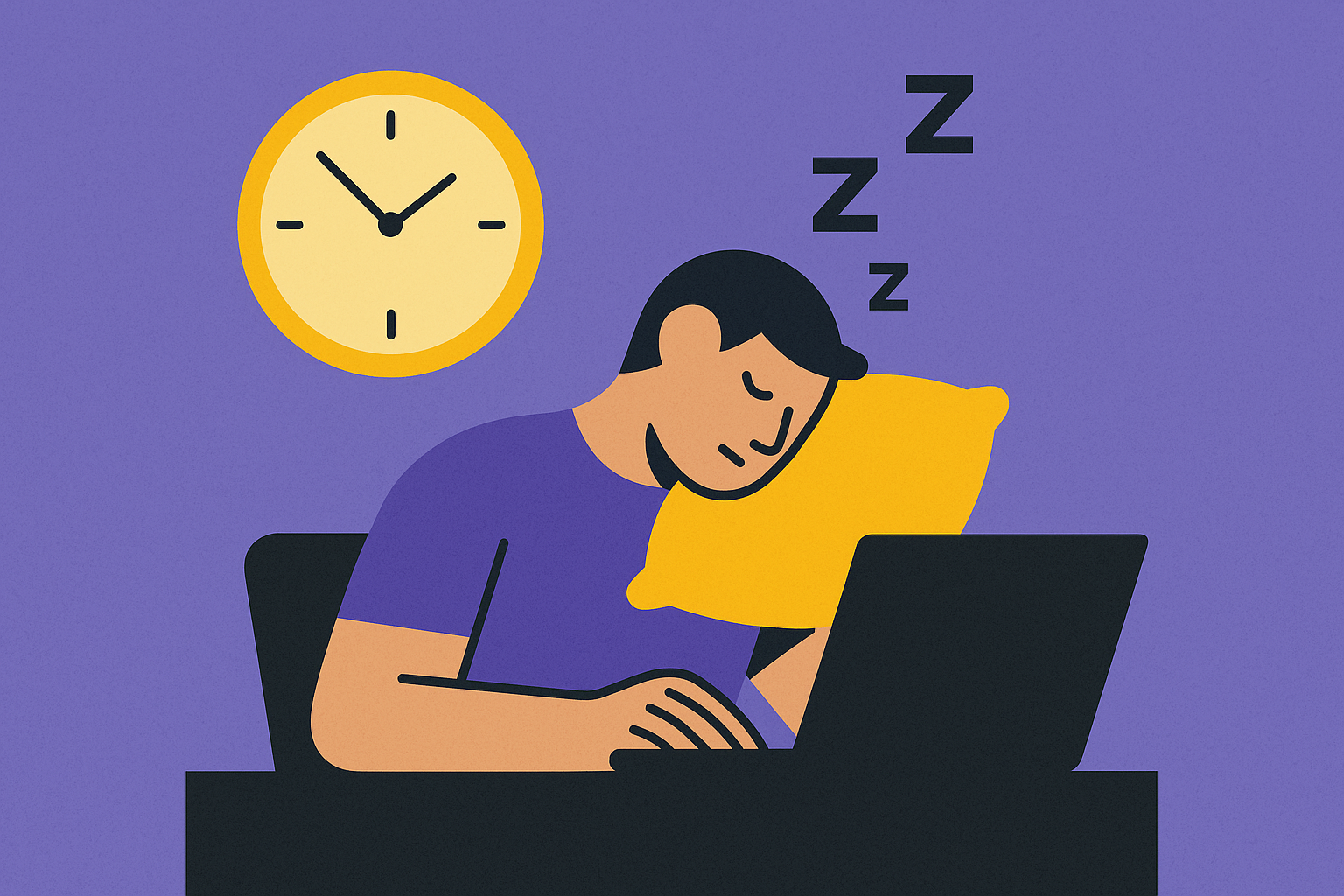
Afternoon cognitive recovery depends on more than finding time to lie down. A useful nap aligns two things, namely the afternoon dip in alertness and a duration short enough to avoid deep sleep. Get either wrong and the break can leave you groggier. A short nap should work without adding more sleep during the day or taking from the night.
Why most naps feel worse than no nap at all
You drag yourself back to the desk after a nap and feel worse than before you lay down. The break was supposed to restore your attention, but now even getting started feels hard. It is easy to decide that napping simply does not work for you. Yet that result can say more about the nap’s timing and length than about napping itself.
There are two main ways the plan goes wrong. A nap outside the natural afternoon dip fights the body’s timing. A nap that runs too long can cross into slow-wave sleep, leaving you to wake through the fog called sleep inertia. These are different failures, so fixing one does not automatically fix the other.
The two biological clocks that determine whether a nap helps or hurts
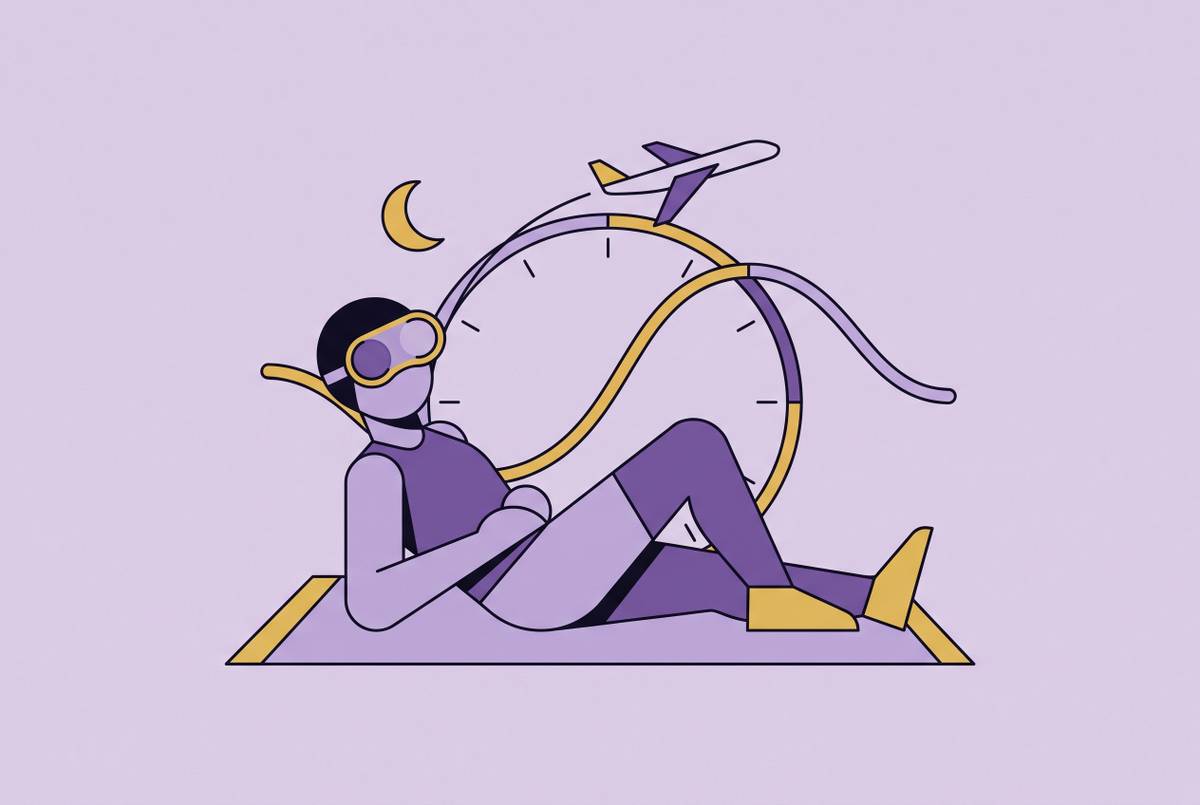
The first system is the circadian rhythm, which governs the daily pattern of alertness. During the afternoon dip, the signal promoting wakefulness weakens. The 1–3 PM window is therefore a period when sleep fits the body’s rhythm. This is the timing side of the problem. This helps explain why a free slot in the calendar may be a poor time for a nap.
The post-lunch dip happens regardless of meal timing and persists even when lunch is skipped or diet alone is changed. Cortisol, which helps signal the body to stay alert, is also at a low point during this window. That adds to the alertness deficit and makes demanding mental work particularly costly. The slump has a biological basis.
The second system is sleep pressure, driven partly by adenosine, a substance that builds up in the brain during waking hours. As it binds to receptors that promote sleepiness, the pressure to sleep grows. Even light sleep clears some of it, so a short nap can ease sleep pressure without deep sleep. Duration then determines how far into sleep you go while seeking that relief.
The strength of the dip also depends on the sleep you bring into it. It is more pronounced in sleep-deprived people and less pronounced in well-rested people, though being rested does not make it disappear. In that sense, the dip amplifies existing sleep debt. The same afternoon window can therefore offer a different amount of recovery to different people.
What sleep architecture actually looks like across nap lengths
Sleep architecture is the stages of sleep a nap goes through. Those stages matter because a longer nap is not simply a larger dose of the same experience. Light sleep can ease some sleep pressure, but waking from slow-wave sleep is more likely to bring sleep inertia. For afternoon work, the distinction is practical. More time asleep does not necessarily mean a cleaner return to the desk.
A short power nap, such as the 20-minute nap used here, aims for light sleep and a quick return to wakefulness. Its benefit is some relief from the accumulated pressure to sleep. The nap must remain short. This fits someone seeking an afternoon reset.
A longer nap that reaches slow-wave sleep creates a different waking problem. Its defining risk is grogginess after waking. Abrupt awakening from this deeper stage produces more sleep inertia than waking from lighter sleep. That makes it a poor match when the reason for napping is to resume demanding work promptly. The extra sleep and the immediate ability to think clearly are not the same outcome.
An extended daytime nap also has to be judged against the night that follows. Its cost is not limited to how alert you feel when you wake. If daytime sleep undermines nighttime sleep, the afternoon recovery can become part of a repeating deficit. The relevant comparison is therefore between stages reached, the quality of waking, and the effect on the next sleep period. Nap length matters because it changes that balance.
Why timing within the afternoon window matters as much as length
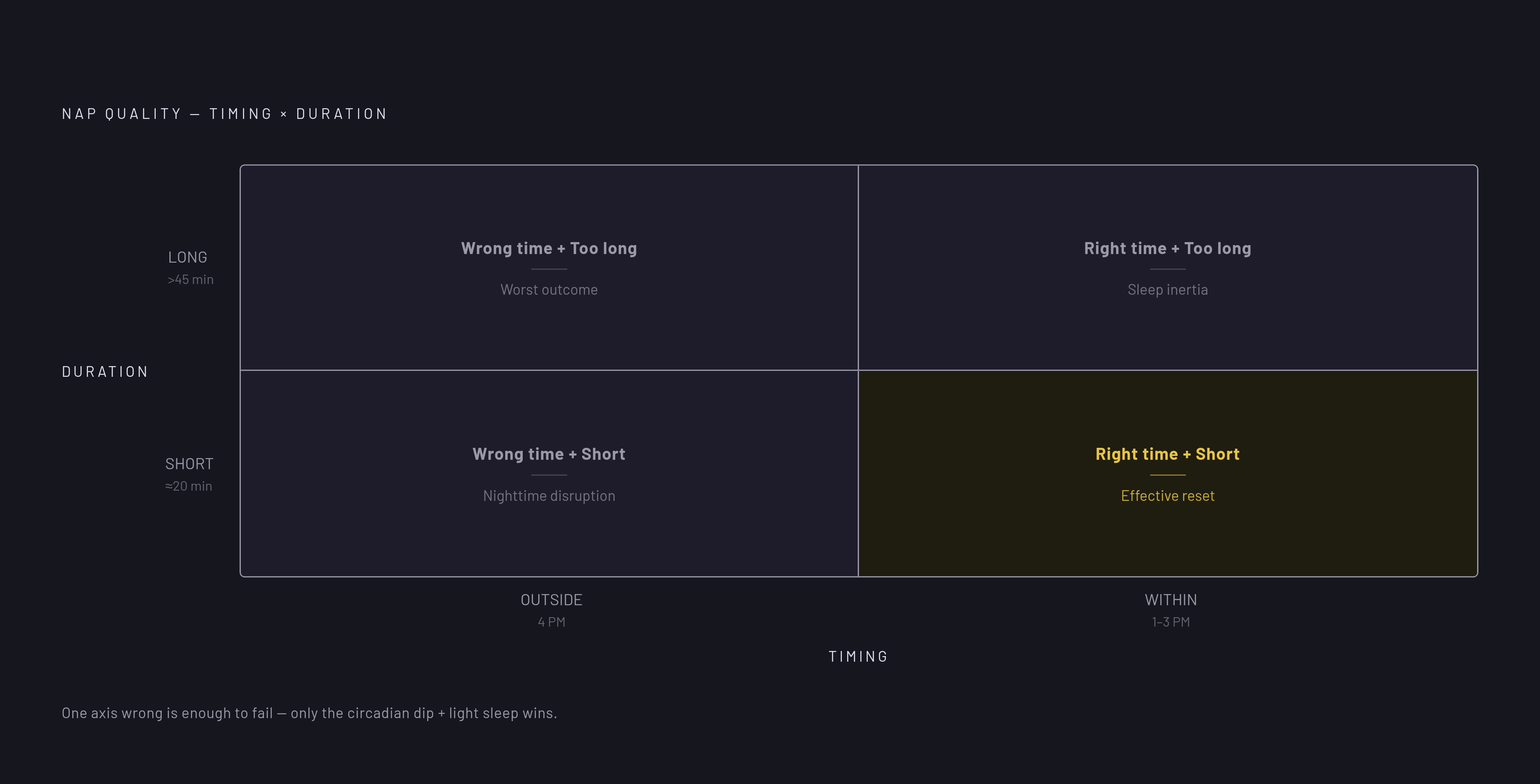
A carefully limited nap can still land at the wrong time. A 20-minute nap at 1 PM and a 20-minute nap at 4 PM are not interchangeable. The later nap has a higher chance of disrupting the night that follows. Repeated over days, that cost can work against the recovery the nap was meant to provide.
Dutheil et al.’s 2021 meta-analysis found that cognitive performance improved more after earlier afternoon naps, before 1 PM, than after later ones. That finding challenges the idea that length is always the main variable to adjust. Getting the duration right cannot make the time of day irrelevant.
The practical 1–3 PM window brings the two systems into the same direction. The wakefulness signal has dipped, and a short sleep can relieve some of the pressure built up during the day. That alignment is why the window is useful, rather than a claim that every person will respond identically throughout it. Evening napping is almost always counterproductive for nighttime sleep in healthy adults outside deliberate shift-work schedules.
The coffee nap: stacking caffeine and sleep to compound both effects
Once the sleep-pressure mechanism is clear, the coffee nap becomes a precise extension of it. Light sleep helps clear some adenosine, while caffeine acts at the receptors involved in its sleepiness signal. The timing of caffeine absorption allows the short nap to do its work before caffeine helps with the return to wakefulness. The combination is not simply two separate ways of forcing yourself to stay alert.
The dose used in most research is 100–150 mg, consumed immediately before lying down. The nap stays short so it ends within the time it takes to absorb the caffeine. Most sleep researchers recommend that short duration for this reason. Extending the nap would change the timing that makes the combination useful. Precision here means matching the drink and the sleep.
A controlled driving study found that the caffeine-plus-nap treatment cut mid-afternoon driving incidents to about 9% of those seen with placebo. It outperformed caffeine alone and napping alone in that setting. That performance result is specific to the task studied. The result nevertheless supports the logic of combining the two mechanisms.
The waking experience can also differ from an ordinary nap. A caffeine nap typically brings less grogginess than a nap of the same length without caffeine, because the arriving caffeine helps smooth the transition back to wakefulness. That matters when recovery is judged by the ability to work afterward. Even so, caffeine adds to an already well-timed nap. It does not remove the need to protect nighttime sleep.
How consistent napping and a daily cognitive support stack compound over time
Short, consistent early-afternoon naps are associated with more favorable cognitive trajectories across several cohorts. Long, late, or highly irregular patterns track with worse outcomes. These associations suggest that regularity and timing matter beyond the feeling after a single nap. They do not, by themselves, prove that napping causes better long-term brain health.
Bacopa Monnieri helps with memory recall and attention span, and its effects build over weeks. Its neuroprotective alkaloids may also help protect against oxidative stress. That makes its proposed role different from the acute clearing of sleep pressure. It belongs in a discussion of sustained support.
Ashwagandha brings cortisol regulation into the discussion. A 2025 study published in Biomolecules from Firat University, Turkey, found that ashwagandha extract considerably reduced corticosterone elevation caused by sleep deprivation. That finding connects the ingredient to a stress-related response under sleep loss. It does not establish that taking it improves the outcome of an afternoon nap. The distinction matters when moving from a biological rationale to a claim about a combined routine.
Rhodiola Rosea acts faster than Bacopa, with noticeable effects within days and acute effects arriving within under an hour. Evidence shows it can ease mental fatigue under stress and help people perform better under sleep deprivation, and early morning is usually a good time to take it. Cognizin® is a form of citicoline that supports brain energy metabolism and phospholipid synthesis. It helps support thinking over time, beyond the nap window itself.
The case for pairing daily support with napping is therefore one of complementary timescales. A short nap gives a quick reset, while ingredients that take longer to work may help with memory, attention, or other parts of normal cognitive function over time. That rationale should not be confused with evidence that the complete combination has a proven compounding effect. For healthy, high-performing adults, the aim is support for normal cognitive function. A nap or a supplement stack still leaves the need for enough nighttime sleep.
When napping makes things worse and what to do instead
The strongest objection to napping is that it can make an unhealthy sleep pattern feel workable. A person may get a short-term lift in performance and mood while continuing to sleep too little at night. Strategic napping is a calibration tool for healthy adults carrying normal sleep debt. It is not a solution for a structural sleep disorder.
Some circumstances make that limit especially important. In people with depression, hypersomnia and excessive daytime napping can maintain or worsen depression, and behavioral treatment typically includes reducing naps and increasing daytime activity. In older adults with fragmented nighttime sleep, daytime napping can further disrupt sleep architecture. These are not simply cases of choosing the wrong nap length.
Long-term research also leaves an important question about cause and effect. Long, morning, or irregular napping patterns track with worse cognitive outcomes and, in at least one biomarker-linked study, greater Alzheimer's pathology. Yet it is still partly unclear whether napping adds to decline or early cognitive changes lead people to nap more. The more favorable findings for short, consistent early-afternoon naps show why different napping patterns should be treated as different behaviors, while that uncertainty remains.
A persistent or escalating need to nap, especially with poor nighttime sleep, calls for a clinician evaluation. The decision rule is straightforward. Use a well-timed 20-minute nap in the circadian window for ordinary afternoon recovery. If it still leaves you exhausted or unable to function, the problem is upstream of the nap.