Altitude and Sleep Quality for High-Performance Travelers
Here is how thin air fragments sleep and raises cortisol, and what helps.

Altitude can quietly damage sleep quality and leave high-performance travelers less sharp than they feel. The disruption follows a known chain, from reduced oxygen to irregular breathing, broken sleep and a reinforcing cortisol response. Understanding that chain gives travelers a practical way to protect rest and manage the first difficult days, rather than assuming that enough time in bed or a longer stay will solve the problem.
Why altitude disrupts sleep — the physiology behind periodic breathing and lost deep sleep
You wake in the night and notice that your breathing is uneven. It may become deeper or faster, then shallow, with a brief pause before a gasp or another cycle begins. This pattern is called periodic breathing. At altitude, it reflects the body’s response to less oxygen.
This starts with hypobaric hypoxia. Lower air pressure leaves the body with less oxygen from each breath. The body tries to compensate, but during sleep that response can produce a repeating rise and fall in breathing. These cycles cause frequent arousals, some of which the traveler may not remember. Sleep is disrupted even when the night seems to contain long stretches of rest.
Changes in the balance and sequence of sleep stages begin around 1,500–2,500 m and become more pronounced higher up. The first nights also mark the beginning of acclimatization, so the disruption is part of an adjustment. That does not make it harmless. Periodic breathing can shift time toward light sleep and away from deep sleep and REM sleep, the stages involved in physical recovery, memory consolidation and cognitive repair.
What fragmented sleep at altitude actually costs cognitively — and why acclimatization does not fully repair it
The loss of restorative sleep matters because altitude already places demands on the brain through hypoxic exposure. Long-term memory and perceptual function are among the most affected capacities, followed by executive control, attention and psychomotor skills. For a professional traveler, those categories translate into remembering information, interpreting what is happening, making decisions and reacting promptly. A night in bed is therefore not proof of readiness for demanding work.
Acclimatization helps the body adjust, but cognitive recovery does not necessarily follow the same course. Jiang et al.’s 2025 meta-analysis found that even after more than a year at high altitude, cognitive performance remained significantly different from lowland controls. That finding covers the effects of altitude exposure as a whole, including more than sleep disruption.
The sleep evidence also needs a measured reading. A 2025 peer-reviewed paper in Somnologie found that objective sleep measures, including total sleep, REM percentage and delta sleep percentage, were better than many had thought. Subjective sleep quality remained worse, so a miserable night did not always mean that sleep had been objectively catastrophic. Equally, an acceptable sleep measurement cannot establish that cognition is unaffected by altitude.
A traveler arriving in Bogotá, La Paz, Addis Ababa or a high-altitude training camp can therefore misjudge readiness in either direction. Feeling awful may overstate the sleep loss, while feeling rested may understate the functional cost of hypoxia. Passive waiting is not a complete performance strategy.
How the cortisol loop at altitude extends the damage beyond the night itself
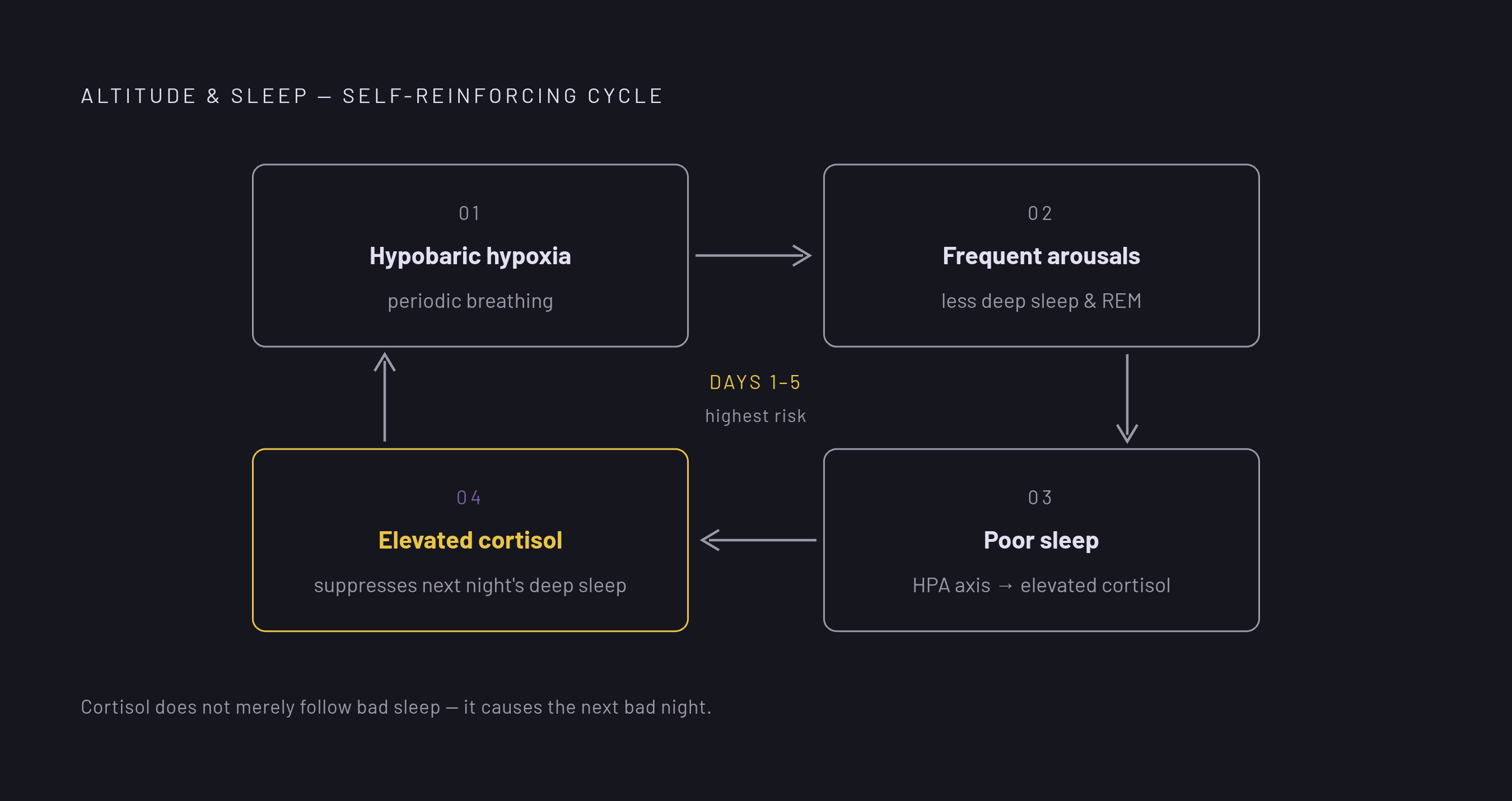
The problem can persist because broken sleep also affects the stress response. Poor sleep raises cortisol, and elevated cortisol can further suppress deep sleep. Insomnia patients typically show elevated cortisol, particularly in the evening and at sleep onset. Sleep fragmentation linked to the HPA axis, the body’s stress-response system, can both start and sustain this cycle.
At altitude, periodic breathing breaks up sleep again and again. If that disruption raises cortisol, it can make sleep harder the next time. The traveler then wakes with poorer executive function and a greater accumulated stress load. Instead of ending at breakfast, the night’s effects can carry forward into the following evening.
Sustained cortisol elevation can also disturb circadian rhythm and reduce the proportion of time in bed spent asleep. This feedback loop helps explain why night two or three may feel worse than the first. This feedback loop is a reason to treat the first several days, before acclimatization meaningfully improves sleep, as the highest-risk window for compounding disruption.
The target during that window is therefore broader than getting to sleep. Managing the cortisol response matters as well, because sleep and stress can keep worsening each other.
What behavioral strategies actually help during the high-risk adaptation window
The behavioral foundation begins before the first night at elevation. Getting full, high-quality sleep for at least three nights before ascending builds a reserve for the fragmented nights ahead. Gradual ascent then reduces the abruptness of the adjustment. Where the itinerary allows, “climb high, sleep low” means gaining elevation during the day and descending to sleep, reducing the hypoxic burden when breathing is most vulnerable.
Hydration helps with that plan because faster breathing at altitude makes the body lose more fluid, even as it feels less thirsty. Staying consistently hydrated helps prevent the blood-thickening that can make adjustment harder. Raising the upper body 4–6 inches at night can make breathing easier.
Controlled breathing at bedtime addresses the arousal that can accompany irregular breathing. Box breathing, extended-exhale patterns and 4-7-8 breathing are ways to help calm the nervous system. Their role is to lower the state of alertness around bedtime while the reduced oxygen that drives periodic breathing remains. Used with ascent planning, hydration and head elevation, they form a coordinated routine.
Severe headache, confusion, chest crackling, persistent vomiting or worsening symptoms require immediate descent and medical attention where applicable. These are not signs to manage with a better bedtime routine. When sleep is broken as the body adjusts, changes in habits can help, though some disruption may remain. The cortisol loop may still need attention.
Nutritional and compound-based support for sleep and cortisol management at altitude
The relevant distinction is between supporting sleep regulation and simply sedating the traveler. Traditional sleep medications can suppress respiratory function and worsen breathing irregularities at altitude. The compounds discussed here work on stress, relaxation or neural pathways. However, evidence for a mechanism or a benefit in another setting is not the same as proof that a compound restores performance at altitude.
Ashwagandha has clinical evidence relevant to the cortisol side of the problem. A double-blind, placebo-controlled trial in adults with chronic stress found that high-concentration ashwagandha root extract lowered serum cortisol by 27.9% and helped with sleep quality and stress-related symptoms. That result makes it relevant to the proposed stress-sleep loop. It does not establish the same reduction in travelers experiencing hypobaric hypoxia.
L-Theanine supports relaxation without respiratory suppression. It promotes alpha-wave brain activity in the 8–13 Hz band associated with calm, focused alertness and can reduce cortisol during stressful situations. Matcha combines L-theanine and natural caffeine in a single botanical matrix. Its proposed role here is alert energy with less of the jitter pattern associated with conventional caffeine sources, while restorative sleep remains necessary.
Lion’s Mane, or Hericium erinaceus, addresses the cognitive side through compounds associated with nerve growth factor expression. These include hericenones in the fruiting body and erinacines in the mycelium. Erinacines cross the blood-brain barrier and can support neuroplasticity in central nervous system tissue. That mechanism is relevant to cognitive recovery, but it does not demonstrate that Lion’s Mane reverses altitude-related impairment.
Magnesium, particularly in forms with good bioavailability, is a practical acute sleep-support option because it calms the nervous system and supports deep sleep without suppressing respiration. Its role differs from the longer-term stress or cognitive aims of the other compounds. Taken together, these options address distinct parts of the problem rather than functioning as a single proven altitude treatment. None removes the need for acclimatization, behavioral protection or descent when warning signs appear.
Why the format compounds are delivered in matters as much as which ones are chosen
The active compound must also reach systemic circulation, and the strain that altitude puts on the body can include reduced gut perfusion. That makes absorption relevant when the body is already adjusting to hypoxia. A label’s ingredient amount does not, by itself, tell the traveler how much becomes available in the body.
Standard capsules and powders can lose a proportion of active ingredients through digestion and first-pass processing. Liposomal formats wrap compounds in a lipid shell, while nanoencapsulation uses lipid or polymeric carriers. These approaches can protect delivery and improve absorption, with bioavailability of up to 98% reported for some applications. That upper figure may not hold for every compound or every finished formula, and greater absorption alone does not prove that a formula works better at altitude.
A formula with more than one ingredient is harder to make because the ingredients must stay compatible and stable. Strong delivery of one ingredient does not establish consistent delivery of all the others. The format needs to support the compounds actually present, regardless of the technical term used on the packaging. Faster onset and greater absorption matter only when those claims apply to the formulation.
Quality also extends beyond absorption. Third-party testing for contaminants, including PFAS, heavy metals and mycotoxins, is a meaningful signal for anyone taking a daily formula over weeks.
How to structure the days before, during, and after altitude travel to protect cognitive output
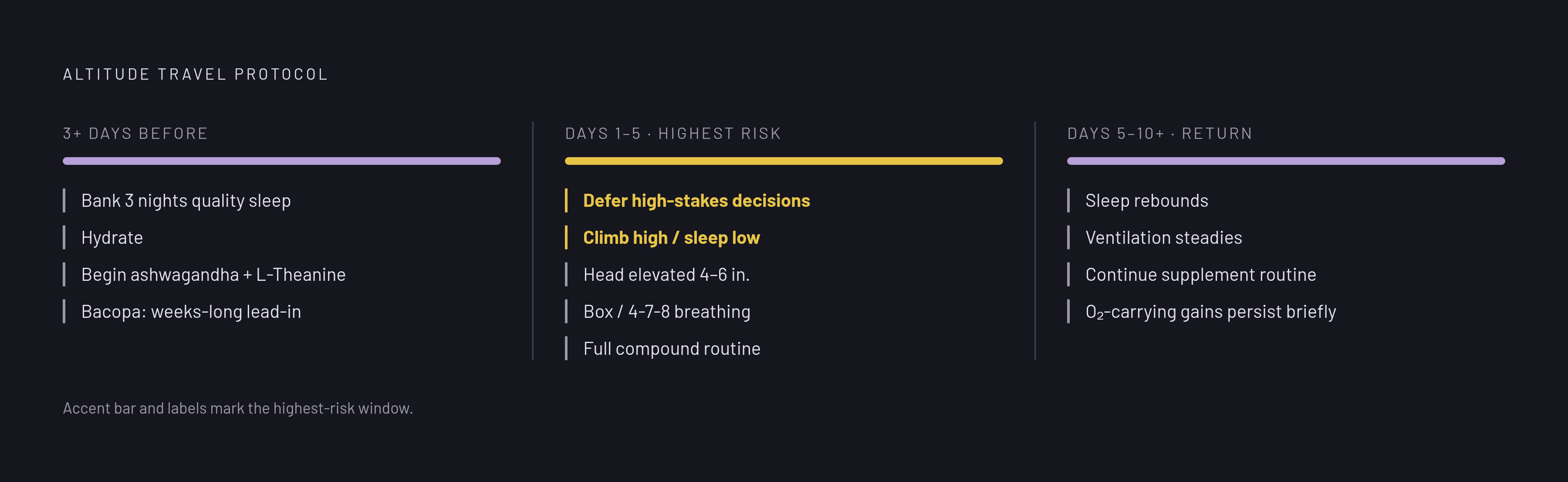
The practical plan has distinct phases because the body’s needs change across the trip. Three or more days before departure, the priority is to arrive without an avoidable sleep deficit. Bank full, high-quality sleep for at least three nights and arrive well-hydrated. If ashwagandha and L-Theanine are part of the chosen support plan, begin before the physiological stress starts rather than making the first disrupted night the starting point. Bacopa belongs to a longer lead-in because its stress-reactivity benefits emerge over weeks.
During days one through five, make the routine consistent. Use “climb high, sleep low” where possible, then pair head elevation with controlled breathing at bedtime. Manage temperature, ventilation and noise so that avoidable environmental disruption does not add to the hypoxic burden. Maintain the chosen daily compound routine, which may include ashwagandha, Lion’s Mane, magnesium and an L-Theanine/Matcha matrix, while treating delivery quality as part of the selection.
Keep cognitive demands realistic during days one through three and defer high-stakes decisions where possible.
During days five through ten and beyond, sleep can measurably rebound as acclimatization develops. Ventilatory adaptation becomes steadier with more time at altitude, but this does not ensure full cognitive recovery. Continued cognitive support therefore has a different purpose from getting through the first few nights. It remains a sustained support strategy while the effects of hypoxia may persist.
The return to sea level is another transition, particularly after a training camp or extended work trip. After the body has adjusted, gains in how the blood carries oxygen and how well the body uses it can last for a while, and sleep quality usually returns to normal quickly. Continuing the chosen daily cognitive support is intended to support that post-altitude window, although the adaptation itself should not be confused with a supplement effect.
The central performance edge is understanding what is happening. A phased plan protects rest, addresses the cortisol loop and keeps work demands aligned with the adjustment. That is a firmer basis for arriving or returning sharp than relying on how rested the traveler happens to feel.
Sources
- Sleep at high and extreme altitude—it’s not that bad
- A Meta‐Analysis of Multidimensional Cognitive Functions Changes in Different Intensities of High‐Altitude Hypoxia - Jiang - 2025 - Brain and Behavior - Wiley Online Library
- Early adaptation to high‐altitude: Mood and cognitive responses at simulated 4500 m - Bottura - 2025 - Physiological Reports - Wiley Online Library