Recovery Sleep After an All-Nighter for Knowledge Workers
Feeling rested comes first; sharp judgment takes several nights.
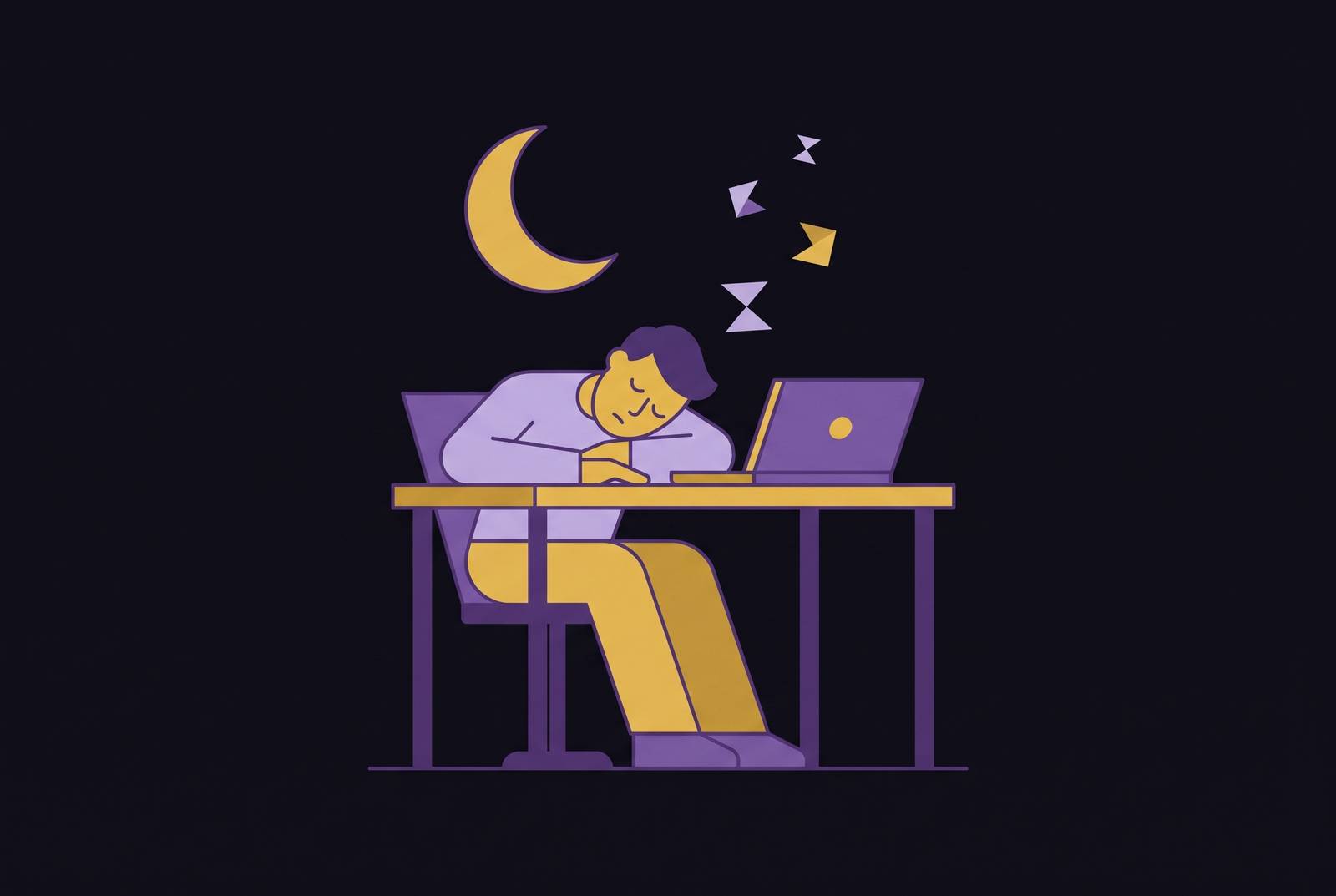
Recovery sleep after an all-nighter is not a one-night repair job for knowledge workers. A long sleep can restore the feeling of being capable before it restores the abilities that matter most at work. Plan several recovery nights and match the work between them to the functions that recover first, reserving high-stakes decisions until the abilities they require have recovered.
Why the all-nighter feels recovered before it is
Waking up after catch-up sleep can feel like being human again. The exhaustion has lifted, ordinary tasks seem manageable, and the obvious conclusion is that the damage is behind you. Sleep loss can also make it harder for the brain to judge how well it is working.
The prefrontal cortex helps with self-monitoring, error detection, and judgment. Research in participants whose total sleep was restricted by 33% throughout one week found that frontal brain regions were the first affected during reaction time tests. That was restricted sleep rather than a single all-nighter, but it exposes the problem with relying on self-assessment. Subjective sleepiness can plateau while objective impairment keeps accumulating. Feeling less tired is therefore useful information about how you feel, but weak evidence that your judgment has recovered.
What total sleep deprivation actually does to the working brain
An all-nighter disrupts several systems at once. The glymphatic system, the brain’s waste-removal network, is much more active during sleep than waking. Missing a night of sleep means missing the time when the brain clears away more metabolic byproducts, including beta-amyloid.
Different sleep stages also do different work. Slow-wave sleep, known as N3, concentrates tissue repair, immune strengthening, and declarative memory consolidation. It is the stage the brain most urgently rebounds toward during the first recovery night. REM sleep helps with emotional regulation, creative integration, and emotional memory consolidation, but takes longer to rebound. The functions a knowledge worker needs are therefore spread across sleep stages that do not recover together.
Memory has another point of vulnerability in the hippocampus, which is central to encoding new information. Sleep deprivation impairs its connectivity with prefrontal regions and the default mode network, degrading both encoding and retrieval. Elevated cortisol caused by sleep loss can further impair the hippocampus through a separate hormonal route. At the same time, sustained attention, reaction time, and emotional regulation are among the first abilities to get worse. Problem-solving may be more resistant, but verbal fluency is also meaningfully impaired, so being able to tackle one difficult problem does not establish that the rest of cognition is intact.
The recovery sequence: which cognitive functions return first, and which lag
The fastest rebound can happen before the first recovery night. Research on a two-hour nap after an all-nighter found increased alertness and performance, together with reversal of elevated cortisol. The improvement is limited to particular measures.
Ya Chai and colleagues’ 2020 fMRI study, “Two nights of recovery sleep restores hippocampal connectivity but not episodic memory after total sleep deprivation,” makes the distinction concrete. The study of 39 healthy adults found that hippocampal functional connectivity was close to normal after two nights of extended recovery sleep. Yet the same recovery period did not fully restore episodic memory performance. Functional connectivity is not the same thing as reliable memory performance.
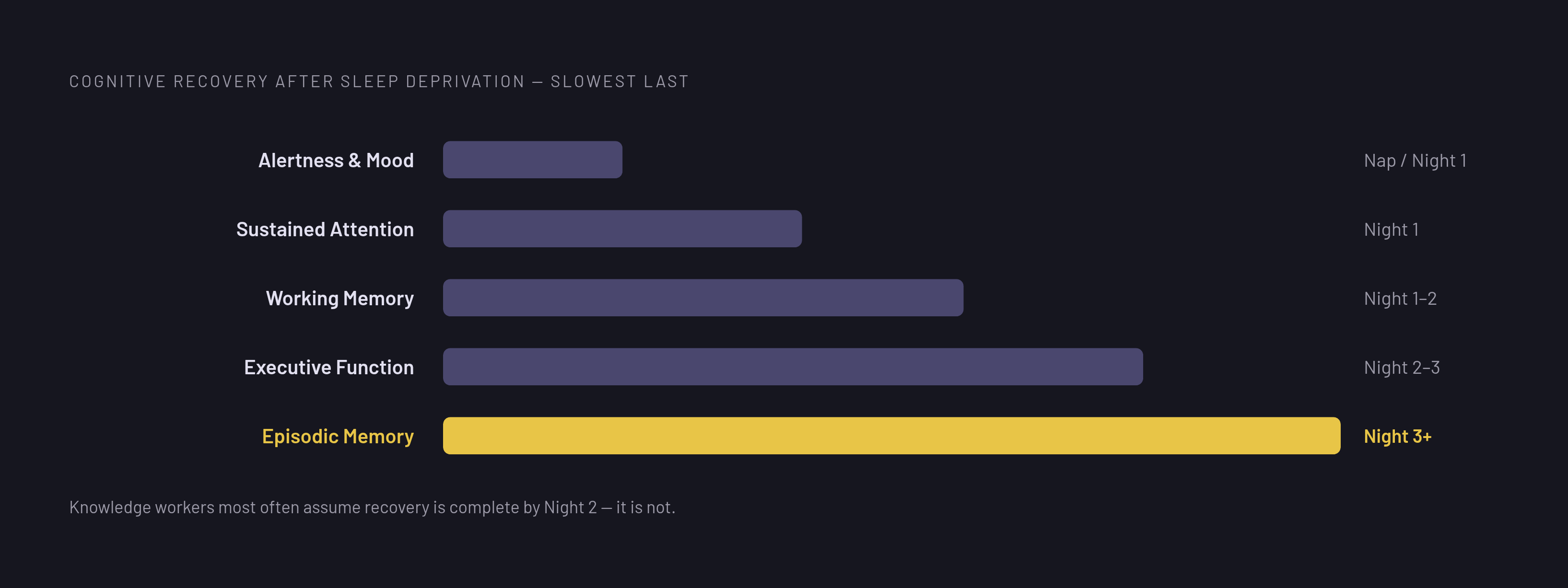
The practical recovery hierarchy starts with basic alertness and mood, followed by sustained attention and then working memory. Executive function and complex decision-making come later, with episodic memory and creative integration among the lagging abilities. These stages can overlap. Basic mood can get better before the more demanding work of emotional regulation returns to normal, and REM-dependent functions can still suffer while REM recovery catches up.
That sequence makes answering email a different proposition from reviewing a contract, making a hiring decision, or producing original strategic work. Research on attentional vulnerability also shows meaningful differences between people in how quickly performance returns. The timeline therefore serves as a planning guide that allows for individual variation in recovery.
Why one long sleep cannot compress multi-night recovery into a single event
Sleeping nine hours is not proof that recovery is complete. The first recovery night brings a pronounced slow-wave rebound as the brain prioritizes its most urgent physiological needs. But that rebound has limits. More time to sleep helps, but recovery still takes several nights.
Recovery follows a staged architecture. Slow-wave rebound dominates initially, then diminishes across subsequent nights as the pressure for sleep falls. REM normalization follows behind it. Because REM is concentrated in the final hours of a full sleep period, cutting recovery sleep short can disproportionately reduce the stage needed for emotional and creative functions. Even eight hours after an all-nighter is not automatically enough for every person or every cognitive measure.
Timing matters as well as duration. The pressure to sleep interacts with circadian timing, so a long daytime sleep may improve some measures while disrupting the timing needed for the nights that follow. Sleep is not a tank that can be filled whenever the calendar has a gap. Protect a series of nights with enough sleep at the same times, so recovery has more than one marathon sleep to work with.
A multi-night recovery protocol mapped to cognitive function, not just hours
For Night 1, aim for nine or more hours in bed, beginning at a consistent, biologically appropriate time. The goal is to give slow-wave rebound room to do its most urgent work, without pushing bedtime back for social obligations or screens. On the day leading into that night, keep work routine and low-stakes. Complex analysis, high-stakes decisions, and creative problem-solving call on abilities that are still weakened.
If the schedule allows, a nap of around two hours early in the afternoon can help improve alertness and reverse the acute cortisol rise before Night 1. Napping late risks interfering with nighttime sleep onset, which would undermine the next step in recovery. Stop having caffeine at least six to eight hours before the time you plan to go to bed. Keeping daytime coping from borrowing against the night takes priority over squeezing the greatest possible output from the day.
For Night 2, aim for eight to nine hours and keep going to bed and waking up at the same times. This gives REM recovery more room, with hippocampal connectivity approaching near-normal levels by the end of the night in the fMRI study. Sustained attention and working memory should be closer to working well at this stage. Even so, it is still better to put off high-stakes judgment calls, complex negotiations, and work that calls for large amounts of new information. The memory findings make that restraint more than an exercise in caution.
For Night 3 and beyond, aim for seven to nine hours with consistent timing. Episodic memory and higher-order executive function continue to normalize, and creative integration and complex decision-making should be more reliable by day three. Returning to the full cognitive workload is appropriate for most knowledge workers at that point, though some will need an additional night. On every recovery night, keep the place where you sleep dark and cool, and avoid blue light in the hour before bed. These conditions support the melatonin timing that anchors circadian recovery.
Managing the recovery days: what to do with compromised cognition during working hours
The days between the all-nighter and recovery call for sequencing tasks, with work possible during recovery. Day 1 is for email triage, scheduling, and administrative work that does not require original thinking or consequential judgment. Day 2 can include tasks that need sustained attention and structured analysis that has a framework in place. Day 3 is the point for returning to full-complexity work, allowing for individual lag.
Caffeine can support alertness during those days, but attention support is not sleep replacement. A double-blind, placebo-controlled crossover study published in British Journal of Nutrition tested a high-dose L-theanine–caffeine combination in young adults who were acutely sleep-deprived. It found that people were more accurate at spotting hazards and had faster neural responses, measured as reduced P3b ERP latencies. Reaction time improved in both groups, with a greater improvement for the combination than placebo. Those findings concern selective attention.
L-theanine increases alpha brain wave activity associated with calm, focused attention within 40 to 60 minutes of ingestion and can moderate caffeine’s stimulating effect. Combining L-theanine at roughly twice the caffeine dose is an option for supporting alertness with less jitter. Ceremonial-grade matcha supplies both compounds naturally, although that does not make it equivalent to the high-dose combination tested in the study. Keep total daily caffeine under 400 mg and stop it six to eight hours before the target sleep time. Protecting the next night matters more than extending the stimulant effect.
Other cognitive-support compounds operate on a different timetable. A 2025 study published in Biomolecules found that ashwagandha extract considerably reduced elevated corticosterone under sleep deprivation conditions in rats. That is a finding about a stress hormone in an animal study. Rhodiola Rosea appears more useful for fatigue-related cognitive decline than for sharpening cognition in rested people. Both compounds operate on a multi-week accumulation timeline for durable benefit, so neither belongs in the role of an emergency fix.
Combining matcha, L-theanine, Ashwagandha, Lion’s Mane, or Cognizin® does not establish that the finished product restores cognition after an all-nighter. Evidence about particular ingredients and attention measures is narrower than that claim. Any such routine remains support around recovery, which depends on the nights that produce it.
Do not use alcohol to wind down, because it fragments sleep architecture and suppresses REM. Do not use a large caffeine dose to force a full complex workload, because delayed sleep onset undermines recovery. Above all, do not treat the absence of tiredness on Day 2 as proof that the process is finished. The self-monitoring blind spot is precisely why the work plan needs to outlast the feeling of exhaustion.
The longer view: why repeated all-nighters have structural, not just functional, consequences
A single all-nighter calls for recovery, but repeated all-nighters change the scale of the problem. Chronic sleep deprivation and poor sleep quality are linked to disruptions in BDNF, a protein that modulates the cellular machinery of synaptic plasticity. That includes strengthening existing connections and supporting the formation of new ones, as well as hippocampal health. Chronic stress and poor sleep are also associated with measurable reductions in hippocampal volume.
Consistent deep sleep also supports the glymphatic clearance of beta-amyloid. Repeatedly skipping that maintenance period is therefore more than a short-term exchange of sleep for working time. The long-term frame is preserving the systems that make learning and memory possible. Recovery habits matter because those are the same systems a knowledge worker expects to depend on throughout a career.
Evidence for additional cognitive support remains early. An eight-week human trial of 109 adults aged 40 to 75 who reported having cognitive difficulty found that visual attention, working memory, sleep, and mood were better with Lion’s Mane than with placebo. The reported results come from a preprint, and they do not establish recovery from an all-nighter. Recovery is possible, but protecting the next several nights, and the pattern that follows, is what makes it dependable.
Sources
- Two nights of recovery sleep restores hippocampal connectivity but not episodic memory after total sleep deprivation
- Interindividual differences in attentional vulnerability moderate cognitive performance during sleep restriction and subsequent recovery in healthy young men
- NREM sleep brain networks modulate cognitive recovery from sleep deprivation