Overtraining Syndrome and Sleep Quality Degradation in Athletes
How overtrained cortisol wrecks sleep, and sleep loss deepens it.
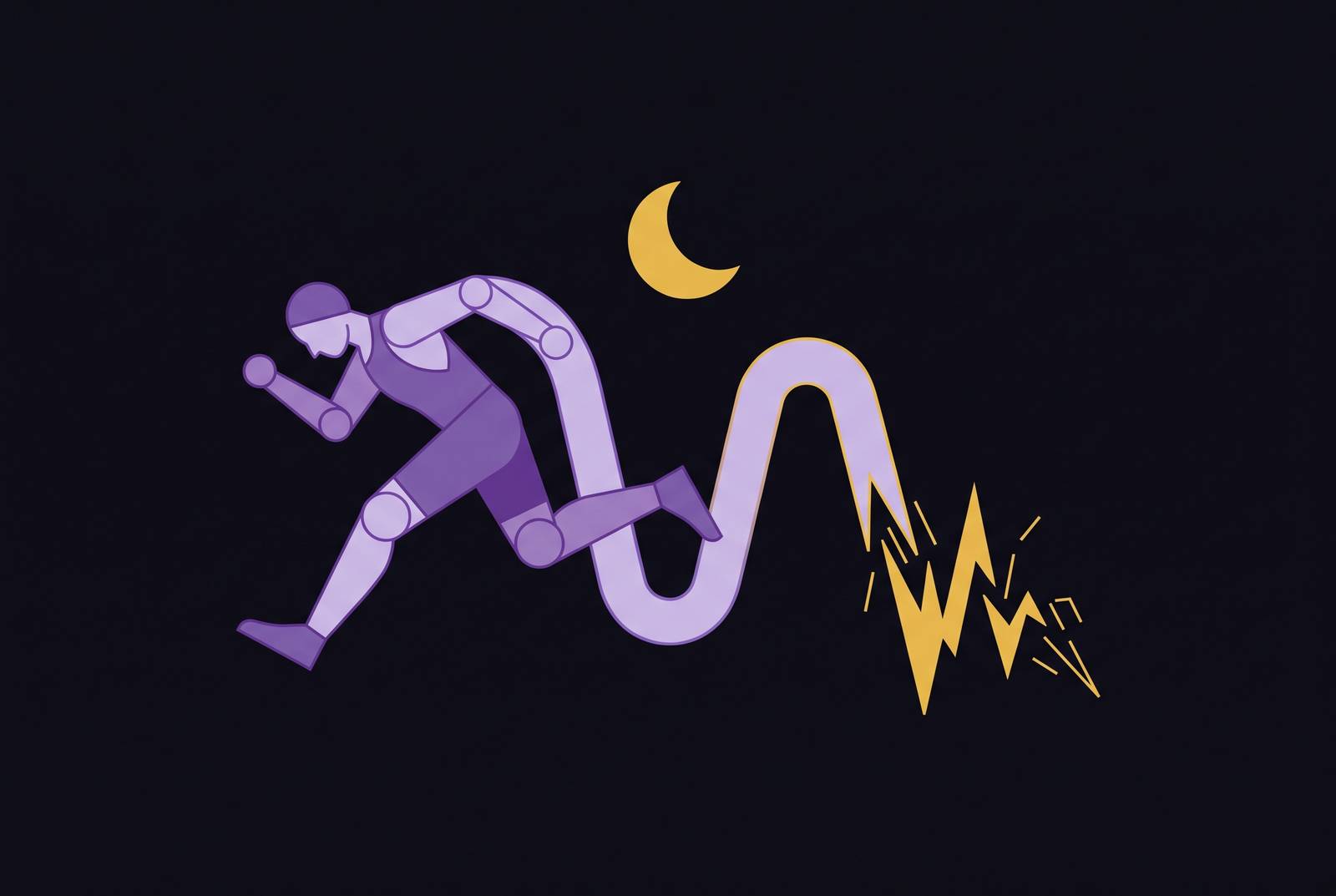
Overtraining syndrome is what happens when the body's stress-response system, run through the hypothalamic-pituitary-adrenal (HPA) axis, breaks down under the weight of recovery debt that never gets repaid. The distinction matters because it changes what athletes and coaches are actually managing: not a volume number on a spreadsheet, but a hormonal system that has lost its capacity to respond.
In healthy training, the HPA axis works the way it's supposed to. A hard session triggers a rise in ACTH (adrenocorticotropic hormone) and cortisol, and that rise is what drives adaptation: muscle repair, metabolic adjustment, the whole apparatus of getting fitter. Functional overreaching is the first sign that something is off. At this stage, the cortisol response starts to blunt even as ACTH stays elevated, a dissociation between the signal and the response that marks the beginning of neuroendocrine strain. If you push through that stage long enough, ACTH and cortisol responses decline together. That is full OTS: the adrenal glands have lost sensitivity, and the HPA axis can no longer mount the response training requires.
The EROS study gives this a measurable signature. Mean cortisol measured shortly after waking was substantially higher in healthy athletes than in athletes diagnosed with OTS. The morning cortisol curve is a number that separates a functioning stress-response system from one that has stopped working.
None of this requires an athlete to be training at some extreme volume. Inadequate sleep, poor nutrition, and psychological load all add to the same burden, and the HPA axis has to absorb it. OTS is the product of total stress exceeding total recovery, and sleep sits at the center of both sides of that equation.
How a dysregulated cortisol axis actively destroys sleep architecture
Cortisol does not just respond to training stress. It also regulates the body's circadian rhythm, so a dysregulated cortisol axis doesn't sit quietly alongside poor sleep in an overtrained athlete. It causes it. When cortisol stays elevated or starts firing at the wrong times, it disrupts the normal cycling of melatonin, and this is visible in delayed sleep onset, fragmented sleep through the night, and reduced sleep efficiency overall.
The stakes of that fragmentation become clear once you look at what sleep is supposed to deliver. Growth hormone, essential for physical recovery, memory consolidation, and emotional regulation, is released as sleep cycles between non-REM and REM stages, with the largest secretory burst occurring during slow-wave sleep. That release depends on an athlete reaching and sustaining that deep stage of sleep. Fragmented sleep, driven by a cortisol axis that won't settle, cuts that process short before it can do its work.
Patel and colleagues, writing in Cureus in 2024, documented what follows from that interruption: reduced glycogen stores, impaired clearance of metabolic byproducts, and disrupted growth hormone release. These are physical consequences with a cascading effect on recovery, not complaints about feeling tired. Sleep disturbance is already one of the most frequently reported symptoms among athletes experiencing overreaching and full OTS, and that fact alone reveals something important about the shape of the syndrome: it produces the very impairment that would otherwise allow an athlete to recover from it.
The swimmer data put a number on the gap. Research on overreached versus non-overreached swimmers found sleep efficiency near 95 percent in the non-overreached group, with overreached swimmers running substantially lower. The same body of research also linked slow-wave sleep percentage directly to swimming performance, so sleep quality became a competitive outcome, not just a background variable. The arrow at this stage runs one direction: OTS disrupts cortisol regulation, and disrupted cortisol regulation destroys sleep.
How poor sleep accelerates the progression toward OTS
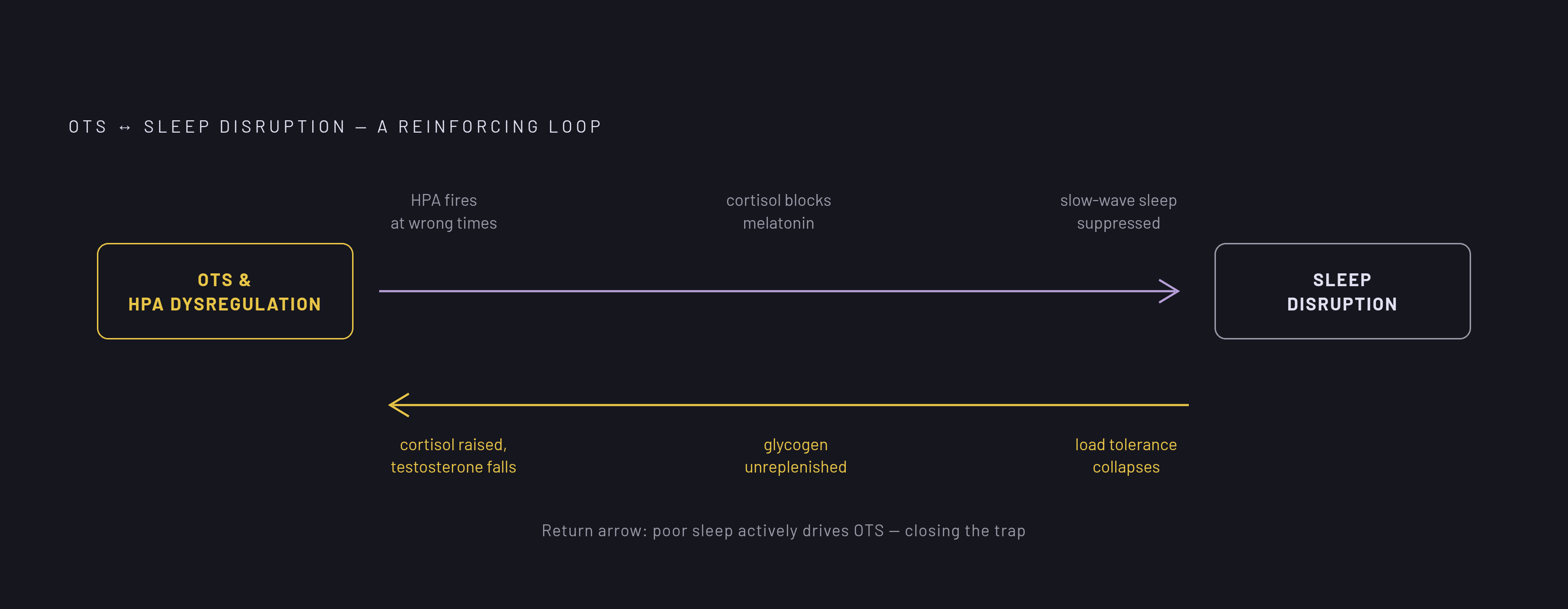
The loop closes when poor sleep, instead of remaining a downstream symptom, begins acting as its own cause. Sleep loss does more than slow recovery down. It actively worsens the neuroendocrine and metabolic conditions that define OTS in the first place, building a trap that gets harder to exit the longer an athlete stays in it.
Several mechanisms drive that return arrow. Sleep deprivation raises cortisol, lowers testosterone production, and impairs glycogen replenishment, undercutting the exact adaptations that a full night of sleep was supposed to lock in. It also suppresses immune function, raising susceptibility to illness, which forces training interruptions and adds a fresh layer of physiological stress on top of what the athlete was already carrying. Perhaps most directly: inadequate sleep lowers the body's tolerance for the next training load. A session that would have been perfectly manageable on a full night's sleep becomes, without it, an overreaching stimulus in its own right. Training load and sleep efficiency move together in a documented dose-response relationship, where rising training load drives sleep efficiency down and fatigue up, and the loop then amplifies that decline on the next cycle.
Injury risk rides on the same mechanism. Research from Milewski and colleagues in 2014 found that athletes who sleep fewer than eight hours a night face a meaningfully elevated injury risk. Even a one- to two-hour reduction in nightly sleep impairs neuromuscular response speed, the same mechanism that links sleep debt to both injury and the slow erosion of skill execution under fatigue. Poor sleep is one of the engines driving the syndrome forward, not a problem that sits beside OTS as a parallel track.
Three clinical cases of full OTS when the loop goes unbroken
A 2025 case series published in BMJ Case Reports, led by Kreher and colleagues, followed three endurance athletes through full-blown OTS: one professional runner, one competitive runner, and one recreational runner. The progression described in each case moved from something that read as confusing and annoying into something life-changing and debilitating.
One athlete had been running over 100 miles a week in training. At the lowest point of the illness, that same athlete could not jog a single mile slowly. Any exercise attempt triggered migraines severe enough to require days of bed rest. Restful sleep was no longer achievable, and the athlete's own ability to think and speak clearly broke down along with it.
Recovery did not start with a training plan. It started with basic wellness: resolving brain fog and stabilizing mental clarity before any return-to-sport protocol could even begin. Two of the three athletes made it back to full competition. The third, as of the case series' publication, remained in an active recovery protocol roughly 22 months after diagnosis, with relapse indicators identified but no definitive return-to-sport protocol yet established in the literature.
The case series makes a point beyond the individual outcomes: OTS is frequently misdiagnosed, even by experienced clinicians, because its earliest signals look like ordinary training fatigue and get explained away as such. That diagnostic blind spot makes the next question, how to catch the loop before it reaches this point, the one that matters most.
Sleep quality as the most accessible early warning signal for OTS
Sleep sits on both sides of the loop, acting as a driver of HPA-axis dysregulation and a product of it. That dual position is what makes a decline in sleep quality something more than a late symptom of OTS. It marks the beginning of the loop itself, and an athlete who tracks it has a real chance to intervene before the syndrome takes hold.
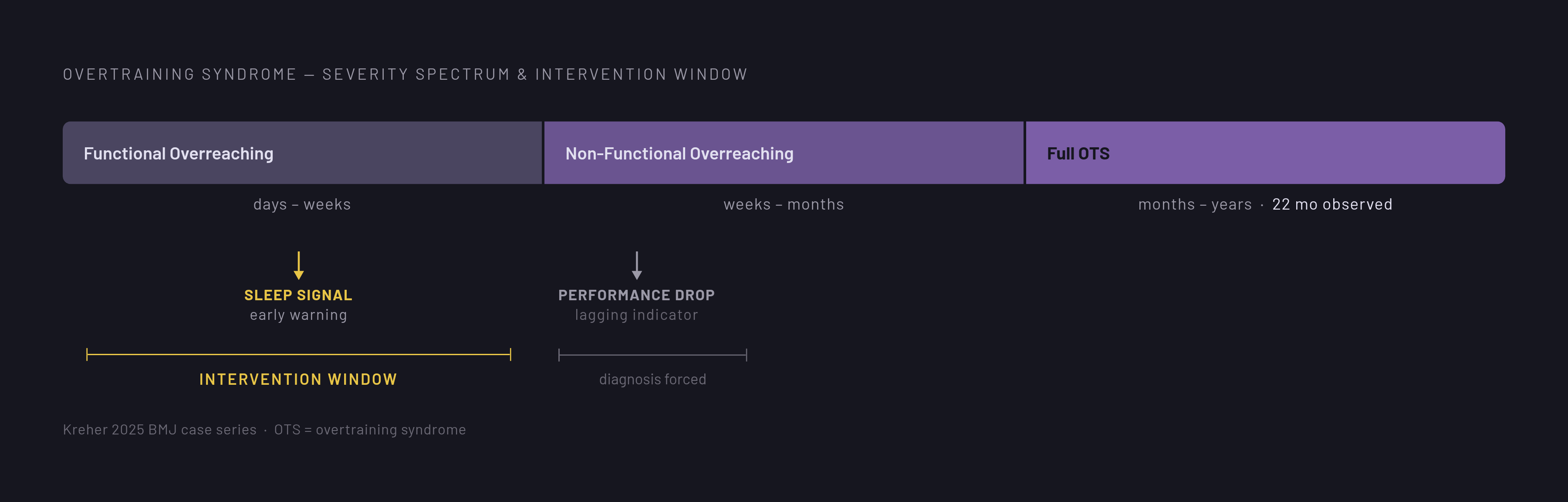
Performance decline, the marker most commonly used to flag OTS, is a lagging indicator by nature. Because this marker lags, substantial physiological damage has usually already built up by the time it shows up in race times or competition results. Sleep metrics move earlier. You can track sleep efficiency, sleep duration, and the presence of slow-wave sleep through wearable devices or a straightforward subjective report, with no clinical testing needed.
The timing distinction carries real consequences. Functional overreaching is recoverable within days to weeks. Non-functional overreaching can take weeks to months to resolve. Full OTS can take months to years, as the Kreher case series shows. Catching a decline in sleep quality at the overreaching stage is what separates a brief recovery block from a prolonged medical withdrawal. ACE's clinical guidance on OTS frames the response in three steps: assess, address, adapt, treating early identification as the primary lever for intervention.
Cognitive and physical performance data once the loop is established
Once the loop is running, the damage does not confine itself to endurance metrics. It reaches into cognitive and neuromuscular territory that determines how an athlete performs under real competitive pressure.
Reaction time offers one of the clearest examples. Cognitive fatigue and poor sleep quality each independently predict slower reaction time in athletes, and the two effects compound rather than cancel each other out or substitute for one another. A 2026 systematic review went further, finding that impairments in cognitive inhibitory control, the capacity to suppress an inappropriate response under pressure, appear specifically in athletes with full OTS, not simply those in an overreached state. That distinction matters for diagnosis: a cognitive marker this specific gives clinicians something firmer than self-reported fatigue to work with.
Physical performance follows a similar path. Sleep deprivation reduces output across strength, power, and endurance, while raising cortisol and lowering testosterone, directly working against the hormonal environment that training is meant to build. The clearest demonstration of what can be recovered comes from a sleep extension study conducted on a college basketball team at Stanford. Over five to seven weeks of substantially extended sleep duration, sprint times improved, free throw accuracy rose by nine percent, and three-point shooting accuracy rose by nine percent as well. That reversal confirms something important about the losses documented in OTS and sleep-deprived athletes generally: a meaningful share of them trace back to recoverable sleep debt, not permanent physiological damage.
Breaking the loop: recovery sequencing, sleep restoration, and stress-modulating support
Breaking the OTS-sleep loop takes more than rest. You have to restore HPA-axis function and sleep architecture at the same time, because rest alone cannot do its job if the neuroendocrine signals that enable deep, recovery-quality sleep are still dysregulated.
The Kreher case series offers a sequencing lesson that's easy to miss. Full recovery needed baseline general wellness resolved first, including brain fog and mental health challenges, before any physical return-to-sport protocol could start. Sleep restoration wasn't a parallel track running alongside physical rehabilitation; it came first. The practical implication follows directly: treating OTS purely as a training-load problem, and prescribing rest without addressing sleep quality itself, produces an incomplete recovery and raises the odds of relapse.
Ashwagandha has direct evidence behind it as a cortisol-stabilizing tool in this context. In a 2026 randomized controlled trial published in Nutrients, pre-season team sport athletes got 600 mg per day of ashwagandha root extract over 42 days. Salivary cortisol stabilized in the female athletes studied, while the placebo group saw a significant cortisol increase over the same period; perceived recovery and muscle soreness (DOMS) both improved, and male athletes showed significant gains in countermovement jump performance. A 2025 systematic review and meta-analysis in BJPsych Open backed this up with a broader statistical finding: significant cortisol reduction and a sleep improvement signal, strongest at doses of 600 mg per day or more sustained for at least eight weeks. The proposed mechanism runs through GABAergic activity, the same pathway involved in initiating sleep. Cortisol changes take four to eight weeks to register on lab tests, so the timeline fits a sustained training block, but it rules ashwagandha out as anything resembling an acute fix.
The cognitive inhibition impairments documented in full OTS point toward a deficit in neuroplasticity, and a few specific compounds have evidence addressing that angle. Lion's Mane stimulates production of NGF and BDNF, the proteins the brain relies on to build and maintain synaptic connections, and a 2025 systematic review of five randomized controlled trials in Frontiers in Nutrition found cognitive score improvements on a similar four-to-eight-week timeline. Bacopa Monnieri, dosed at 300 to 450 mg of standardized extract over a course of weeks, improves delayed recall and working memory accuracy and lowers salivary cortisol during acute cognitive challenge; under chronic stress, rodent studies show it preserves BDNF levels in the hippocampus and cortex. Rhodiola rosea reduces oxidative stress, restores mitochondrial energy function, and raises BDNF even under ongoing stress, with the fastest onset among these three and evidence of reduced mental fatigue across most of the trials that have tested it.
Signals athletes and coaches can monitor to catch the loop early
The most useful consequence of understanding this mechanism as bidirectional is practical: OTS can be detected before it becomes OTS, and the signals to watch follow directly from the biology described above.
On the sleep side, declining sleep efficiency or duration during a block of intensified training is the earliest marker to watch, with the swimmer data making efficiency especially sensitive to catch. Loss of slow-wave sleep percentage, now trackable through consumer wearables, predicts competitive performance independently of total sleep duration. Difficulty falling asleep despite genuine physical fatigue is a specific tell pointing to cortisol-driven circadian disruption.
Cognitive and mood changes travel alongside the sleep decline. A 2026 systematic review documented alterations in mood, stress perception, burnout, and fatigue among elite athletes experiencing non-functional overreaching or full OTS, establishing these as legitimate early psychological markers. Slower reaction time and fraying concentration appear in training sessions well before any drop-off occurs in competition results.
Training load data adds a layer of physiological corroboration. The Lundstrom research found elevated resting heart rate, along with elevated exercise heart rate at submaximal effort, so a coach does not have to rely on an athlete's subjective sleep report alone to link sleep debt to average exercise heart rate. The monitoring logic follows the mechanism itself: because the loop runs in both directions, any two of these signals appearing together, worsening sleep alongside elevated perceived stress, or sleep debt alongside a climbing exercise heart rate, should prompt a reduction in training load before performance decline forces the diagnosis.
Sources
- (PDF) The Impact of Inadequate Sleep on Overtraining Syndrome in Male and Female College Athletes 18–22 Years Old: A Literature Review
- The Impact of Inadequate Sleep on Overtraining Syndrome ...
- Overtraining Syndrome (OTS) in Three Endurance Athletes and Roads to Recovery - PMC
- Sleep Quality Impacts Training Responses and Performance in Elite Swimmers - PMC
- Can Sleep Be Used as an Indicator of Overreaching and Overtraining in Athletes?
- The Impact of Inadequate Sleep on Overtraining Syndrome in 18-22-Year-Old Male and Female College Athletes: A Literature Review
- ACE - Certified™: November 2025 - Overtraining Syndrome: Assess, Address, Adapt