Pre-Competition Sleep Protocols for Elite Athletes
Why race-week sleep collapses, and how to prepare weeks ahead.
The night before the biggest race of the year is, reliably, one of the worst nights of sleep an elite athlete will have. That is not a coincidence of nerves or a personal failing in discipline. Sports science documents that a large majority of athletes report sleep quality the night before competition that falls well below their normal baseline, and the pattern holds across sports, levels, and cultures. What makes pre-competition sleep different from ordinary poor sleep is the way its causes arrive together, compounding each other.
That convergence collides with a cruel structural fact: race week is precisely when sports science recommends the most sleep, not the least. The taper phase calls for 8 to 9 hours a night at the exact moment anxiety is most likely to fragment sleep architecture. An athlete is being asked to sleep better during the one stretch of the season when sleeping well is hardest. A systematic review of elite female athletes found that subjective sleep complaints are common before competition, even when an athlete's objective, habitual sleep quality is otherwise solid. Decent sleepers, by every normal measure, can still fall apart the night before it matters. That gap between habitual competence and pre-event collapse is the real subject of this piece, and it is why generic sleep hygiene advice, useful as it is for ordinary insomnia, cannot solve a problem built from training load, travel, anxiety, and biology layered on top of each other in a single compressed week.
What sleep deprivation costs an athlete on race day
The cost of a bad night before competition is not marginal, and it does not confine itself to one system. A 2025 systematic review and meta-analysis in Frontiers in Physiology found that sleep deprivation significantly impairs aerobic endurance, explosive power, maximum force, and speed, hitting the physical foundations of performance across the board. The same analysis found that performance losses are especially pronounced in afternoon assessments, a detail with direct relevance for any athlete whose event falls later in the day.
The damage extends past the muscular and cardiovascular systems into the cognitive and psychological territory that precision sports depend on. Focus, reaction time, strategic thinking, and fine motor control all draw on the same reserves that a sleepless night depletes. Sleep-deprived athletes also report that identical workloads feel harder, a shift in perceived exertion that happens independent of any change in actual output and that quietly undermines pacing and tactical judgment over the course of an event.
The inverse case makes the stakes vivid. Sleep extension stands as one of the highest-return interventions available in sport, and its ceiling is what pre-competition anxiety threatens to take away.
How cortisol creates the pre-competition sleep trap
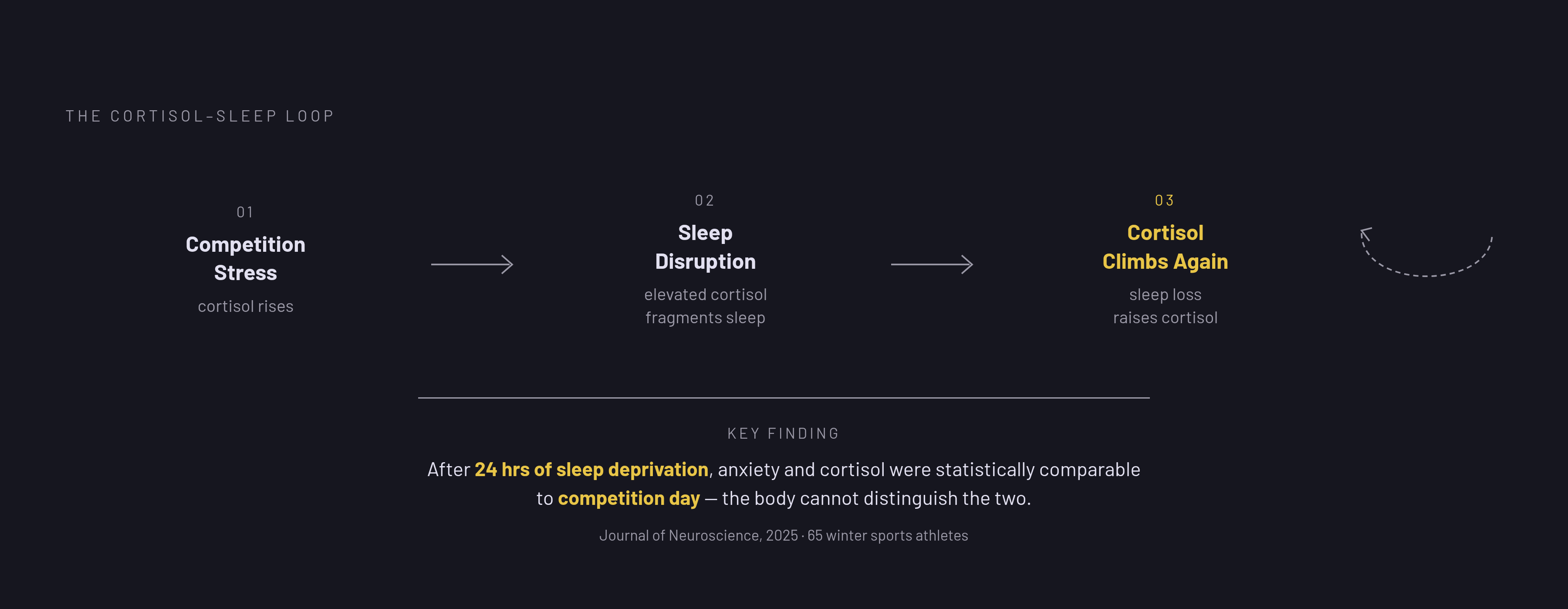
Cortisol is the biological reason this problem resists willpower. A 2025 multivariate analysis in the International Journal of Research in Medical Sciences identified high cortisol as a significant, independent risk factor for poor sleep quality in athletes, separate from anxiety, travel, or training load. Cortisol is not a side effect of pre-competition sleeplessness; it is the mechanism driving it.
The cycle runs in one direction and feeds itself. Competition stress raises cortisol, elevated cortisol disrupts sleep, and the resulting sleep loss raises cortisol further. A 2025 study in the Journal of Neuroscience followed 65 winter sports athletes and found that anxiety and cortisol levels after 24 hours of sleep deprivation were statistically comparable to levels recorded at official competition. The body cannot distinguish a sleepless night from the day of the event itself; it responds to both as the same stressor. That cascade does not stop at sleep. Insufficient sleep suppresses anabolic hormones, including testosterone and growth hormone, while promoting pro-inflammatory signaling, adding recovery debt on top of a night already lost.
The pattern is visible in competition itself, not only in laboratory measures. One modifiable lever stands out inside this cortisol story: light. Light timing operates as a mechanistic target in its own right, not merely a proxy for avoiding screens at night.
Why the solution has to span weeks
Because cortisol builds gradually and circadian rhythms shift slowly, the night before competition is the last place an effective intervention can begin. By the time an athlete lies awake at midnight before a race, the window for changing the outcome has mostly closed. The protocols that work treat sleep as a physiological foundation built over weeks, not a problem solved in a single evening.
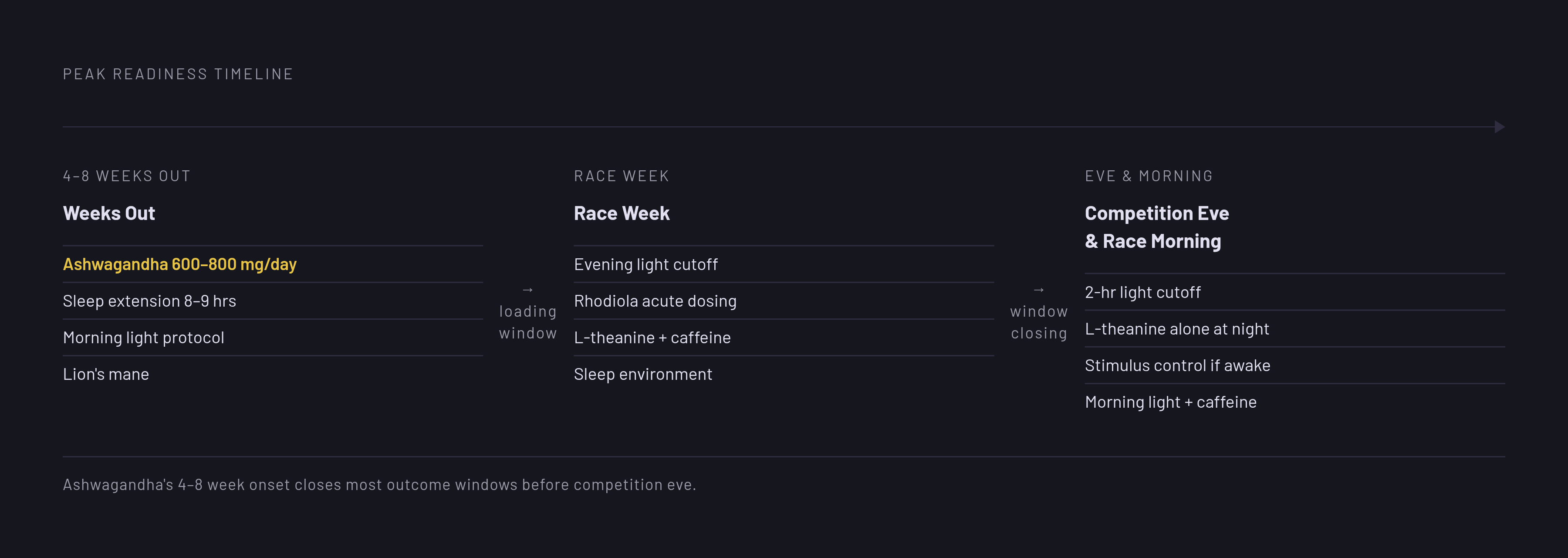
Ashwagandha illustrates the point precisely. The adaptogens that blunt cortisol meaningfully need four to eight weeks of consistent use before they produce measurable change, so you use them for chronic preparation, not as night-before supplements. None of this narrows the window of opportunity. It expands it, by giving athletes weeks instead of hours to work with.
The weeks-out phase: building the sleep foundation before race week arrives
The weeks-out phase is where an athlete has the most leverage, because the interventions that matter here, biological, behavioral, and nutritional, compound by the time race week actually arrives. Several tracks run concurrently.
Sleep extension comes first as a deliberate practice. The target during normal training blocks is 8 to 9 hours a night, with a banking attempt, aiming slightly higher, in the final one to two weeks before the target event. Consistency of bedtime and wake time anchors circadian rhythm, and if sleep timing around rest days versus competition days goes irregular, it disrupts that rhythm, so athletes can hold a fixed schedule to keep it in check.
Morning light exposure belongs in this phase as a scheduled protocol step, not a lifestyle suggestion left to chance. The same research ties higher morning and daytime light exposure to longer total sleep time and better subjective sleep quality, so you should treat a morning light session, outdoors or through a light therapy device, with the same seriousness as a training session on the calendar.
Adaptogen loading forms the cortisol-management layer of the weeks-out plan. Ashwagandha, at doses around 600 to 800 milligrams per day, has been shown to blunt cortisol increases following intense exercise, but its onset runs four to eight weeks, which makes early initiation essential. Rhodiola is permitted by sports regulators.
Cognitive and neuroplasticity support rounds out the weeks-out stack. A 2025 systematic review in Frontiers in Nutrition confirms its cognitive-enhancing properties, but a separate 2025 literature review in Quality in Sport notes that direct evidence tying lion's mane to athletic performance metrics still needs further, well-designed human trials. A double-blind randomized controlled trial of lion's mane extract did demonstrate acute cognitive effects, including improved reaction time and better performance on the Stroop task, a measure of processing speed and response inhibition relevant to any athlete whose event demands both physical output and attentional precision.
Pre-sleep nutrition remains the newest frontier in this phase. A trial at Florida State University (NCT06102460, with a primary completion date of March 2025) looked at how pre-sleep milk-derived protein affects sleep quality and recovery in elite female athletes, and it is one of the first controlled trials to target pre-sleep nutritional protocols in elite women's sport. The signal is promising but still emerging, and athletes should treat it as a habit worth establishing in training.
Race-week protocol: managing the taper paradox and pre-competition anxiety
Race week calls for a different operating mode than the weeks-out phase. The goal is no longer building sleep capacity; it is defending the capacity already built against the cortisol spike, the schedule disruption, and the anxiety that all converge in the final days before competition.
Evening light discipline becomes non-negotiable in this window. The same research linking evening light exposure to poorer sleep behaviors applies directly here: increased light exposure in the hours before bed during race week is tied to greater sleep disturbance, which makes blue-light and ambient-light management a protocol requirement. That discipline has to extend past phone screens to hotel room lighting, team facility lighting, and the lighting in warm-up venues, all of which an athlete rarely controls but can still manage.
Rhodiola earns its place specifically in this window because of its acute profile. A single dose can produce measurable anti-fatigue and cortisol-modulating effects within hours, which matters on nights three, two, and one before competition in a way that ashwagandha, already doing its slower work from the weeks-out loading phase, cannot.
During the day, the pairing of L-theanine and caffeine serves as a race-week cognitive tool, not a sleep aid. Combined with caffeine, L-theanine suppresses caffeine-induced awakenings, as shown by EEG measurement, so the pairing sustains daytime alertness without fragmenting the night's sleep the way caffeine alone can. A January 2026 randomized, double-blind, placebo-controlled crossover study in Frontiers in Nutrition, led by Tuncer and colleagues, examined isolated and combined caffeine and L-theanine supplementation on maximal strength, intermittent aerobic endurance, and eye-hand coordination in competitive athletes. Matcha offers a naturally occurring vehicle for both compounds, with antioxidant co-factors alongside them.
Sleep environment standardization matters as much as any supplement during a week that often involves travel. Portable blackout solutions, earplugs, and white noise normalize unfamiliar venues, and holding a wake time equivalent to the one used at home anchors the circadian rhythm even when every other cue around the athlete has shifted.
Anxiety management belongs inside the sleep protocol itself, not alongside it. The air-rifle shooter study found that sleep quality scores correlated positively with both cognitive and somatic anxiety and negatively with self-confidence and energy, so sleep and psychological state work as a bidirectional loop. If you journal anticipated race scenarios or run a brief breathing protocol before sleep, you reduce cognitive arousal without any pharmacological intervention, and you address that loop directly.
Competition-eve and race-morning: what the protocol looks like in its final hours
The night before competition is the time to execute, with precision, the protocol built over the preceding weeks, not to introduce anything new.
The evening sequence starts with a light cutoff: ambient light dimmed at least two hours before the target sleep time, built on the same mechanism established earlier in the research. L-theanine, taken alone and without caffeine, can support relaxation and sleep quality through its effect on alpha wave activity, a distinct late-evening use from the daytime L-theanine and caffeine pairing used earlier in race week. A short, predictable cognitive wind-down routine, established well before competition eve, closes the sequence; its value lies in its familiarity, since a predictable ritual signals safety to the nervous system in a way a new or unfamiliar one cannot.
Sleep still may not come easily, and the protocol accounts for that. Stimulus control offers a concrete response: an athlete lying awake for more than 20 minutes should leave the sleep environment briefly, preventing the bed from becoming associated with wakefulness. Reframing also plays a role. When athletes understand that a single bad night has limited acute impact on performance, and that weeks of banked sleep provide a buffer against it, they report lower pre-competition anxiety in practice.
Race morning closes the protocol. Morning light exposure immediately upon waking, outdoors where possible, re-anchors cortisol's natural morning peak to a functional role, keeping it from becoming an anxiety driver. The L-theanine and caffeine pairing, whether through matcha or a formulated combination, returns here as a jitter-free alertness tool, timed to reach peak plasma concentration ahead of warm-up. Rhodiola's acute anti-fatigue action makes it a rational addition on race morning if you are carrying sleep debt from the night before. By this point, the athlete has done the work; the morning routine is simply the last act of a system built weeks in advance.
Where the research is still incomplete
The science behind pre-competition sleep is moving quickly, but several questions remain open, and acknowledging them is part of using the evidence responsibly. Female athlete specificity stands out first. A 2021 systematic review of elite female athletes found high variability in objective sleep outcomes and pointed to sex-specific factors, ovarian steroid hormones, circadian misalignment, and a higher prevalence of anxiety, that interact with competition-related sleep disruption in ways not yet fully mapped. The Florida State University trial is one of the first randomized controlled trials built specifically to address this population, and its results deserve close attention.
National-level intervention evidence is also still thin. The Swiss Federal Institute of Sport Magglingen's SISEA study, completed in March 2025, is a small feasibility study, 16 participants, single-arm, without a control group, but it represents one of the first attempts to test a sleep intervention at a national sport institute level. Its findings will matter for setting protocol standards beyond individual teams. Lion's mane's role in athletic performance also remains unsettled: the 2025 systematic review in Frontiers in Nutrition confirms cognitive benefits, but evidence tying it to endurance, strength, or recovery time in athletes still needs further, well-designed human trials.
Individual variation underlies all of this, affecting how practitioners should apply these protocols. Population-level protocols describe averages, not individuals, so actigraphy and sleep monitoring tools have become standard in elite programs, because an athlete's own sleep signature often tells practitioners more than the group data can. Monitoring, individualizing the protocol to the athlete in front of them, and watching for the SISEA results are the three things practitioners should be doing now.
Sources
- Pre-sleep Macros on Sleep Quality and Recovery
- What are the sleep characteristics of elite female athletes? A systematic review with meta-analysis
- Sleep Intervention Swiss Elite Athletes
- Frontiers
- Relationship between sleep quality, mood state, and performance of elite air-rifle shooters
- Shining a Light on Athletes' Sleep
- Sleep interventions in elite sport – a systematic review
- Sleep loss costs performance: Physical, cognitive, and psychological impairments after 26 h of sleep deprivation in student athletes - PubMed