Night Shift Worker Sleep Hygiene Protocols
A three-window protocol for the many night workers who never adapt.
A small minority of night shift workers adapt their circadian rhythm to the inverted schedule. The rest never fully do, no matter how disciplined they are. So sleep hygiene for night workers is not about trying harder. It is about applying a structured, biology-aware protocol that works with circadian mechanisms rather than against them.
Why most night shift workers never truly adapt, and what that means for sleep hygiene
The core problem is not fatigue management but circadian misalignment. The body is running a genetic program that cannot simply be overridden by willpower or habit. Night work does not pause this program. It puts the worker in direct conflict with it.
That program operates through a transcription-translation feedback loop in core clock genes: CLOCK, BMAL1, PER, and CRY. This is not merely feeling tired. It is a hormonal and neurological state that differs fundamentally from ordinary sleepiness.
Adaptation does exist as a biological possibility. Adaptation can start in about ten days, but you have to keep a night-schedule sleep pattern even on days off. The circadian clock stays perpetually unstable, caught between two competing signals it can never fully resolve. This is why the protocol that follows treats adaptation as the exception rather than the expectation. The intervention is designed for the majority of workers whose bodies will not adapt on their own.
What chronic circadian misalignment actually costs — cognitively and occupationally
After six to seven consecutive night shifts, reaction time slows to a level comparable to a blood-alcohol concentration of 0.05%. The comparison is not rhetorical. It is what the research on sustained night work shows.
The cognitive and occupational costs extend well beyond reaction time. A 2026 ScienceDirect systematic review of 59 studies and 17,660 healthcare workers found that most rotating night shift workers had poor sleep quality. The same pattern holds in transportation, manufacturing, and emergency response.
Schedule design compounds the problem. The sequence in which shifts rotate matters independently of the total number of hours worked. A worker on a poorly designed rotation faces a higher error burden than a worker doing the same job on a well-designed one.
The disruption also outlasts the shift itself. The 2025 Frontiers in Neuroscience pilot study on medical shift workers found that brain connectivity changes in the default-mode and dorsal attention networks persisted beyond the four-day recovery period. The brain carries the signature of misalignment into the recovery window, which suggests that the cost of night work is cumulative and structural, not episodic.
Why the standard advice to "sleep in a dark room" is necessary but not sufficient
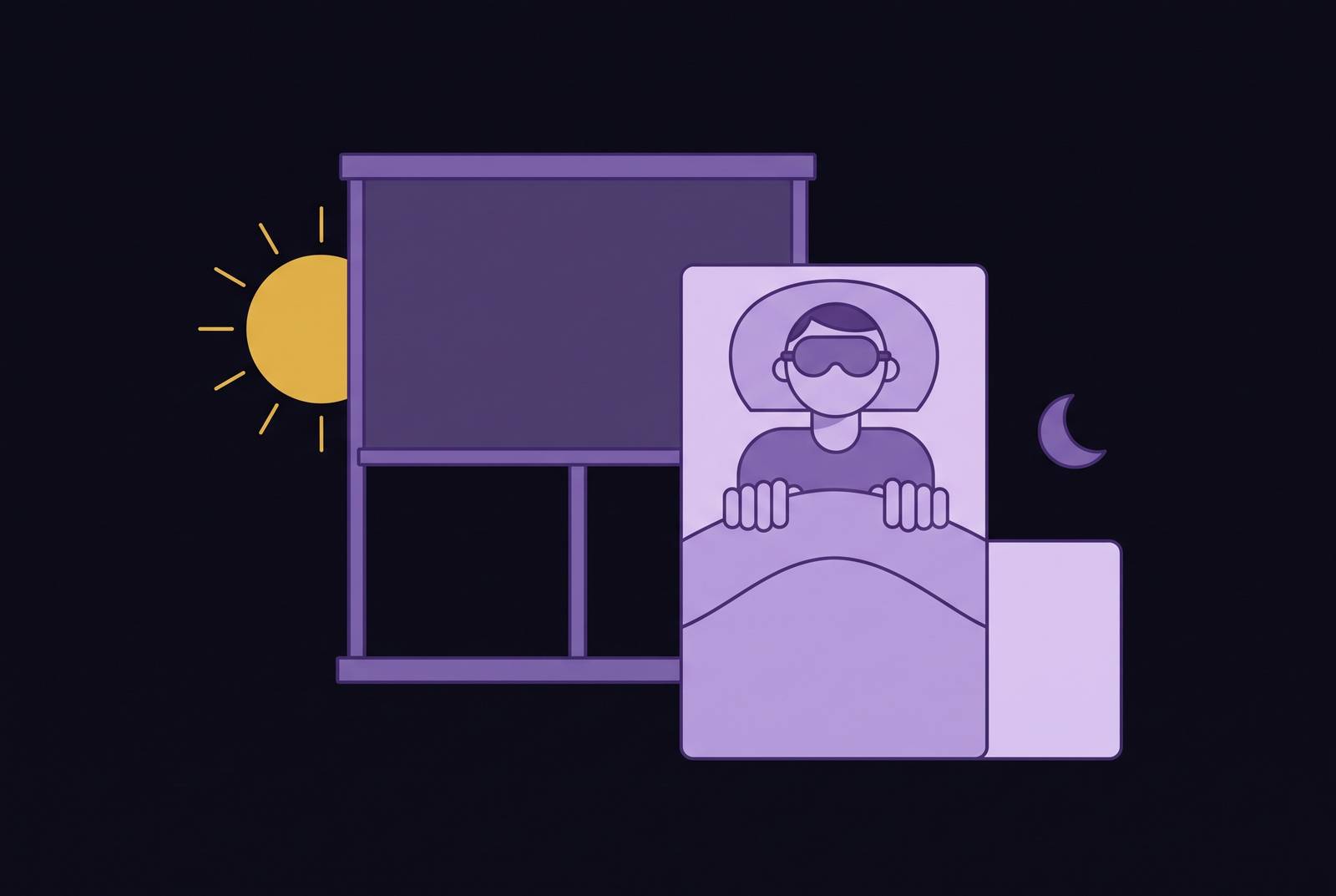
The advice most night workers receive is the same advice day workers receive: sleep in a dark room, avoid screens before bed, keep a consistent bedtime. These recommendations are not wrong. But they treat night-worker sleep as identical to normal nocturnal sleep, which it is not. They address the sleep environment but not the circadian signal system driving the underlying dysfunction.
The evidence that this advice alone is inadequate is hard to dismiss. A 2026 analysis of shift worker sleep patterns found that 58.2% of shift workers are dissatisfied with their sleep quality. More than half of the population this advice targets reports that their sleep is not working for them. That is not a compliance problem. It is a signal that the intervention model is incomplete.
Relying solely on any single intervention fails for the same reason. What is actually required is a protocol that operates across three time windows: during the shift, for alertness management. Immediately after the shift, for circadian signal management, and during the sleep block, for sleep architecture protection. The sections that follow cover each phase in turn, with its specific levers. This is the difference between a checklist of tips and a structured approach.
Managing light exposure before and during the shift to maintain the circadian signal
Light is the primary zeitgeber, or time-giver, for the circadian system. Deliberate light exposure during the shift and deliberate light avoidance afterward can meaningfully anchor the clock to a night-worker schedule. The principle is directional: bright light in, dark out.
During the shift, exposure to bright light of at least 1,000 lux, ideally 2,500 to 10,000 lux, especially during the first half of the shift, signals daytime to the brain and supports sustained alertness. The first half of the shift matters most because that is when the circadian system is most responsive to phase-shifting input. If you get strong bright light exposure early in the shift, you push the clock toward a night-aligned phase.
The countermeasure on the commute home is equally important. If you wear blue-light-blocking glasses or avoid morning sunlight on the walk to the car, you stop the light that would re-anchor the clock to a daytime phase. Effectiveness requires coordinating the light protocol with melatonin timing and consistent scheduling.
Strategic napping during the shift as the strongest behavioral lever for cognition
Scheduled napping during the night shift is not a concession to tiredness. The 2026 ScienceDirect systematic review found that scheduled 30-minute naps reduced sleepiness and improved cognition. Together, these findings suggest that the length of the shift and the presence of a scheduled nap opportunity are both modifiable variables that affect safety.
The institutional frontier of this research is the NAPWORK randomized controlled trial, registered in 2026. Its primary outcome is cardiovascular risk biomarkers, specifically endothelial function, not cognitive performance. Results are not yet published, but the trial shows that major research institutions now treat scheduled napping as a protocol component, not a fringe accommodation.
The practical constraints are real. Individual workers cannot always control these variables. If you lack institutional support, you can still use break time for a brief rest period, but the protected, scheduled nap is stronger.
Sleep inertia is the main counterargument. Waking groggy from a nap can impair performance briefly, which is a legitimate concern for a worker returning to safety-critical tasks. Limiting naps to 20 to 30 minutes and timing them before the circadian trough, roughly 1:00 to 4:00 AM, mitigates this. If you nap at the right point in the shift, you get the alertness benefit without the grogginess.
The post-shift window: protecting the transition from work to sleep
What a night worker does in the hour between leaving the shift and attempting to sleep has an outsized influence on how well and how long they sleep. The body is primed by the shift's demands to stay alert, and the morning environment is sending daylight signals. The transition must be actively managed.
The key actions in this window are sequential. First, avoid bright morning light. Second, delay food intake. The routine should signal to the circadian system that sleep is the next event.
Melatonin timing matters most when it is coordinated with both light avoidance and sleep timing. Taking melatonin at an arbitrary time, disconnected from the intended sleep block, is far weaker than taking it in coordination with the light management and the scheduled sleep start. The post-shift window is where most spontaneous sleep failures begin, and it is also the window where individual choices have the most immediate effect.
Exercise timing and its effect on sleep onset and brain function in night workers
Exercise improves sleep architecture and supports cognitive function, but when you work nights, the timing of exercise relative to the shift determines whether it helps or interferes with sleep. Growth hormone release and enhancement of brain-derived neurotrophic factor, or BDNF, support synaptic plasticity and cognitive function. These are real mechanisms with measurable downstream effects.
The protocol rule follows directly from the thermoregulatory mechanism: exercise before the shift, not after. A worker who exercises after the night shift is working against the transition the previous section described. Move that same workout to before the shift and it becomes an asset, because it raises alertness for the work block and leaves the post-shift window undisturbed.
BDNF enhancement is relevant beyond sleep. For night workers, exercise is therefore a long-term neuroprotective habit and not just a sleep aid. The cognitive protection compounds over time even as the acute sleep benefits operate on a nightly cycle.
Compounds that work with night-shift biology: what the evidence actually supports
Some compounds are genuinely useful for night workers, but the honest case for each depends on matching mechanism to problem. A compound that helps with stress-induced sleep disruption works differently from one that reduces acute fatigue during the shift. The two should not be treated as interchangeable.
Matcha is the strongest in-shift option, because it combines caffeine with L-theanine. A trial in Nutritional Neuroscience found the caffeine-plus-L-theanine combination improved task-switching accuracy and alertness beyond placebo while reducing tiredness. The practical timing is at the start of or during the shift, never after, to avoid interfering with the post-shift wind-down.
Rhodiola Rosea addresses acute fatigue during the shift through a different mechanism. The mechanism involves modulation of the hypothalamic-pituitary-adrenal (HPA) axis and neuroprotective effects. Its acuity distinguishes it from other adaptogens in a night-shift protocol context.
Ashwagandha serves the cumulative, sleep-focused role. A 2025 AIIMS double-blind RCT found that 600 mg KSM-66 daily for eight weeks reduced sleep onset latency by a meaningful margin and raised sleep efficiency. Consistency over the eight-week build-up matters more than dose timing on any single day.
Lion's Mane deserves honest framing. It stimulates production of nerve growth factor (NGF) through a specific, measurable mechanism, and that mechanism is genuinely novel and relevant to the prolonged brain connectivity changes documented in night-shift workers. The Alzheimer's Drug Discovery Foundation's cognitive vitality review found that in a placebo-controlled trial of healthy adults aged 18 to 45, four weeks of Lion's Mane resulted in worse performance on delayed word recall versus placebo. The argument for healthy night-shift workers is mechanistically plausible but not yet confirmed by high-quality human trials in this group. Include it for its long-term neuroprotective plausibility while noting the evidentiary limitation. This kind of transparent disclosure distinguishes science-led supplement formulas from marketing-led ones.
Protecting the sleep block itself: environment, timing, and architecture
Night workers are at a structural disadvantage even when they sleep long enough. Daytime sleep architecture is shallower and more fragmented than nighttime sleep. A 2023 PMC study found that longer deep sleep on days off correlated with significantly better cognitive performance, but longer deep sleep during daytime sleep was associated with slower reaction time. The same amount of deep sleep is not equally protective at all hours.
The environment controls are the minimum necessary, not optional comfort upgrades. Phone silencing with an exception-only contact list for family protects the sleep block from interruption. These steps are familiar, but they serve the specific circadian requirements of daytime sleep rather than general comfort.
Sleep timing is the anchor. The clock responds to regularity, not total hours alone. The days-off dilemma complicates this, since fully reverting to a daytime schedule on days off perpetually resets the clock and makes the next work cycle harder. A partial compromise, shifting the sleep block a few hours toward normal rather than fully reversing, is more sustainable than either extreme.
What an integrated night-shift sleep protocol looks like in practice
The protocol works only when the levers are coordinated across all three windows. If you apply any single lever in isolation, the others keep working against it. The integrated version sequences each intervention to support the next.
Before and during the shift, the levers are alertness and light management. Bright light exposure of at least 1,000 lux, ideally higher, during the first half of the shift anchors the circadian signal. Exercise is completed before the shift, not after, to harness thermoregulatory and BDNF benefits without delaying sleep onset.
The post-shift transition is about signal protection. Ashwagandha, in a standardized extract such as KSM-66, is taken daily for cumulative cortisol and sleep-onset support, with consistency over weeks mattering more than timing on any single day. No high-caffeine drinks and no large meals in this window.
The sleep block is protected by environment and timing. Sleep-start time stays anchored within a consistent window, including on days off with partial rather than full schedule reversal. Sleep block length is prioritized to protect deep sleep stages, and the days-off period is used to maximize nighttime deep sleep where possible, given the cognitive performance correlation.
The frontier of this work is individualized, technology-assisted protocol adherence. Henry Ford Health System's SAIL trial, registered as ClinicalTrials.gov NCT06809335 and currently recruiting with estimated completion in 2027, is testing a personalized circadian mobile health intervention for night shift workers. Results are not yet published, but the trial represents the direction institutional research is moving: toward protocols that adapt to individual circadian profiles rather than applying one standard set of rules to every worker.
Sources
- Frontiers
- Associations between sleep, cognitive function, and work performance among rotating shift and night-shift healthcare workers: A systematic review - ScienceDirect
- ASSOCIATIONS OF NIGHT AND DAY SLEEP WITH COGNITIVE PERFORMANCE IN SHIFT WORKERS: PRELIMINARY RESULTS
- A Pilot of a Personalized Circadian mHealth to Improve Sleep in Night Shift Workers
- ASSOCIATIONS OF NIGHT AND DAY SLEEP WITH COGNITIVE PERFORMANCE IN SHIFT WORKERS: PRELIMINARY RESULTS
- Exercise interventions for sleep and cognitive dysfunction in shift workers: a systematic review of randomized trials
- Effects of Shift Work on Cognitive Performance, Sleep Quality, and Sleepiness among Petrochemical Control Room Operators