Nootropic Delivery Formats Ranked by Bioavailability
Delivery format can change absorption, but only evidence for each ingredient shows whether it does.

A daily nootropic shot using nanoencapsulation can improve absorption over conventional capsules or powders, but the advantage depends on the ingredient and formulation. A claim that one format is better needs human evidence for the compound in it.
Why the format a nootropic comes in determines how much of any ingredient you actually absorb
A 500 mg Lion's Mane capsule and a 500 mg liposomal Lion's Mane capsule list the same dose, but they need not deliver the same amount into circulation. The label measures what goes into the product. Bioavailability describes how much becomes available in the bloodstream. Between those two points, digestion and liver processing can leave less of the ingredient intact, so the same milligrams may not give the same exposure.
First-pass liver metabolism is one major bottleneck. A swallowed compound can reach the liver before it enters general circulation, and processing there lowers its effective concentration. Stomach acid and digestive enzymes can cause losses before that stage, although the losses depend on the compound. There is no sound universal percentage to subtract from every capsule. Format thus matters when comparing doses, but it cannot take the place of evidence about the ingredient itself or show how much reaches neurons.
How the main delivery routes work, and what separates them mechanically
Gastric acid can break compounds down, digestive enzymes can degrade them, and gut microbes can alter them through processes including deamidation. After absorption from the gut, an ingredient still has to pass through liver processing. How much these barriers affect an ingredient depends on what it is. A delivery system has to protect a compound from the barrier it faces to be of use, however advanced it sounds.
Sublingual and oral-mucosal products use tissue under the tongue or lip as an entry point into circulation. The portion absorbed there bypasses first-pass liver metabolism and can act sooner than a swallowed dose. But the route is usually a hybrid. Some of the dose is swallowed and follows the ordinary digestive pathway, with the split depending on the compound and formulation.
Liposomal encapsulation instead surrounds an ingredient with a phospholipid bilayer, a shell made from the same broad type of material found in cell membranes. That shell can provide partial protection during digestion and support uptake through intestinal cells, including endocytosis, in which cells take material inside. It is not an indestructible wrapper. Digestive enzymes and bile salts can disrupt lipid membranes, so protection depends on how the formulation behaves in the gut. Related nanoencapsulation technology uses a microscopic lipid shell, but its presence alone does not prove that liver processing is bypassed.
Intranasal delivery reaches circulation quickly through tissue inside the nose that is rich in blood vessels. For some molecules, olfactory and trigeminal nerve pathways also offer access to brain tissue without crossing the blood-brain barrier from the bloodstream. Ordinary liquids do not provide that shortcut. Dissolved ingredients can begin absorbing sooner than compressed or encapsulated solids, but still face digestive and liver processing. Capsules and powders go through those same gut pathways, while an oil-based liquid matrix can be a better fit for fat-soluble ingredients.
Nootropic delivery formats ranked from highest to lowest bioavailability
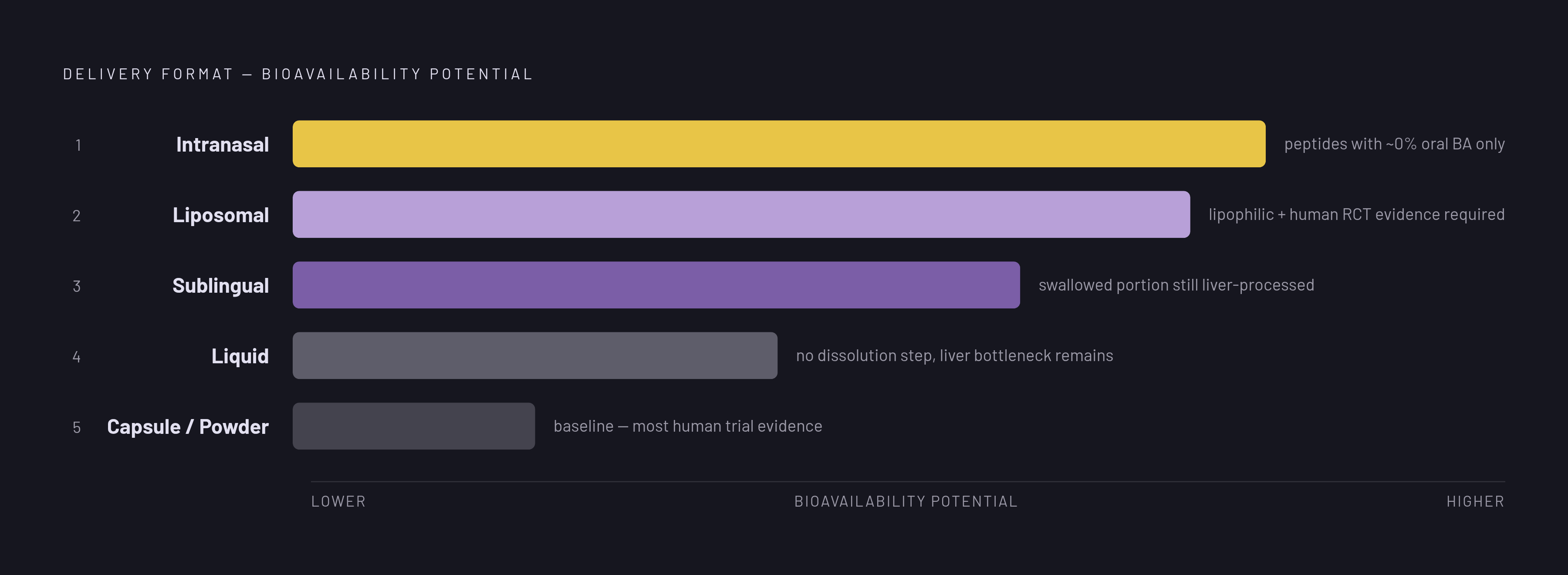
The working order is intranasal for suitable peptides, liposomal for suitable lipophilic compounds, sublingual, ordinary liquids, then standard capsules and powders. Those qualifications are part of the ranking. It compares how formats address absorption barriers for suitable ingredients. Bloodstream exposure, intracellular delivery and brain concentration are different endpoints, so a format that improves one has not automatically demonstrated all three.
First is intranasal delivery for peptides that have negligible oral bioavailability. These amino-acid chains can be highly vulnerable to stomach acid and digestive enzymes, making a swallowed dose ineffective as a delivery route. Semax, a synthetic ACTH analog used in Russia for cognitive support and stroke recovery, has approximately zero oral bioavailability. Intranasal products have a specialist application and require calibrated dosing equipment, and their position here does not extend to ordinary supplement stacks.
Second is liposomal encapsulation for lipophilic compounds with supporting evidence. A double-blind randomized controlled trial published in Frontiers in Nutrition in 2025 found significantly higher area-under-the-curve exposure for liposomal CoQ10 than for standard CoQ10 at the same dose. That measure captures blood exposure over time. The result supports the tested compound and formulation, rather than every product with “liposomal” on its label. Liposomal delivery may also take longer to peak than sublingual delivery, so total exposure and how soon it starts to work need to be weighed separately.
Third is sublingual delivery through pouches or drops, whose clearest advantage is speed. The portion absorbed through oral tissue avoids the initial liver pass, while the swallowed portion does not. A sublingual product may start working sooner even if a well-formulated liposomal product delivers as much or more of the ingredient overall. For a meeting or deadline, earlier onset can be useful, but undisclosed blend amounts still make effective dosing impossible to judge.
Fourth is ordinary liquid or ready-to-drink delivery, which can work better than solids depending on the ingredient. Dissolving a compound removes the need for it to be released from a capsule or compressed solid first. It does not remove the liver bottleneck. Nor does an aqueous drink automatically suit fat-soluble vitamins or botanical extracts, which may benefit from an oil-based matrix.
Fifth is the standard capsule or powder as the baseline route, which can be a sound choice. Water-soluble ingredients can absorb reliably through the gut, and oral formats often underpin the human evidence. Igarashi 2022 and Yoshino 2021 used oral NMN, while Pencina 2023 used MIB-626, a microcrystalline pharmaceutical polymorph of beta-NMN. That last formulation should not be treated as interchangeable with an ordinary powder. These studies complicate any claim that a newer delivery system is necessarily the better-supported option.
Why the same ingredient produces different results across formats — key examples from the evidence
Lion's Mane, or Hericium erinaceus, contains beta-glucans, polysaccharides, erinacines and hericenones. Erinacines and hericenones are linked to nerve growth factor synthesis, which underlies the proposed neuroplasticity mechanism. However, that mechanism does not establish that a liposomal Lion's Mane product delivers more to neurons or reaches a clinical threshold at a lower dose. Taking it with fat-containing food may help absorption of its fat-soluble terpenes, but that possibility has not been tested in a controlled bioavailability study.
Cognizin® Citicoline supports brain energy metabolism and acetylcholine precursor pathways, with a well-characterized human evidence base at 250–500 mg. It comes in both oral-mucosal products and drinks, so comparing those formats calls for knowing the dose in each. A disclosed dose gives the comparison a foundation. A hidden blend does not, even when the delivery technology sounds compelling. Sublingual delivery offers a reason to expect earlier onset, but the ingredient's broader evidence does not by itself establish the size of that cross-format advantage.
Peptides present a more extreme problem because many have effectively negligible oral bioavailability. Even here, claims must remain compound-specific. A nasal result for one molecule cannot establish an equivalent gain for another, and higher brain exposure cannot be inferred from the word “intranasal.” The format implication is narrower than the marketing version, namely that a vulnerable peptide needs a route suited to its chemistry.
L-Theanine and caffeine show the opposite pattern because both are water-soluble and absorb reliably through standard gastrointestinal routes. For this pairing, including when supplied through ceremonial-grade matcha, ingredient quality and ratio can be more useful distinctions than capsule versus drink. Advanced packaging is not automatically necessary. B vitamins also have a place in well-rounded formulas, but adding them does not make the whole formula need lipid delivery. A stack can contain ingredients with different delivery needs.
Ashwagandha and Bacopa Monnieri bring food and consistency into the comparison. The amounts noted for each day are 300–600 mg of standardized Ashwagandha root extract and 300 mg of Bacopa standardized to a high bacoside concentration. Both can benefit from food, particularly fat-containing meals. Bacopa's clinical timeline is 8–12 weeks of consistent use, which makes sustained dosing more relevant than a rapid peak. Better absorption might improve exposure, but it does not establish that an advanced format shortens that timeline.
Where format claims outrun the evidence — liposomal marketing versus human trial data
The strongest case for liposomal delivery starts with a test in humans that compares a specific formulation with another way to take the same compound. The weakest takes a result that worked for a pharmaceutical and claims it also holds for an unrelated nootropic. Those are different standards of evidence. The CoQ10 trial supports a real absorption advantage, but it cannot establish the same gain for Lion's Mane, Ashwagandha or a mixed daily shot. A plausible protective shell offers a mechanism that still requires clinical comparison.
Kawakami 2025 provides the human comparison cited for liposomal NMN, but its groups contained only five participants each. The study reported a plasma-level difference and has not been independently replicated. That is a limited foundation. It does not settle broader claims about intracellular delivery or longevity, and it should not displace the distinction between ordinary oral NMN and the microcrystalline formulation used in the earlier trial. Different preparations need their own evidence.
Powdered liposomes can nevertheless be genuine liposomes. Some manufacturers have used TEM and Cryo-TEM imaging to examine whether their products retain the claimed nanostructure. Structure is only one part of the case. An image can support the existence of a lipid particle without demonstrating its survival through digestion or its effect on human absorption. Dismissing every liposomal powder would be as careless as accepting every liposomal claim.
For buyers, the practical test is whether a human randomized controlled trial supports that specific compound in that specific format. When that evidence is absent, transparent dosing and third-party testing become especially important. Neither substitutes for a bioavailability trial. A certificate of analysis, or COA, can establish actual compound concentration, which is essential when judging what a serving contains.
What daily nootropic shot absorbs better than capsules or powder, and how should you choose?
For a daily nootropic shot, the best choice is a liposomal or nanoencapsulated formula that lists its ingredients and doses and shares the human evidence for its absorption. The evidence here is too limited to recommend a named product. The decision starts with chemistry. Lipophilic ingredients such as CoQ10, curcumin and fat-soluble vitamins have a clearer reason to use lipid-based delivery than water-soluble L-Theanine, citicoline or B vitamins. Lion's Mane terpenes also give lipid delivery a rationale, but not a proven product-level advantage.
To match that chemistry to a use case, distinguish an immediate focus need from a daily protocol. A sublingual pouch or drop can suit a meeting, deadline or creative session because onset is the priority. Individual doses still need to be visible. For sustained use, liposomal or nanoencapsulated delivery is more relevant where it improves total exposure, while consistency is central for adaptogens such as Ashwagandha. A faster peak is not the same benefit as dependable delivery over weeks.
A liquid formula can combine vitamins, amino acids and botanicals in one daily serving, and nanoencapsulation can make that format more than a convenience choice. The benefit must still be demonstrated ingredient by ingredient. A lipid shell around a mixed stack does not prove that every ingredient gains as much, and better blood absorption does not prove that it helps people think better. Intranasal peptides call for specialist use and have a separate role from everyday drinks.
Before buying, look for human data on the compound, a listed dose for each ingredient and a COA showing the actual concentration. Third-party testing for heavy metals, mycotoxins, PFAS and plastic chemicals is still a basic safety check. Delivery technology does not replace those safeguards. Where the evidence supports only the mechanism, the honest description is “promising formulation,” not “proven superior daily brain performance.” Pay for a delivery system’s demonstrated advantage.