Morning Cognitive Stack Protocols Used by High-Output Professionals
Layered stacks beat single shots, and absorption claims remain unproven.
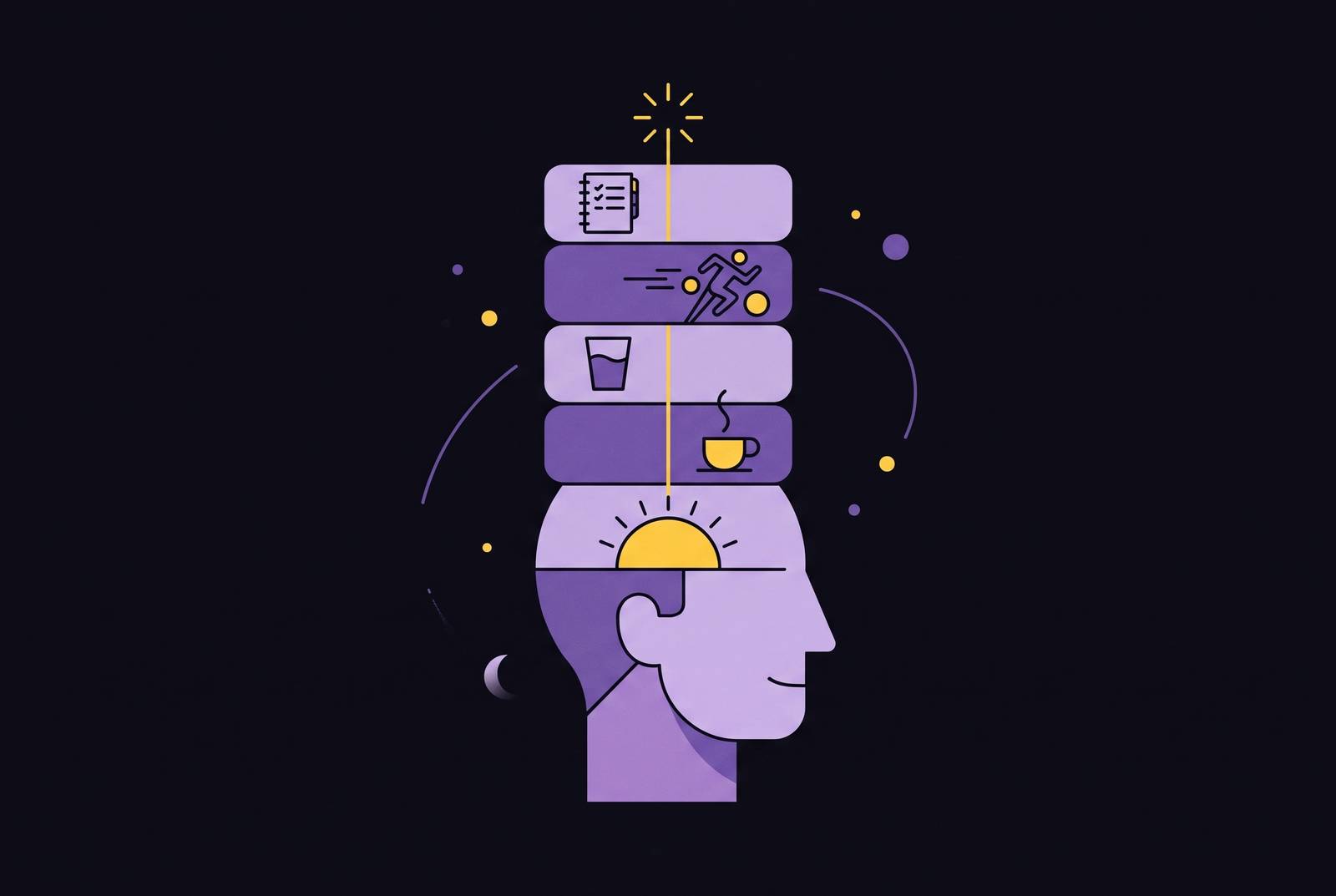
Morning cognitive stack protocols work best as layered systems. Sleep and behavioral priming are the base, sustained compounds need to be taken regularly, and acute focus agents belong close to demanding work. A daily nootropic shot with nanoencapsulation fits that system only if evidence supports its absorption claims. The evidence here does not establish that a particular shot absorbs better than capsules or powder, or justify a single-product recommendation.
Why the morning hours deserve a dedicated cognitive architecture, not just better habits
The Cortisol Awakening Response, or CAR, is a cortisol surge over roughly the first half-hour after waking. Its purpose is not fully settled, but research connects it with preparation for cognitive work through interactions between the hippocampus and prefrontal cortex. A stronger response has been associated with less activation in both regions but stronger functional coupling between them.
The study Brain preparedness: The proactive role of the cortisol awakening response in hippocampal-prefrontal functional interactions linked that pattern with better working memory during a demanding task hours later in the afternoon. What happens after waking may shape performance later. It also helps explain why a protocol should allow for the time it takes to wake up instead of assuming the brain is ready for its hardest work as soon as an alarm sounds.
However, waking early and thinking well are not interchangeable. A 2025 systematic review found a synchrony effect in 45% of adult studies, with late chronotypes performing significantly worse on complex tasks in the morning than during their natural peak. For knowledge work built around decisions, creativity, and sustained attention, the useful target is the individual’s sharpest window.
Why sleep quality is the upstream variable that determines what any morning stack can actually do
Poor sleep limits what the morning layers can achieve. Memory deficits of 20 to 40 percent have been reported to persist for several days after sleep recovery following insufficient sleep. A stimulant-induced feeling of readiness is not evidence that those losses have disappeared. Morning compounds therefore belong on top of sleep.
The Einstein Aging Study found that quality, measured through time awake between sleep onset and rising, was the sleep variable that made a day-to-day difference in cognitive performance among older adults. That population limit belongs with the finding. A study published in Sleep also found worse next-day processing speed when people slept less well or for less time than their own average, making the personal baseline more useful than a population target alone.
In practice, serious stack design treats the evening as part of the same system. Magnesium L-threonate, as Magtein, appears in that evening layer for its support of NMDA receptor modulation and synaptic plasticity. Its inclusion does not make sleep loss repairable by supplementation. Practitioners also stop the use of caffeine-containing compounds before mid-afternoon for people whose sleep is easily disrupted, so that today’s efforts to focus do not hurt the next day’s starting point.
Why behavioral priming before the first compound is part of the stack, not a warm-up ritual
Morning light, movement, and breathwork affect systems that the compound layers also target. They are not decorations around the real protocol. Light exposure can amplify the CAR, while exercise before work increases brain-derived neurotrophic factor, or BDNF, which supports neuroplasticity and working memory. The movement need not be a full workout, since a brisk walk, short yoga session, or bodyweight circuit can provide the behavioral layer.
Cold exposure can bring on a large norepinephrine response, which draws on a system that plays a part in focus and attention. Breathwork works in the other direction when arousal is already too high. Cyclic sighing, a double inhale through the nose followed by a long exhale, activates the parasympathetic nervous system and has outperformed mindfulness meditation for mood improvement under controlled conditions. More stimulation is not always the useful outcome.
These behaviors also give the waking transition a practical role. As a sequencing choice, the protocol proposes a 90-minute wait before caffeine, which leaves time for light, movement, and breathwork before the acute layer. This gives natural alertness time to build before caffeine is added, but the evidence here does not show that everyone needs the same wait or that taking caffeine right away necessarily leads to worse performance later.
How the acute focus layer works and why compound pairing beats single-ingredient dosing
Caffeine paired with L-theanine is a well-studied example of complementary compounds. The aim is not merely to soften caffeine’s edge. The pairing acts across different systems, and controlled research has found benefits in task performance beyond caffeine alone. That is a stronger reason to combine ingredients than the promise of feeling more stimulated.
Owen et al. (2008), identified by PMID 18681988, found that the combination improved speed and accuracy on an attention-switching task and reduced susceptibility to distracting information. This was one randomized trial, not multiple trials contained in one citation. Its result supports a specific pairing and specific outcomes. It does not establish that any mixture containing caffeine and L-theanine will produce the same effect regardless of dose.
Using two stimulants or two cholinergics does not always mean twice the benefit, and when their actions overlap, side effects can grow without as much gain. The protocol starts with a pairing of caffeine 100 mg and L-theanine 200 mg. That explicit dosing is more informative than an unnamed “focus blend,” because the ingredients and their amounts remain visible.
For sessions of four or more hours, the proposed acute layer adds Cognizin® citicoline to support the acetylcholine system involved in working memory and sustained attention. Its role differs from the caffeine and L-theanine pairing. Sublingual formats can reach the bloodstream faster than capsules, but a liquid shot that is swallowed may not be a sublingual product, and reaching the blood faster does not in itself show that it helps people think better.
Why the background compound layer requires a different logic — sustained mechanism, not acute timing
Bacopa, Lion’s Mane, and Ashwagandha belong to a different timescale from the acute focus layer. Their proposed role is sustained support through repeated use. Day one is the wrong test for that role. Bacopa requires 8–12 weeks to build its effects, while Ashwagandha’s stress-response benefits accumulate rather than functioning like an immediate stimulant response.
The mechanisms also differ within this background layer. Ashwagandha, including KSM-66, targets modulation of the body’s stress-response system, whereas Lion’s Mane is associated with NGF stimulation. A 2026 meta-analysis of 20 randomised trials found that ashwagandha improved memory, attention, processing speed, and executive function. Its cognitive evidence in healthy adults is stronger than Lion’s Mane’s. However, a finding for ashwagandha across trials should not be treated as proof that every extract or finished blend is equivalent.
Lion’s Mane illustrates why the evidence needs careful reading. Surendran et al.’s 2025 trial found no significant overall effect on cognitive function or mood after a single dose and described the cognitive findings as inconclusive. That weakens an instant-focus pitch. Product identity also counts, with fruiting-body material distinct from mycelium-on-grain. The proposed daily base places these sustained compounds at a consistent morning time with food, rather than timing them to an individual work block.
How timing and sequencing turn a list of compounds into a working protocol
At the foundation tier, waking begins the behavioral layer of light, movement, and breathwork. The sustained compounds follow at a consistent morning time with food. The acute pairing of caffeine and L-theanine comes shortly before the first block of demanding work, after the proposed wait on waking. Cognizin is added for sessions of four or more hours, so every morning need not involve the largest possible stack.
Practitioners cap caffeine-containing compounds before mid-afternoon, particularly where sleep disruption is a concern. This makes the protocol a repeating cycle. A focus intervention that compromises the following night works against the foundation on which the next morning depends, even if the current work session feels productive.
The intermediate tier is for times when work is unusually demanding. Rhodiola Rosea appears before high-stress sessions because its anti-fatigue effect can be available the same day while its adaptogenic effect accumulates. Alpha-GPC at 300 mg is also proposed as a choline precursor in the acute layer. “Intermediate” cannot mean adding it blindly on top of every existing source of acetylcholine support.
The advanced tier broadens the design to energy production, signal transmission, and neurogenesis. Phosphatidylserine is included for neuronal membrane support and cortisol blunting, with morning dosing intended to address cortisol management. Yet the CAR discussion already established that morning cortisol has a useful role. Blunting it is therefore not an unconditional goal. Periodic N-back or working memory testing provides a more disciplined way to judge the overall protocol than relying only on whether a larger stack feels stronger.
Delivery must fit the schedule as well. A format that reaches peak blood concentration after the target meeting may not serve an acute timing plan, while sustained compounds are less dependent on that narrow window. Encapsulated liquids with demonstrated enhanced bioavailability could offer a timing advantage. But nanoencapsulation, a liquid format, and superior absorption are not interchangeable claims. Without a finished-product comparison against capsules or powder, the strongest defensible statement is that delivery technology may improve a protocol.
What makes a cognitive stack trustworthy enough to take every day — ingredient quality, testing, and the compounding benefit of consistency
A proprietary blend that hides doses prevents a reader from comparing the product with the research behind its claims. Unverified contamination testing creates a different gap, because the ingredient list says nothing about what else may be present.
The concrete quality markers are transparent dosing, appropriate ingredient identity, and third-party contamination testing. For mushroom compounds, the proposed standard specifies dual extraction and fruiting body. The tests should check for heavy metals, mycotoxins, and synthetic chemicals. These checks address product quality, while proof of cognitive benefit requires separate evidence. Likewise, an absorption claim needs its own evidence rather than borrowing credibility from an ingredient study that used another preparation.
The Lion’s Mane MCI trial reported that benefits faded within 4 weeks of stopping, while Bacopa’s 8–12-week buildup makes sporadic use a poor match for its intended role. The MCI result should not be generalized into a promise of neurogenesis in healthy professionals. Nor does a sustained mechanism prove that benefits increase indefinitely. It establishes a reason to evaluate the right timescale.
The decision depends on whether the ingredients, doses, delivery claims, and testing support the intended use, and whether that use produces a worthwhile result over time.