How Sleep Debt Undermines Nootropic Absorption and Why Delivery Format Closes the Gap
Sleep debt damages the brain's ability to use nootropics, but better delivery can help.
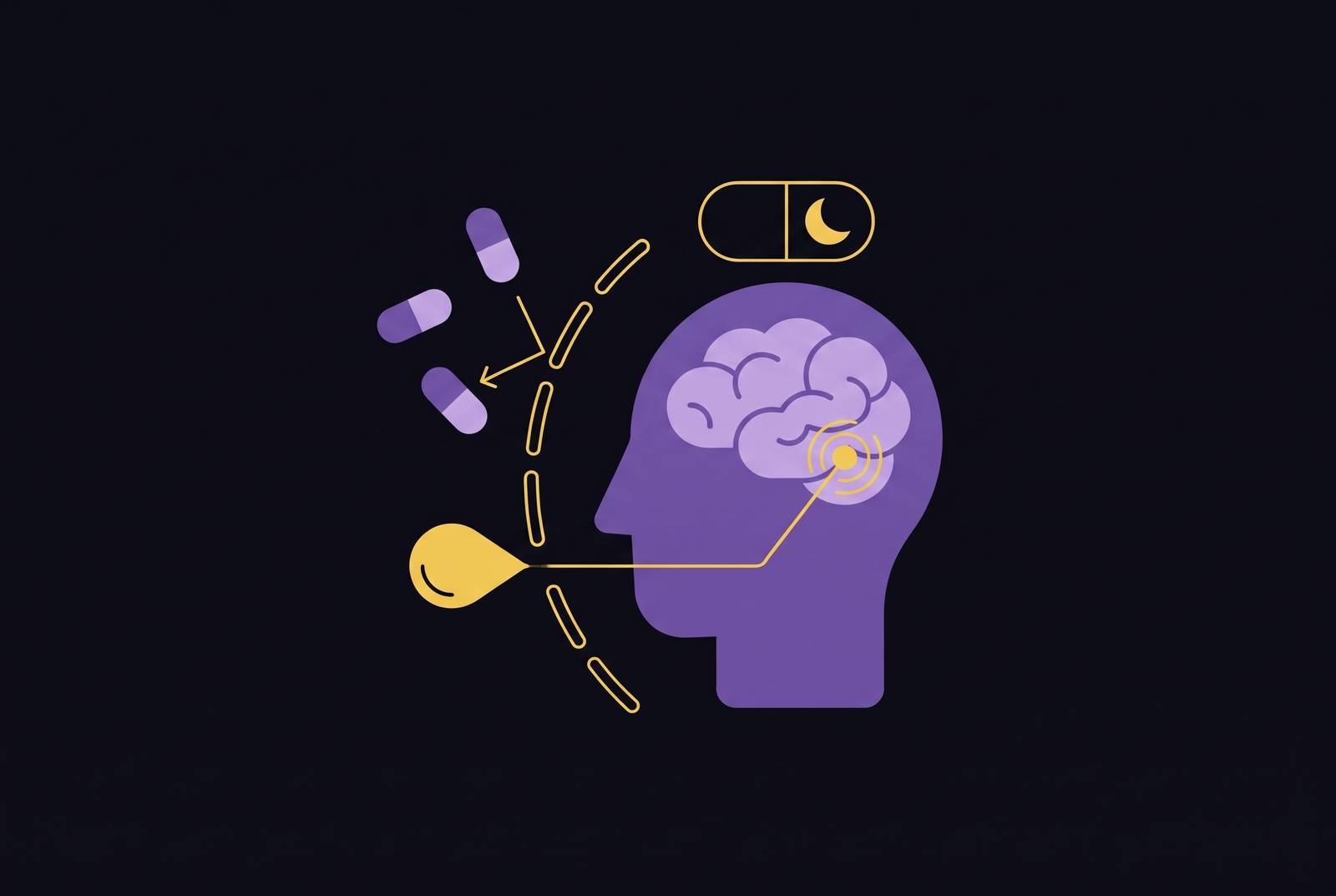
Sleep debt can undermine both the brain’s response to cognitive support and the pathways that absorb it. A daily nootropic shot with nanoencapsulation may improve delivery, but being a liquid does not prove that it is absorbed better than capsules or powder. Evidence for the specific formulation supports its delivery claims. Better delivery can address an absorption problem. It cannot replace sleep.
Sleep debt is not just fatigue — it structurally degrades the neurological infrastructure that cognitive support depends on
The person reaching for cognitive support after a run of bad sleep may be less able to use it well. The problem starts with the receiving system. Sleep loss changes how brain networks connect and coordinate, limiting the flexibility that attention and complex work require. A compound introduced into that state faces a different neurological environment from the one present after adequate sleep.
Cross et al. (2025) found that sleep deprivation spread connections more widely across networks while reducing how much those connections changed over time. Brain regions became stuck closer to intermediate configurations, and the more restricted they were, the less accurate people were on tasks and the slower they were to respond. The thalamus, which helps the brain move between connected and more separate brain states, also became less precise in its timing. The brain had less room to manoeuvre. This describes a constraint on network organisation.
Ren et al. (2025) found more severe deficits with acute deprivation and milder but persistent impairment with chronic deprivation. In the chronic group, reaction time barely changed after another night without sleep because the starting point was already degraded. That creates a hidden floor problem. Someone used to poor sleep can take a small further decline as a sign that they are coping well, even though they were already impaired when the comparison began. Feeling little different does not establish that the system is working well.
The glymphatic system — the brain’s overnight clearance process and what sleep debt does to it
Sleep is an active maintenance period for the brain. The glymphatic system uses pathways around blood vessels to exchange cerebrospinal fluid with fluid between brain cells, helping clear metabolic waste, including amyloid-beta and tau. This process works more rapidly during sleep than wakefulness. Its relevance here is ordinary brain upkeep. Memory, attention and learning depend on the condition of the tissue in which they operate.
A 2026 randomized crossover trial published in Nature Communications studied this process in 39 people. The trial linked NREM sleep duration to overnight clearance of amyloid-beta and tau into plasma, adding human evidence to the mechanistic account of sleep-dependent clearance. The result needs careful wording, however. Measured overnight plasma changes did not differ significantly between the sleep and sleep-deprivation conditions, and release of these substances was the dominant explanation for morning plasma variation during deprivation.
A 2025 study published in Cell identified synchronized oscillations in norepinephrine, cerebral blood volume and cerebrospinal fluid as the strongest predictors of glymphatic clearance during NREM sleep. Coordination was central to the process. The same work found that zolpidem, a hypnotic that enhances GABAergic activity, impaired the noradrenaline-driven oscillations behind glymphatic inflow. More time asleep is therefore not the only relevant variable. Sleep architecture and neurochemical activity help shape how well clearance works during that time.
Xu et al. (2025) also described how high-quality sleep helped more cerebrospinal fluid clear along the olfactory nerve pathway. For supplementation, the implication is limited but important. Introducing a cognitive-support compound does not itself establish that the brain’s maintenance processes are ready to support its intended effect.
How sleep debt corrupts the gut-absorption pathway before compounds even reach the brain
The same lack of sleep can disrupt the route that oral compounds take into the body. Sleep deprivation activates the hypothalamic–pituitary–adrenal axis, usually shortened to the HPA axis, and the sympathetic–adrenal–medullary system. These stress-response systems can sustain elevations in cortisol and corticosterone. The stress response becomes an added burden. It is no longer just a consequence of the original lost sleep.
Chronic cortisol elevation can reduce secretory IgA, part of the gut’s immune protection, and increase intestinal permeability. Sleep deprivation can also disturb gut microbes and damage the intestinal lining. A more permeable barrier is not automatically a better absorber. Barrier integrity and useful absorption are different functions, so a disrupted gut cannot be assumed to deliver a larger or more reliable dose of a bioactive compound. These changes can compound the absorption limits already associated with an ingredient or formulation.
The loop can then reinforce itself. HPA-axis overactivity can break up the sleep that follows and keep the gut exposed to stress hormones that help disrupt it. As weeks of poor sleep pass, the conditions in which supplements have to work may get worse. These changes explain why the same swallowed dose cannot guarantee the same biological exposure, while leaving any reduction in the amount of a particular nootropic reaching the bloodstream unquantified.
Brain-network flexibility is restricted, overnight clearance is disturbed, and the intestinal environment may be compromised. Ingredient selection therefore has to be understood within that system. Different compounds address different parts of it, and none can be judged by the label dose alone.
What each key cognitive-support ingredient actually targets — and why timing and mechanism count in a sleep-deprived state
Lion’s Mane, or Hericium erinaceus, belongs on a longer timeline. Its evidence concerns nerve growth factor and, in some human trials, brain-derived neurotrophic factor. A Japanese double-blind placebo-controlled trial found that cognitive-function scores improved after 16 weeks of daily use in a population of people who already had cognitive impairment. That population limits the conclusion. The result leaves an acute rescue for otherwise healthy people after a bad night unproven.
Bacopa Monnieri also depends on sustained use. Clinical data from more than twenty trials suggest benefits for attention and memory retention, with several weeks of daily use needed before those benefits reliably emerge. Its mechanisms include reduced oxidative stress markers and reduced NF-κB phosphorylation, which is relevant to inflammatory signalling. Timing is part of the intervention. An occasional dose taken only when work becomes difficult does not match the sustained use behind its clinical record.
Ashwagandha targets the stress loop more directly through HPA-axis modulation. A double-masked trial found that cortisol fell in stressed adults who took a standardized extract at 300–600 mg daily for eight weeks. That finding bears on the stress hormones involved in sleep debt, but it does not prove that gut absorption or glymphatic clearance was restored. Rhodiola Rosea has a moderate evidence base and a faster onset than many compounds in this category. Its rosavin and salidroside affect stress hormones and neurotransmitter balance, which may help with mental fatigue, but this does not show that it repairs sleep-deprived networks.
Caffeine presents a different trade-off. It does not directly break glymphatic function, but taking it too late can shorten or fragment the deep sleep needed for overnight clearance. The case for carefully timed caffeine paired with L-theanine is about supporting alertness without ignoring the next sleep period.
Cognizin® (citicoline) targets phosphatidylcholine synthesis and brain energy metabolism. Here, too, delivery affects how much of the compound reaches the body, so its name alone cannot tell how it will affect the brain. Across these compounds, the distinction is between supporting growth-related signalling, memory, stress regulation, alertness and energy metabolism. Those are separate jobs, with different evidence and timescales.
Do nootropic shots absorb better than capsules or powder — and why delivery format is a pharmacokinetic variable
A liquid nootropic shot does not automatically absorb better than a capsule or powder. Pharmacokinetics concerns what happens to an ingredient between swallowing it and reaching its target. Solubility, degradation and first-pass metabolism all influence that journey. First-pass metabolism is what happens when the digestive tract and liver process a compound before it reaches the wider circulation. A format earns its advantage by changing those barriers.
Acid-sensitive compounds in capsules and compressed tablets can come into contact with stomach acid before the body absorbs them. For many small molecules, however, solubility and first-pass metabolism are the larger obstacles. The bottleneck depends on the ingredient. Piperine, or black pepper extract, illustrates this specificity because it blocks glucuronidation in the liver and digestive tract and can greatly increase curcumin bioavailability. That finding does not establish the same improvement for every cognitive-support compound.
Nanoencapsulation is one approach to changing delivery. In the lipid-shell form described here, it wraps active ingredients in microscopic lipid structures designed to help the body absorb them and perhaps cut some first-pass losses. Its advantages depend on the formulation. The presence of nanoencapsulation alone does not establish faster onset, greater brain exposure or an ability to bypass a damaged intestinal surface. Those are separate claims that need evidence for the compound and preparation concerned.
A 500 mg Lion’s Mane capsule and a 500 mg liposomal preparation therefore present different delivery questions, even though their label doses match. The comparison cannot establish which delivers more to the brain without supporting data. For a buyer considering a daily shot, the useful criteria are the ingredient, the encapsulation method, the comparator and the measured absorption outcome. The evidence presented here includes no head-to-head tests of specific products that would show which shot performs best. Under sleep-debt conditions, any claimed advantage needs evidence from that state.
The honest boundary — what delivery format can and cannot fix when sleep debt runs deep
Even when a formula reliably increases exposure, that alone does not restore network flexibility, preserve NREM architecture or break the stress–sleep loop. These are distinct biological tasks. An absorption improvement can be real while its practical cognitive benefit remains limited by deep or persistent sleep debt.
The zolpidem finding distinguishes sedation from effective clearance and gives a reason to study how compounds that affect stress regulation work beyond the waking day. Ashwagandha and L-theanine may help parts of the system involved in sleep, but any link to clearance is still indirect. Modulating stress or noradrenergic activity is not the same as demonstrating restoration of the synchronized oscillations identified in the Cell study.
For someone who cannot recover sleep immediately, the practical position is to address format, consistency and sleep support together. High-bioavailability cognitive support is more plausibly useful with mild to moderate sleep debt than as an acute rescue from severe deprivation. Bacopa’s eight-to-twelve-week evidence window makes it especially important to take it consistently. Its clinical record comes from daily use over time and does not show that crisis-dosing before a demanding task works. Attention to sleep architecture belongs in that plan because improved delivery still depends on a functioning recipient.
What the 2025–2026 research changes about how to think about sleep, supplementation, and the system they share
The recent research brings nighttime physiology into the supplementation discussion. The human crossover trial links NREM sleep to the ways the brain clears waste, while the Cell study shows how neurovascular activity works together to drive that process. Together, they sharpen the explanation of why sleep changes the conditions for cognition. They do not turn every proposed supplement benefit into a demonstrated causal effect. The human trial’s plasma findings, in particular, do not show that sleep loss simply shuts clearance off.
The identification of a neurovascular driver also changes which ingredient questions are worth asking. HPA-modulating compounds and those affecting noradrenergic tone may have an indirect role in supporting the conditions for overnight maintenance. That possibility links daytime stress regulation with sleep-phase biology. It remains different from evidence that an adaptogen increases human glymphatic clearance, and it should be described that way until the specific pathway is demonstrated.
The next useful comparison is therefore not merely a shot against a capsule. It is whether a defined formulation improves exposure to a defined ingredient, and whether that improvement produces a meaningful benefit in the sleep conditions of its intended users. That keeps delivery claims tied to outcomes. It also places supplementation within the system it depends on, rather than presenting it as an escape from that system. The strongest case for nanoencapsulation is a measured improvement in delivery.