Nootropic Ingredients With the Strongest Evidence for Executive Function
Caffeine with L-theanine offers the sharpest evidence for acute executive function gains.
For founders and entrepreneurs who crash on coffee, the strongest evidence favors matching nootropic ingredients to a specific job when evaluating promises of “clean energy. Caffeine paired with L-theanine is the acute attention benchmark, while citicoline, Bacopa, and stress-pathway ingredients work on different timelines. No evidence presented here establishes a best mental performance shot or guarantees crash-free focus. The useful comparison is between ingredients, doses, and outcomes.
Why executive function is a harder target than general "cognition"
Executive function draws on the skills of planning, working memory, cognitive flexibility, and inhibitory control. These skills help people hold information in mind, change course, and resist distractions as they work toward a goal. The prefrontal cortex and its circuits govern much of this work, making it especially sensitive to stress, fatigue, and poor sleep. Feeling awake is not the same thing.
That distinction gets lost in nootropic marketing. Alertness and reaction speed are easier outcomes to move with stimulants, but neither establishes that a person can plan better or manage competing demands. The 2026 European Journal of Nutrition randomized controlled trial describes caffeine’s effects as “largely restricted to improved alertness and enhanced attention and do not typically extend to other cognitive domains such as working memory and executive function.”
How pathways and timelines divide the evidence into distinct categories
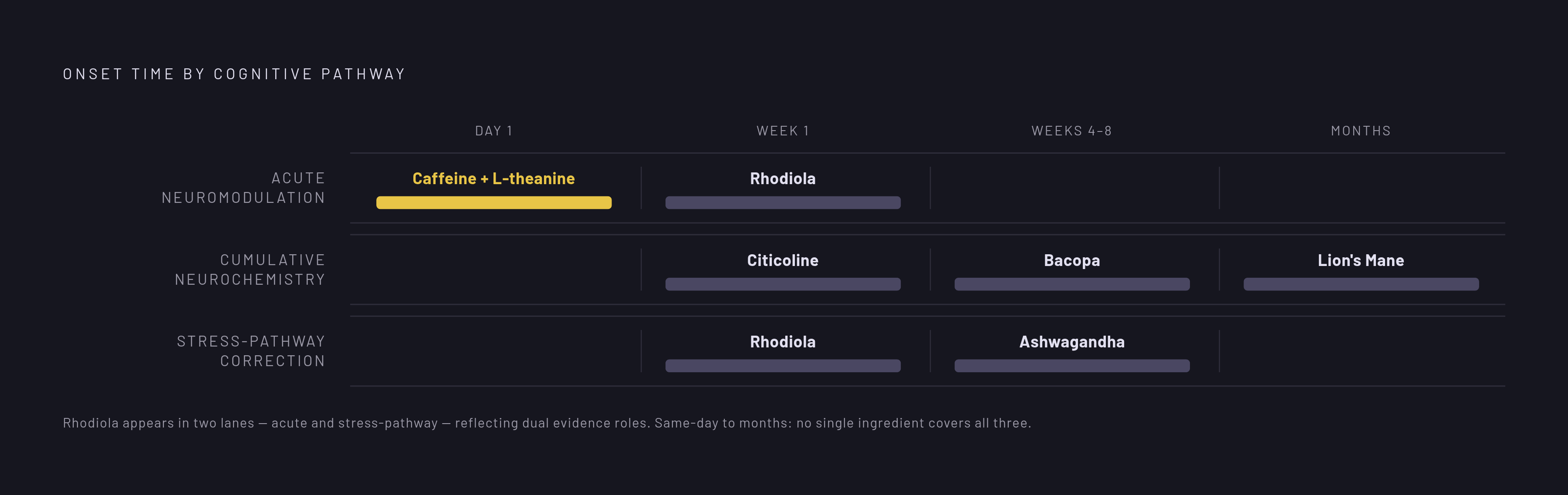
The evidence fits into three broad groups: acute neuromodulation, cumulative neurochemistry, and stress-pathway correction. The first changes performance over a short period. The second helps processes whose effects build with repeated use, and the third helps when stress disrupts cognitive function.
Caffeine and Rhodiola belong in the acute category, while Bacopa, citicoline, and Lion’s Mane sit in the cumulative group. Ashwagandha and Rhodiola address the stress pathway, giving Rhodiola a role across two categories. That overlap helps explain why an ingredient can be relevant both to fatigue resistance and to stress resilience without being a universal cognitive enhancer.
An ingredient that does nothing after one dose but produces benefits after eight weeks has not failed the same test that an acute ingredient passes. Population is another filter. Several strong findings for cumulative ingredients come from older adults or people who report cognitive problems, while healthy young adults may benefit less or not at all. “Strongest evidence” therefore needs an outcome, a timeline, and a population attached to it.
Caffeine paired with L-theanine as the acute executive function benchmark
Caffeine paired with L-theanine provides the clearest acute benchmark among these options. Caffeine raises alertness, while L-theanine promotes alpha brainwave activity and calm focus. Trials in humans show that the combination can help people do better on tasks that test selective attention and executive function. That is a narrower, more useful claim than “makes the brain work better.”
The 2026 trial also found that caffeine on its own raised blood pressure and negative mood scores significantly. Its nootropic formulation avoided those penalties while producing comparable selective attention improvements. However, the formulation contained multiple ingredients, including citicoline, so its results cannot be assigned to the caffeine-theanine pairing alone.
The 2025 Journal of Clinical Medicine meta-analysis adds another limit. It found that L-theanine’s cognitive benefits depended on dose and the task being measured, with significant effects on rapid visual information processing and recognition visual reaction time at higher doses, but not on simple reaction time or Stroop performance. The pairing is not a broad executive function solution. A result on one attention task does not promise improvement across every form of cognitive control.
Matcha has both compounds in a whole-food matrix. A 12-month randomized trial found improvements in cognitive functions including emotional perception and a trend toward better sleep quality. Baba et al. found that theanine suppressed caffeine-induced increases in time awake after sleep onset, with no corresponding reduction in the number of awakenings. That distinction is relevant because executive function depends on sleep, but it does not prove that matcha prevents afternoon crashes. Nor does the pairing establish cumulative neurochemical support, neuroplasticity, or cortisol correction.
Citicoline (Cognizin®) and the cholinergic route to sustained attention
Citicoline takes a different route from caffeine. It supplies choline for acetylcholine synthesis and cytidine for membrane repair and brain energy metabolism. Rather than acting on caffeine’s adenosine brakes, it supports the neurochemical infrastructure involved in attention.
Cognizin® is a form of citicoline studied specifically in human trials. Published research suggests support for brain energy metabolism and cell membrane formation, with effects developing over days to weeks. Its evidence is moderate-to-strong on the basis of replicated human randomized trials. It has not accumulated the meta-analyzed trial volume of the caffeine-theanine pairing, so the strength of its mechanism should not be mistaken for equal depth of evidence.
The 2026 trial provides useful but limited context. The full citicoline-containing formulation matched caffeine for selective attention improvements on the Arrow Flanker and Stroop tests, but not for sustained attention. It also avoided caffeine’s blood pressure and mood penalties. Those findings give reason to keep studying combinations that contain citicoline in healthy adults, though they do not show how much citicoline helped or prove that the formulation improved sustained attention. The practical distinction is between a plausible cholinergic route and the precise outcome a trial actually demonstrated.
Bacopa Monnieri's working memory case — and what the strongest objections reveal
Of the single plant-based ingredients discussed here, Bacopa monnieri has the strongest evidence from human trials that its effects on working memory and information processing speed build with use. Multiple randomized trials and a meta-analysis support its case. That makes it more than an ingredient with an appealing laboratory story.
Peth-Nui et al. found improved working memory together with reduced N100 and P300 latencies, which are neurophysiological markers of attention and cognitive processing. The findings were consistent with suppression of acetylcholinesterase activity, one of Bacopa’s proposed mechanisms. This links performance changes to a measurable physiological response. It does not establish that every extract, dose, or user will produce the same result.
The strongest objection concerns how a broad claim about “memory” can conceal differences in the tasks tested, the people enrolled, and the length of treatment. For cumulative ingredients, benefits in adults who had cognitive deficits at the start do not mean that healthy young adults will benefit too. Likewise, a test of one dose tells little about an ingredient that needs to be taken regularly to help.
The evidence points to standardized extracts at meaningful doses. The evidence here does not give a single minimum dose that works across all Bacopa preparations. So there is no basis here for treating every shot that contains Bacopa as equal to an extract used in a study. Its working memory benefits require a suitable dose and several months of daily use.
Ashwagandha and Rhodiola — how cortisol disruption degrades executive function and what correcting it produces
Chronically elevated cortisol can directly impair prefrontal cortex function and working memory. Stress management therefore belongs in discussions of executive function alongside “mood. When stress disrupts the systems needed for cognitive control, addressing that disruption targets a genuine bottleneck. More stimulation does not answer the same problem.
Ashwagandha and Rhodiola have randomized trial support for stress resilience through effects involving the hypothalamic-pituitary-adrenal axis, neurotransmission, and immune and hormonal pathways. The HPA axis is the stress-regulation pathway at issue here. Part of the case for their cognitive benefits is that they help create the conditions executive function needs to work. Calm mood and emotional balance can be relevant without being substitutes for measured cognitive outcomes.
An Ashwagandha randomized trial found significant improvements in episodic memory, working memory, and accuracy of attention after eight weeks. It also found improvement in the BRIEF-A metacognition index, behavioral regulation index, and global executive composite. BRIEF-A is a validated executive function measure. That makes the finding more specific than a report that participants simply felt clearer or less stressed.
Rhodiola has a faster timeline in the evidence presented here. A 2025 randomized trial found that cognitive control and executive function improved significantly in resistance-trained adults after seven days of use, whatever their dose or gender. That population limits how broadly the result should be applied. For daily stacking, the evidence supports a complementary timing approach, with Rhodiola in the morning for cognitive energy and fatigue resistance, and Ashwagandha in the evening for cumulative HPA axis recovery. Neither finding makes a stress-pathway ingredient interchangeable with an acute stimulant.
Lion's Mane and the neuroplasticity argument — where the evidence actually stands
Lion’s Mane has the most distinct proposed mechanism on this list. Its compounds, including hericenones and erinacines, are linked to an increase in nerve growth factor synthesis. That makes it interesting for neuroplasticity. Mechanistic promise, however, is not a human performance result.
Preclinical studies support the case for nerve growth factor, but small, short trials in humans have found both cognitive benefits and a lack of them. A 2025 trial found that acute consumption of H. erinaceus fruiting body did not significantly improve overall cognitive performance or mood compared with placebo. Any benefits seemed to be limited to certain tasks or domains. That is weak support for selling it as an immediate focus ingredient.
A randomized placebo-controlled trial of 31 healthy adults over 50 found improvement on only one of three cognitive tests. Two small trials in healthy young adults also produced mixed results, with one finding no cognitive improvement and the other finding some domain-specific benefits. A positive test deserves attention, but so do the tests that did not improve.
Limited large-scale human trial investment leaves questions unanswered, and absence of convincing evidence is not proof that the mechanism has no value. Within this hierarchy, Lion’s Mane sits in a moderate tier below Bacopa, citicoline, and the caffeine-theanine pairing. Its most credible proposed role is in long-term neuroprotection and neuroplasticity support.
What is the best coffee alternative for sustained focus, and how should a daily stack be built?
A clinically dosed caffeine-and-L-theanine pairing offers same-day attention support, ideally in a whole-food matrix such as ceremonial-grade matcha. Cognizin® adds a cholinergic route that begins building over the first weeks.
The cumulative layer has a different job. The evidence for Bacopa’s effects on working memory and processing speed applies when a meaningful dose of a standardized extract is taken daily for several months. The stress layer operates on two timelines, with Rhodiola contributing within the first week and Ashwagandha building over weeks. Layering these mechanisms is the evidence-based rationale, but it does not establish that every possible combination has been tested or will outperform each ingredient alone.
A proprietary blend that hides doses prevents a useful comparison with the trials, while a recognizable ingredient at a sub-clinical dose does not inherit the evidence behind a properly dosed preparation. Dose transparency and bioavailability belong in the assessment from the start. Third-party testing is also a prerequisite, because supplement quality varies and contaminants such as heavy metals and mycotoxins can undermine the intended benefit.
For someone seeking an energy drink alternative, those criteria are more defensible than a promise of focus without a spike or crash. The trials described here do not establish that promise or identify what high-performing founders use. What they provide is a way to read any ingredient list critically. Before asking “does it work,” ask what pathway it targets, how long it takes, who was studied, and whether the dose matches the evidence.