Liquid vs Capsule Nootropics Bioavailability and Absorption Speed
Format helps most for fast-acting ingredients, not slow-building ones.

Liquid versus capsule nootropics involves both absorption and convenience. Format can change how soon a compound becomes available and how much of the swallowed dose reaches circulation. But faster does not always mean better. The strongest choice matches the format to the ingredient, its dose, and the time it needs to work.
Why the format of a nootropic determines how much of the labeled dose reaches your brain
The dose printed on a bottle is the starting amount on the journey to your brain. Between those two points, a compound must be released and absorbed, then survive as the body processes it. Some of it may never reach circulation. Delivery format affects that journey by changing dissolution speed, exposure to stomach acid, and, depending on the route, exposure to first-pass liver metabolism.
Two mechanisms explain much of the gap. Dissolution lag is the wait while a capsule shell breaks down and its contents dissolve. First-pass metabolism happens when compounds absorbed through the gut travel to the liver before reaching the wider circulation, where a portion may be metabolized. A pre-dissolved liquid skips the dissolution step, but swallowing a liquid does not mean it bypasses the liver. And even when a compound reaches the blood, the same amount may not reach the brain.
What actually happens inside the body between swallowing a capsule and feeling its effects
A standard gelatin capsule first reaches the stomach, where its shell takes some minutes to dissolve. Only then can the powder inside disperse. The released ingredients must also survive the acidic gastric environment, where certain amino acids and water-soluble vitamins can be partly degraded. The shell opening is therefore only the beginning. Its contents still need to become available for absorption.
Next, the compounds pass through the intestinal wall and into portal circulation. That blood goes through the liver before it joins systemic circulation, the blood supply that serves the rest of the body. The liver may metabolize part of the dose along the way. This is the first-pass effect, and its size depends on the substance.
What remains of the compound enters circulation and must then cross the blood-brain barrier to have brain-level activity. With a standard capsule, it usually takes 30–60 minutes after swallowing to measure brain-level activity, though the time varies with the ingredient. Release, absorption, and cognitive effects are separate steps, and completing the first two does not establish when a useful effect will appear.
How liquid and sublingual formats change the absorption equation, and by how much
A pre-dissolved liquid starts further along the release process because its ingredients are already in solution. There is no capsule shell to open. Once the solution reaches the gut lining, the compounds are available for absorption without first dissolving from a powder. This can shorten onset, although gastric emptying and the compound itself still affect timing. The advantage is a removed step within the digestive route.
With sublingual delivery, well-suited compounds pass through the tissue under the tongue into capillaries, avoiding stomach acid, intestinal transit, and the initial liver pass for the portion absorbed there. That can increase availability per milligram as well as shorten the wait. Putting a liquid in the mouth brings this advantage only if it is absorbed through the oral mucosa.
These differences do not support one percentage improvement for all liquid nootropics. A swallowed solution and a sublingual product solve different problems, and neither performs identically across ingredients. Lipid nanoencapsulation offers a third approach by enclosing active ingredients in microscopic lipid shells. Such formulations can protect compounds and improve oral delivery, but their performance still depends on what is encapsulated and how the formulation is built.
Why compound chemistry determines which format actually wins for a given ingredient
The best route depends on the molecule itself. An ingredient’s molecular size, water solubility, and electrical charge at the mouth’s pH help determine how well it can pass through oral tissue. A good sublingual candidate needs a workable balance. It must dissolve sufficiently in saliva while also passing through the tissue’s lipid barrier, which favors small molecules with sufficient fat affinity and a partly non-ionized state at salivary pH.
Large, complex molecules face a different problem because they may not cross the oral mucosa efficiently during a short exposure. Many botanical extracts fall into that category. Lion’s Mane illustrates the uncertainty through its complex erinacines and hericenones. Most clinical studies used oral tablets, capsules, or powdered extracts over weeks, leaving unresolved whether brief sublingual exposure delivers a useful amount.
Omega-3s and certain fat-soluble vitamins do not dissolve well in saliva and rely on bile-mediated emulsification in the intestine. Oil-filled softgels can therefore be a better fit than saliva-based delivery. Dose size adds another constraint, since sublingual pouches have practical limits on how much they can deliver in one session. Capsules remain useful when daily requirements are high.
How absorption timelines differ across the specific compounds most commonly stacked for cognitive performance
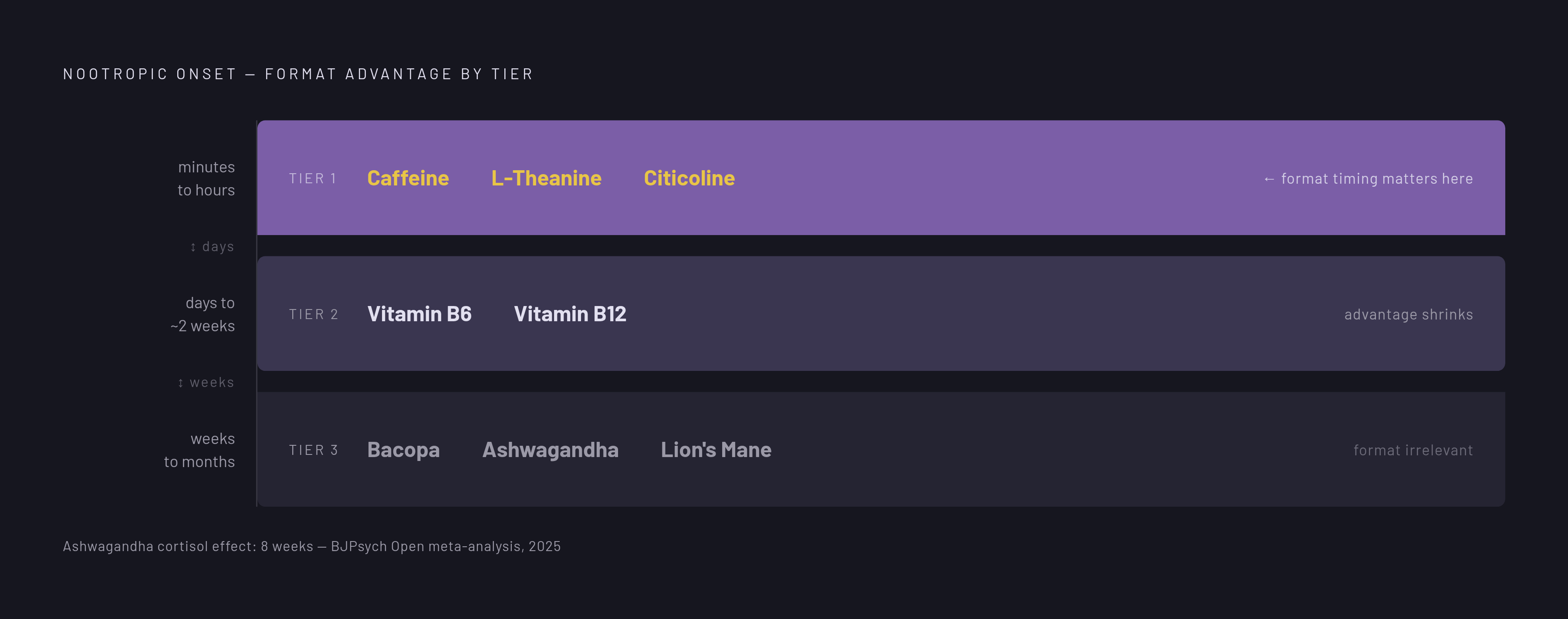
Nootropic ingredients fall into three broad timing groups, namely fast-acting compounds measured in minutes to hours, medium-accumulating compounds measured in days to roughly two weeks, and slow-building compounds measured in weeks. These are effect timelines. Format has its greatest timing value in the first group, where a shorter wait can change when an ingredient is useful. It has less effect on when a benefit that takes weeks starts to appear.
Caffeine and L-theanine are in the fast-acting group. Caffeine blocks adenosine and sharpens attention, while controlled studies of the pairing report improvements in attention, working memory, and reaction time. The calming claim needs more restraint. L-theanine modestly reduces jitteriness in some studies, but evidence that it prevents a later caffeine crash is limited and mixed. Faster delivery can help time the combination without making those uncertain benefits more certain.
B6 and B12 are water-soluble and rapidly absorbed, yet they are better understood as a daily baseline than an acute boost. Fast absorption is not the same as fast cognitive improvement. Cognizin® citicoline is also water-soluble and absorbs well in liquid, supporting acetylcholine synthesis and phospholipid membrane health. Its chemistry supports a liquid format, but that alone does not establish an exact onset time.
At the slow-building end, Bacopa monnieri supports dendritic branching and communication between nerve cells, with cognitive benefits requiring weeks of consistent dosing. Claims of an immediate Bacopa effect deserve skepticism. Ashwagandha acts through the HPA axis to support cortisol balance. A 2025 meta-analysis published in BJPsych Open found significant reductions in serum cortisol after eight weeks of supplementation. For these ingredients, a standardized dose taken daily outweighs a shorter wait for absorption.
Why onset speed is the wrong primary criterion for evaluating a nootropic format
Speed is useful when a task has a deadline, but a full cognitive formula has more work to do than arrive quickly. It needs the right ingredients in the right doses and must be taken every day. A sublingual pouch typically holds two to four compounds at moderate doses. Covering both fast-acting and slow-building ingredients generally requires capsules or a more sophisticated liquid formulation, so choosing only for speed can narrow the formula.
A poorly standardized or underdosed liquid can underperform a well-formulated capsule even if it absorbs sooner. Proprietary blends make that comparison harder because they give a combined weight and hide how much of each ingredient they contain. Without those amounts, the reader cannot tell whether the dose of a compound matches the one used in human studies.
The difference can also be smaller than the marketing suggests. For healthy adults with normal gastrointestinal function, absorption differences are real but modest for many compounds, and total absorption of some water-soluble vitamins can be comparable between well-formulated solid and liquid forms. A fifteen-minute head start is also irrelevant to the weeks-long effects of Bacopa, Lion’s Mane, or Ashwagandha.
How sleep-time dosing makes absorption speed relevant again, and what format serves it best
At bedtime, there is less room to wait for an effect. A compound that takes 45–60 minutes to become active may take too long if it is taken just before the planned sleep onset. Skipping the wait for dissolution can help with that timing. The distinction still follows the earlier timing groups, with faster availability relevant to evening relaxation and daily consistency more important for slow-building ingredients.
L-theanine is a water-soluble amino acid, so taking it in a liquid can make it available sooner to help with calm relaxation before sleep. Dissolved magnesium similarly avoids the breakdown required by a compressed tablet, although its bioavailability varies substantially by magnesium compound. The form of magnesium still counts. Ingredients still differ when dissolved in a drink, and faster release alone is no proof of a better night’s sleep.
Phosphatidylserine offers another example of a phospholipid that may help regulate cortisol, while a pre-dissolved formulation avoids waiting for a hard capsule shell to disintegrate. B6 supports pathways involving melatonin and serotonin precursors, but its water solubility is not proof of an immediate sleep effect. These ingredients have different roles despite sharing an evening formula. Their usefulness cannot be reduced to how quickly the drink leaves the glass.
Ashwagandha belongs on the slower side of that distinction. Elevated cortisol can delay sleep onset, but Ashwagandha’s effect on cortisol operates over weeks. An evening dose serves consistency more than speed. That longer view fits the cognitive goal because sleep affects how well the brain works the next day, when well-supported slow-wave sleep helps with focus, processing speed, and working memory.
What a format-aware nootropic protocol looks like in practice, and where nanoencapsulation changes the calculation
A morning liquid can combine fast-acting ingredients with a daily foundation. Caffeine, L-theanine, Cognizin®, and B vitamins can sit in that routine, while Lion’s Mane, Bacopa, and Ashwagandha are taken for their cumulative roles.
For time-sensitive demands, liquid or suitably formulated sublingual caffeine and citicoline can provide a faster delivery option before a meeting or task. That approach complements a foundational daily stack. It does not replace ingredients whose value depends on repeated dosing over weeks. Nor does every ingredient in the daily formula need to move into an on-demand format simply because that route is faster.
Nanoencapsulation can broaden what an oral liquid delivers effectively. A microscopic lipid shell can protect active compounds from gastric exposure and, depending on the formulation, reduce losses associated with first-pass metabolism. This may improve delivery of compounds that absorb poorly under the tongue and offers a way to combine a broader formula with a once-daily oral liquid routine, narrowing the gap between speed and formula depth.
That technology still needs a sound formula underneath it. A product should still be judged by whether it states how much of each ingredient it contains, uses standardized ingredients, and has doses backed by peer-reviewed human evidence. Independent testing belongs in the same decision. Third-party checks for heavy metals, mycotoxins, and PFAS cover a separate risk that faster absorption cannot fix, while clean sourcing helps keep a delivery system that works well from bringing unwanted contaminants into the body too.