What Sleep-Deprived Brains Actually Need for All-Day Clarity When Stimulants Make Things Worse
Caffeine masks sleep loss, while theanine, Lion's Mane and ashwagandha target stress and memory.
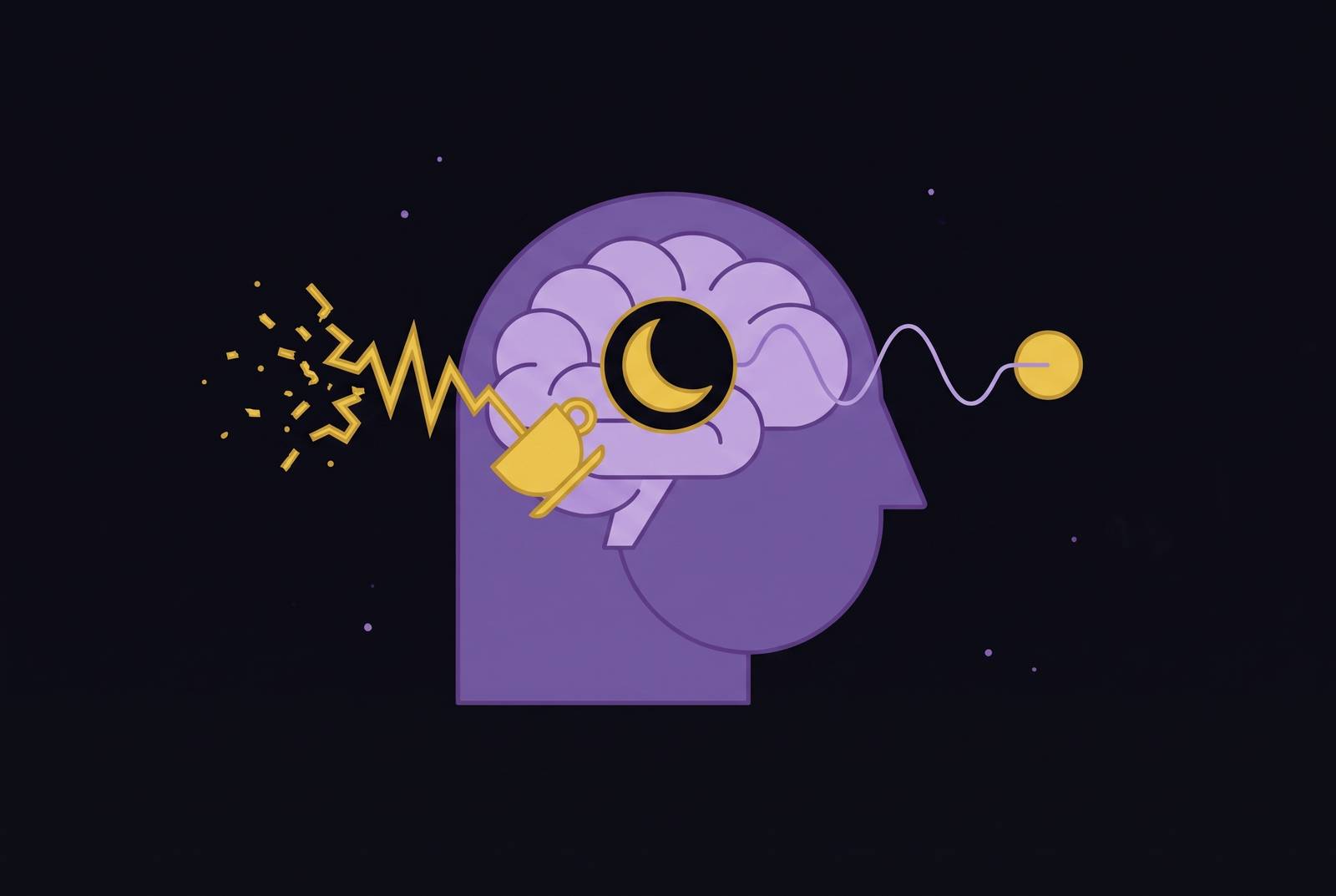
Poor sleep does more than drain energy. It disrupts attention, memory, and stress regulation. Feeling awake is not the same as thinking clearly. Some compounds may help with attention or stress, while others have slower, less certain benefits. None has been shown here to replace sleep or guarantee all-day clarity.
Why a sleep-deprived brain is not simply under-energized
A sleep-deprived person can feel functional while the brain’s attention systems are working less reliably. Frontal regions are affected first, while parietal regions hold out until deprivation becomes more severe. Working memory shrinks, leaving less room to hold and use information. Reduced activity in the insula adds to that disruption.
A separate 2025 neuroimaging study identified reduced flexibility in the dorsal and ventral attention networks. That finding points to a problem with how attention shifts. Sleep loss also suppresses brain-derived neurotrophic factor, or BDNF, a protein involved in learning and the brain’s ability to adapt. These are biological changes. Still, impairment that can be measured does not by itself show that the brain’s structure has been damaged for good.
Ren et al.’s 2025 study in Frontiers in Neuroscience found sharper deficits after acute deprivation and milder but persistent impairment with chronic deprivation. The distinction helps explain a dangerous adjustment. Getting used to poor sleep can make the experience feel less severe without bringing thinking back to normal.
The accuracy-versus-speed illusion that makes sleep debt so dangerous for knowledge workers
Speed is a poor stand-in for sound judgment. Sleep deprivation can hurt accuracy more than reaction time, allowing someone to respond quickly while processing information less reliably. Ren’s study also found lasting changes in baseline measures of thinking among people who regularly work night shifts. Together, these findings expose the gap between tolerating sleep loss and functioning well under it.
For an executive or entrepreneur, that gap can be hidden in a day of making decisions, writing, or negotiating that seems to have gone well. Higher-order work can suffer while simpler vigilance remains intact. The person feels able to do the work because they can still respond quickly. The errors are harder to feel, which makes a stimulant’s promise of sharper attention especially persuasive.
Why caffeine and stimulants fail the sleep-deprived brain at the moment they seem to help
Caffeine can help people stay alert on simpler vigilance tasks. Michigan State University’s Sleep and Learning Lab, led by psychology professor Kimberly Fenn, found that improved wakefulness does not reliably restore higher-level performance. Fenn put the distinction plainly.
“Caffeine increases energy and reduces sleepiness, but it absolutely does not replace a full night of sleep — although people may feel as if they can combat sleep deprivation with caffeine, their performance on higher-level tasks will likely still be impaired”
Feeling sharper after coffee does not contradict that finding. The feeling and the remaining impairment can coexist. Complex reasoning, long-term memory, and creativity do not necessarily improve when sleepiness lifts. Caffeine may also worsen grey matter loss during sleep deprivation by getting in the way of the brain’s compensatory responses, though this does not mean every cup will have that effect.
Caffeine used to push through the day can impair subsequent sleep, leaving a larger deficit that prompts more caffeine. The argument is therefore not against caffeine categorically. It is against treating stimulation as the whole solution.
The cortisol-neuroinflammation loop that stimulants ignore
Pro-inflammatory signaling proteins, including interleukin-1β, TNF-α, and IL-6, rise in sleep-deprived humans. This inflammatory state can disrupt cortisol regulation. Elevated cortisol can then impair the hippocampus, which supports memory, adding to the effects of reduced BDNF and strained working memory.
More arousal does not resolve that cycle. Stimulants can add cortisol pressure to an already stressed system without correcting the underlying inflammatory response. Greater alertness is an incomplete goal for an already stressed system. The biological target is the cortisol-neuroinflammation loop.
What L-theanine and ceremonial-grade matcha actually do to cortisol and attention after poor sleep
L-theanine offers a different way to approach attention. It appears to increase alpha-wave activity associated with relaxed, selective attention while also affecting the stress response. A double-blind, randomized, placebo-controlled crossover trial found that an L-theanine drink reduced subjective stress during a multitasking challenge within one hour. The trial also found a lower salivary cortisol response three hours after the dose.
Theanine’s stress-task results and relatively fast absorption make it relevant to poor-sleep days, although evidence of restored sleep-deprived performance remains lacking. L-theanine reaches approximately 70% bioavailability, with peak blood concentration in under an hour. Those properties support an acute-use case rather than a benefit that necessarily takes weeks to develop.
Ceremonial-grade matcha supplies caffeine with naturally occurring theanine. Matcha also contains epigallocatechin gallate. A randomized controlled trial found lower salivary cortisol secretion in the matcha group, with fatigue moderated too. This supports studying the combination, but it does not establish that ceremonial grade itself is responsible for the benefit.
The theanine is a potential buffer. Matcha still contains caffeine, which can acutely stimulate cortisol. Dose and timing therefore remain important, and the combination is not permission to consume unlimited caffeine.
How Lion's Mane supports neuroplasticity rather than just wakefulness
Lion’s Mane is a candidate for a different job. Its proposed role is to act on nerve growth factor, or NGF, with less emphasis on regulating the stress-response system. NGF supports nerve-cell growth and function. That separates the rationale for Lion’s Mane from the rationale for a stimulant or a cortisol-focused adaptogen.
Preclinical studies support effects on BDNF production and the formation of new neurons in the hippocampus. The connection to sleep loss is biologically relevant because sleep deprivation suppresses BDNF. But a matching mechanism is not a demonstrated treatment. Findings from studies in animals and the lab do not prove that Lion’s Mane repairs sleep-deprived human brains.
Larger clinical trials are still needed. For now, Lion’s Mane belongs in the discussion as a neuroplasticity candidate. It may help over time, but claims about a single dose should not promise that it will repair the brain’s structure.
Ashwagandha's role as a cortisol governor — and why formulation determines whether it works
Ashwagandha has a stronger controlled-trial case for stress regulation and sleep quality than the other adaptogens discussed here. Controlled trials have found that people processed information faster, had lower hormonal responses to stress, and slept better. Those findings are relevant because better subsequent sleep addresses a problem that extra daytime stimulation can worsen. The goal is not merely to push through.
The timeline keeps that promise in perspective. Measurable cortisol reductions have appeared after four to eight weeks of consistent use. Ashwagandha’s proposed effects also involve GABAergic signaling and BDNF. These pathways connect its stress-related role with the broader question of how the brain adapts.
Some key active components, particularly polar withanolide glycosides, cross membranes poorly, which can restrict how much reaches the bloodstream. Standardized extracts, liposomal forms, and phospholipid-complexed forms are therefore not interchangeable simply because their labels name the same plant. Evidence that a formulation leads to better clinical results must come from tests of that formulation, a need that applies across the supplement category.
Rhodiola Rosea for acute fatigue — what the evidence actually supports and where it falls short
Rhodiola has a more immediate anti-fatigue case than ashwagandha. Some findings suggest measurable effects within hours of a single dose. Its active compounds, rosavins and salidroside, appear to affect monoamine oxidase, cortisol responses during acute stress, and energy metabolism within cells. Morning use has also been reported not to significantly affect sleep, making it a possible alternative to escalating caffeine.
The evidence is not uniformly positive, however. Punja et al.’s randomized controlled trial in PLOS ONE found that an extended course of Rhodiola worsened fatigue scores relative to placebo among nursing students doing shift work. The difference appeared on two validated scales. That result directly challenges the idea that Rhodiola reliably improves fatigue for everyone.
Weaknesses in how studies were designed also make broad claims harder to trust. Product analyses have also found bottles missing genuine Rhodiola, so the category name does not guarantee the contents. This makes it important to look at how a product is formulated and whether it has third-party testing, beyond enthusiasm for the ingredient alone. Even a genuine product cannot guarantee a favorable response.
Bacopa Monnieri as a long-runway memory investment, not an acute rescue
Bacopa Monnieri belongs on a different timetable altogether. Memory benefits tend to appear after eight to twelve weeks of taking it every day, and the evidence applies especially to older adults. Studies agree less on the effects on attention than on memory recall. That makes Bacopa a possible longer-term memory support.
The distinction also limits claims about protection from sleep debt. Better memory performance over time does not itself prove that Bacopa prevents damage from a bad night. A 2025 Australian randomized controlled trial reported significantly more adverse events in the Bacopa group than in the placebo group. That finding makes dose, duration, and tolerability part of the decision alongside the potential benefits.
Why delivery technology determines whether any of these compounds actually work
Bioavailability means, in practical terms, that an ingredient needs sufficient absorption to act as expected. With Ashwagandha, poor solubility and difficulty crossing membranes can limit how much of its active components the body can absorb. Liposomal or phospholipid-complexed formats may help address those barriers, but their names alone do not prove superior effectiveness.
Absorption is not a universal problem with one universal fix. Theanine is absorbed fairly well, while many fat-soluble compounds are absorbed less well in their usual forms. It is therefore too broad to assume that most pills and powders fail, or that an advanced delivery label makes every ingredient effective. The useful comparison is between the specific formulation being sold and the one supported by clinical evidence.
Other ingredients can change the picture too. Piperine, or black pepper extract, is used to increase the bioavailability of various compounds, including some drugs. That wider effect makes it more than a neutral label addition. Magnesium has a different role, supporting more than 300 metabolic reactions, and can be depleted under chronic stress.
The Rhodiola findings show why identity and accurate labeling deserve attention as well as absorption. Certified Safe from Plastic Chemicals™ certification and Kosher Certification by the Orthodox Union can signal compliance within their respective scopes. Neither establishes cognitive benefit, verifies an effective dose, or substitutes for evidence that the finished formulation works.
What all-day clarity on a poor-sleep day actually requires — the full picture
Theanine with caffeine through matcha has an acute attention-and-stress rationale, while Rhodiola has a mixed anti-fatigue case. Ashwagandha works on a slower timetable, and Lion’s Mane has a plausible neuroplasticity rationale that still needs stronger human evidence. Bacopa’s memory case requires weeks of consistent use.
Those differences argue against treating every ingredient as a same-day energy tool. The evidence described here comes from tests of individual compounds, formulations, and outcomes, and does not show that a complete stack brings sleep-deprived performance back to normal. More ingredients do not close that evidence gap.
Consistency is relevant where benefits depend on repeated use, but it is not proof of cumulative protection from sleep loss. The firm boundary remains recovery sleep. Support may help with particular symptoms or functions, but feeling better is not reliable evidence that judgment has recovered.
Sources
- Frontiers
- Objective
- The impact of sleep deprivation on dynamic functional connectivity of the brain: Based on alertness task performance - ScienceDirect
- Effects of Caffeine on Event-Related Potentials and Neuropsychological Indices After Sleep Deprivation
- (PDF) Effects of caffeine on sleep and cognition