How Clinical Dosing Standards Apply to Nootropic Shots When Caffeine Is Removed From the Formula
Without caffeine, each nootropic ingredient must prove its own dose.

Removing caffeine from a nootropic shot changes how the formula must be judged. Without caffeine’s reliable short-term effect, each ingredient left in the shot needs evidence for its dose, extract type, and how soon it is meant to work.
Why caffeine is doing most of the work in a standard nootropic shot
Caffeine has decades of replicated human trials behind it, a well-established dose-response relationship, and effects that begin within minutes. Most botanical ingredients in nootropic shots have far less evidence behind them and do not work as fast. Their amounts are also frequently below those used in human trials. Someone who feels sharper within 30 minutes of drinking a caffeinated shot with Lion’s Mane or Bacopa named on the package is generally experiencing caffeine’s effects.
The label does not settle the question. The FDA does not recognize “nootropic” as a product classification, and the word sets no compositional standard. No agency maintains a list of ingredients that qualify a formula for the name or establishes how much it must contain. That leaves room for caffeine to provide almost all the measurable acute benefit while the other ingredients provide the product’s identity. Taking out caffeine tests whether those ingredients do more than give the product its identity.
What removing caffeine actually exposes about a formula
Without caffeine, a formula loses the fast effect that can hide botanical doses that are too low. Each ingredient left in the shot then needs evidence that it works on its own. That means matching more than an ingredient name. Human trials test specific extracts at set amounts, with known concentrations of active compounds. A different extract at the same weight does not necessarily meet that standard.
“Fairy dusting” names the gap between label presence and useful dose. It means adding a well-studied ingredient in an amount too small to support the advertised benefit, while giving its name prominent space on the package. The clinically studied amount would take up more of the formula and cost more. A proprietary blend makes it harder to spot that gap. When a “Focus Blend” discloses only its combined weight, the amount of its key ingredient can remain negligible and invisible.
Water-based environments can speed the breakdown of botanical extracts through hydrolysis and oxidation. Analytical stability data must show that the declared dose survives to the end of shelf life. Most brands do not publicly provide that evidence.
What the clinical dosing standard actually looks like for Lion's Mane
Lion’s Mane shows why a familiar name cannot substitute for a dosing standard. Its hericenones and erinacines have been linked mechanistically to stimulation of Nerve Growth Factor, or NGF, which supports neural growth and maintenance. That is a reason for scientific interest. It is not proof that any Lion’s Mane shot improves human cognition, nor that an NGF-related mechanism produces an immediate feeling of focus.
Trials in healthy adults have studied 1–1.8 g/day, while a trial in people with mild cognitive impairment used 3 g/day of dry powder. Those amounts need their context. A 10:1 extract at 500 mg is not the same preparation as 500 mg of raw powder. Several hundred milligrams of standardized fruiting body extract is a more credible formulation starting point than a token 100 mg, but even that weight needs evidence connecting the extract to the intended benefit. A label should identify fruiting body or mycelium, the extract ratio, and relevant hericenone or erinacine content.
The human evidence remains limited and mixed. Northumbria University registered a double-blind, placebo-controlled, crossover trial, NCT07759687, in August 2026 as part of ongoing research into optimal acute dosing for attention and mood. Lion’s Mane is more defensible as a potential long-term component than as a dependable acute performance ingredient, even though some acute findings exist.
What the clinical dosing standard looks like for Bacopa Monnieri and Ashwagandha
Bacopa Monnieri shifts the question from what is in one shot to what someone receives every day. Its memory benefits are more consistent in trials after about 12 weeks, though the broader pattern is 8–12 weeks of daily use. A single serving does not reproduce that regimen. Bacopa at 300 mg with high bacoside standardization provides a clinical reference point, whereas 150 mg is below that threshold and 100 mg lacks replicated trial support. Many trials also involved adults over 55, which limits how confidently their results can be applied to healthy younger users.
Ashwagandha helps cognition mainly in a different way. Elevated cortisol can impair the prefrontal cortex functions involved in executive control, working memory, and attention, while disrupting hippocampal neurogenesis. Reducing that stress burden may remove a brake on cognition. Better sleep can contribute too, through cortisol reduction and GABA-related effects. This is not the same claim as directly sharpening an already well-functioning brain.
KSM-66 root extract has been tested in many human randomized trials, with a clinical dose range of 300–600 mg/day. Timing is less uniform than for Bacopa. Some Ashwagandha studies report improvements within 8 weeks, and some find selected effects after acute dosing, so a blanket claim that it only works after months would be wrong. ClinicalTrials.gov lists a dose-response study in resistance-trained athletes completed in January 2025, reflecting continued work on population-specific dosing. For a daily shot, the central question remains whether it supplies the studied extract and amount consistently, rather than borrowing evidence from a different regimen.
Rhodiola Rosea as the exception to the rule about acute caffeine-free effects
Rhodiola Rosea provides a more credible route to same-day effects. It can reduce fatigue and support selected cognitive functions within hours of a single dose. Its proposed mechanisms involve the HPA axis, the body’s stress-response system, and monoamine pathways, including reduced cortisol output under stress and reduced monoamine breakdown. Those effects make Rhodiola a better fit for shots, which people often buy to help them perform better soon after taking them.
The studied dose range is 200–600 mg, standardized to 3% rosavins and a defined minimum for salidroside. Standardization is part of the dose. An unstandardized extract at the same weight cannot simply inherit the evidence. Double-blind crossover human trials have reported improvements in associative thinking, short-term memory, concentration, calculation, and speed of audio-visual perception. The evidence is stronger for anti-fatigue effects and more mixed for cognition, so those findings do not justify a promise of broad cognitive enhancement.
Rhodiola’s minimal impact on sleep when taken in the morning makes it an alternative to caffeine for people sensitive to stimulants or concerned about sleep. A shot with 200–400 mg of appropriately standardized Rhodiola takes account of which effects come quickly and which build over time. It gives the near-term claim a more suitable ingredient to rest on, while leaving the effectiveness of the whole formula unproven.
Cognizin® and bioavailability technology as the other half of the clinical dosing standard
Citicoline adds another requirement to the dosing test, namely traceability to the preparation studied. It is an acetylcholine precursor that also supports brain cell membrane synthesis and brain energy metabolism. Its effects can develop over days to weeks, with cumulative benefits as well. That gives it a place in a daily shot without making it an instant caffeine substitute. The clinical dose range is 250–500 mg/day.
Cognizin® is a patented, clinically studied citicoline form with replicated human trial data in healthy adults. The value of the name is traceability. It identifies a documented manufacturing process and purity standard, and it connects the ingredient to trials that used that preparation. Generic citicoline may be effective, but applying those trials to it requires evidence that it is an identical product. A documented equivalent needs its own basis for that comparison.
Delivery creates a separate question after the extract and weight are established. The swallowed dose is not the absorbed dose. Active botanical compounds can be lost before reaching circulation, so a label’s milligram figure does not describe exposure by itself. Liposomal and nanoencapsulation systems use lipid-based structures to protect or deliver ingredients, and legitimate bioavailability data exist for certain nutrients. That does not establish an advantage for every botanical mixture sold in a shot.
“Liposomal” therefore needs analytical support. Whether the system helps much depends on particle size, lipid composition, and how well encapsulation works. Evidence must concern the specific formulation. It must also address stability in the liquid product. Claims about delivery cannot make up for too low a dose, and even a large dose needs evidence from beyond the manufacturing vessel.
The honest timing problem every caffeine-free formula has to address
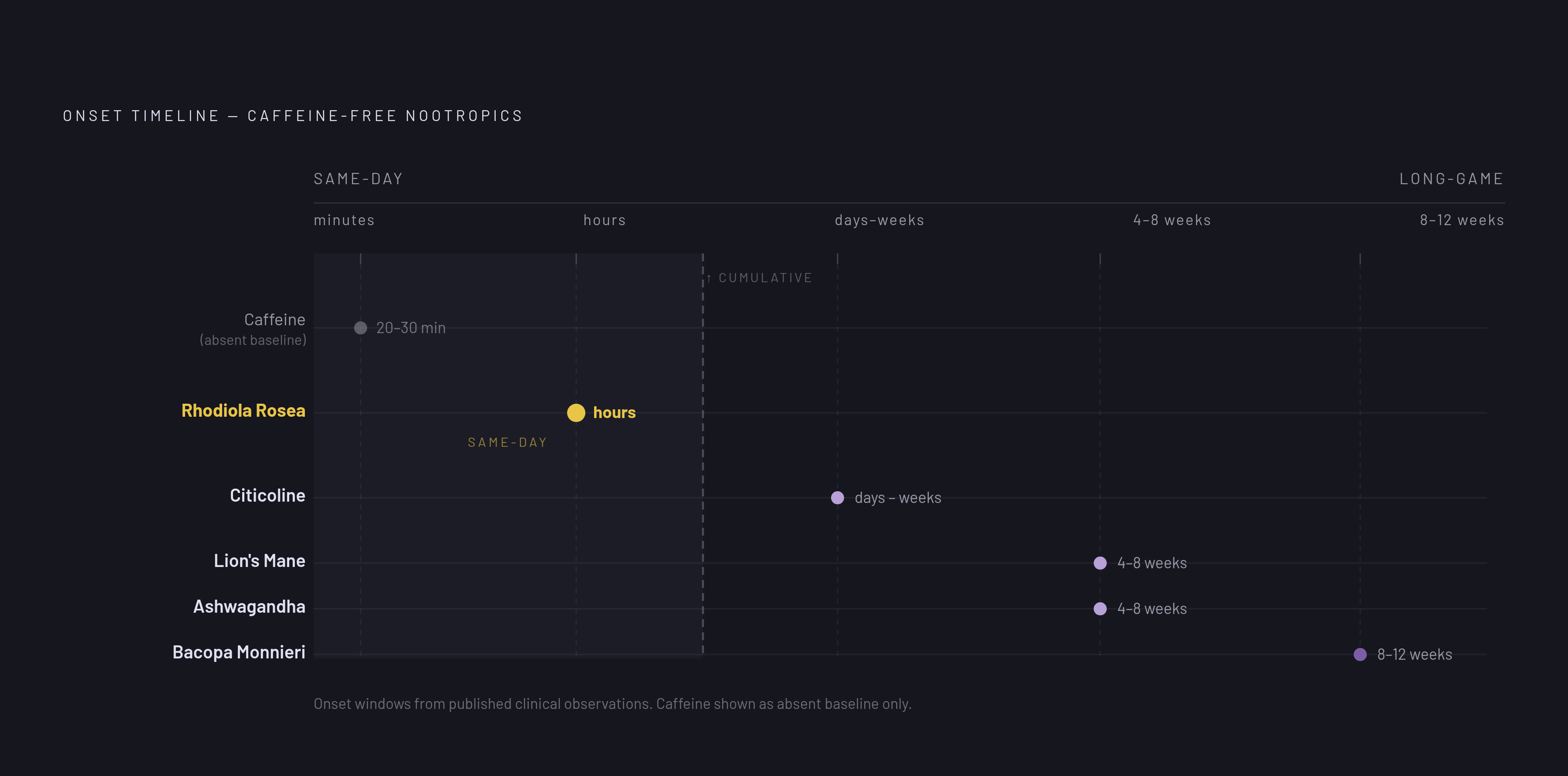
A daily liquid supplement is a legitimate product category. Its usefulness does not depend on producing a sensation immediately after drinking it. The tension comes from the shot format, which can suggest a quick performance effect even when the formula depends mainly on repeated use. Caffeine can produce measurable effects within 20–30 minutes. Bacopa’s primary memory benefits generally require 8–12 weeks, while Ashwagandha and Lion’s Mane may show effects over 4–8 weeks, with some acute findings that do not establish reliable same-day benefits from any finished shot.
A 2026 study published in the European Journal of Nutrition found that a multi-ingredient nootropic formulation produced benefits comparable to caffeine in selective attention. But it did not bring the expected gains from caffeine on a rapid visual information processing task. The distinction is not a technical footnote. Doing well on one measure does not show that it works equally well across cognitive domains.
There are two very different ways to handle that limitation. A coherent formula can use Rhodiola for nearer-term effects and citicoline for effects developing over days to weeks, with cumulative ingredients supporting longer-term goals. Alternatively, a formula can promise the same experience as caffeine while relying on ingredients that do not support that timing. The first approach matches ingredients to claims. The second confuses a plausible long-term use with an unsupported immediate promise.
The long-term case also depends on the user. Ashwagandha’s stress-and-sleep pathway is more relevant when cognition is impaired by stress, poor sleep, or cortisol dysregulation. People who are already healthy and have little stress tend to gain less from adaptogens in terms of cognition, and those gains are less consistent. Bacopa’s dendritic-growth mechanisms and Lion’s Mane’s NGF-related mechanisms do not erase that broader need to distinguish biological plausibility from demonstrated outcomes. A formula built mainly around cumulative ingredients should be presented as a daily brain-health routine.
What a genuinely functional caffeine-free formula looks like in practice
For consumers, the practical test begins with disclosed individual doses. A blend total is not enough. Each amount should be comparable with the human trial used to support it, and the label should specify the extract’s identity and standardization. That includes fruiting body versus mycelium for Lion’s Mane, bacoside content for Bacopa, KSM-66 or a documented equivalent for Ashwagandha, rosavins and salidroside for Rhodiola, and Cognizin® or a documented equivalent for citicoline.
Useful reference amounts include several hundred milligrams of standardized Lion’s Mane fruiting body extract, subject to its specific evidence, and 300 mg of Bacopa with high bacoside standardization. Ashwagandha’s KSM-66 range is 300–600 mg/day. Rhodiola at 200–400 mg with defined rosavin and salidroside standards is a credible formulation signal, while citicoline’s range is 250–500 mg/day. These are not interchangeable quantities or proof that any combination works. The preparation, hoped-for result, and dosing schedule must still match those in the trial.
Bioavailability data should support its delivery claims, and stability data should show that declared doses survive shelf life. Third-party testing should address contaminants, including heavy metals, mycotoxins, and PFAS, with mycotoxins especially relevant to mushroom extracts. Transparency and testing are baseline requirements. Neither alone proves that the product helps cognition, but both are needed for a product meant to be taken every day over the long term.
The final test is whether the promise fits the formula. A cumulative product needs a fair assessment period measured in weeks, and its marketing should say so. The useful questions are what dose each ingredient provides, which extract it uses, and how that corresponds to published human trials. Caffeine-free serves a different use case, and a credible formula makes that use case clear while accounting for the work the missing caffeine can no longer do.