What Morning Capsule Routines Cost You When Sleep Quality Is Already Compromised
Poor sleep undercuts morning supplements, so fix the night first.
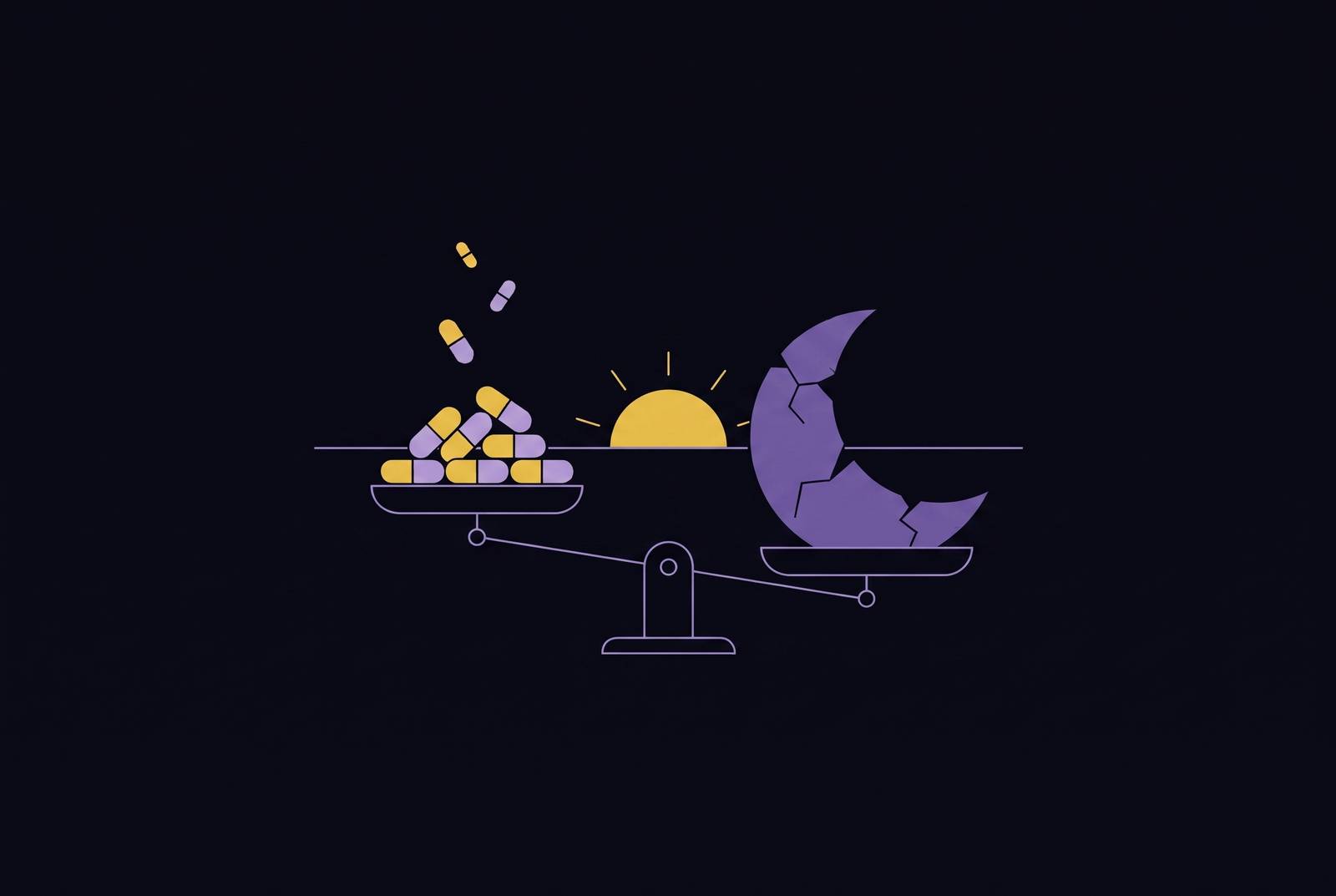
Morning capsule routines cost more than money when sleep is already compromised. Poor sleep weakens the brain function, hormonal rhythm and gut environment that those supplements need to work. The result can be a loop in which the problem undermines its supposed solution. A better routine starts with the previous night, then matches each compound to what it can actually do.
How sleep deprivation creates a cognitive deficit that morning supplements are designed to address — but cannot fix alone
A morning stack promises to help with focus and memory and give enough mental energy to get moving. But taking ingredients associated with those benefits does not mean a sleep-deprived brain can turn them into restored performance. Short-term sleep restriction can already impair cognition, with reaction time and working memory especially sensitive. Chronic deprivation is not required for trouble to start. The gap between feeling ready and performing well can open after a short period of inadequate sleep.
Csipo et al. showed in Scientific Reports in 2021 that sleep deprivation impaired cognitive performance and altered blood flow during mental tasks. It also reduced the brain’s ability to match blood flow to activity in its working regions. That is a supply problem. A supplement aimed at supporting cognition enters a brain whose routing of blood and energy is already compromised. As wakefulness continues, performance can deteriorate further, so the deficit a morning routine is meant to address is not fixed.
What poor sleep does to the cortisol awakening response, and why that matters for every compound you take at 7 a.m.
That impaired performance sits within a disrupted hormonal rhythm. Cortisol and sleep influence each other, with elevated cortisol disrupting sleep and poor sleep disturbing the pattern of cortisol that follows. People with poor sleep quality can show lower morning cortisol output and a blunted cortisol awakening response, the rise associated with waking. Getting started then feels less pleasant and is harder to do. Reduced morning alertness is part of the biological state the routine enters.
The distinction is between cortisol level and cortisol timing. A flattened awakening response signals strain in the HPA axis, the hormonal system involved in the stress response, and makes rhythm recovery the relevant goal. “Lower cortisol” is therefore an incomplete target for someone whose morning response is already blunted. The same hormone can disrupt sleep when elevated and leave waking function poorly supported when its morning pattern is flattened.
A routine set for 7 a.m. follows the clock, even when the body may not be ready. Every compound arrives within the hormonal conditions left by the night before. This explains why a morning capsule must be judged within the sleep and waking rhythm it is supposed to support.
How sleep deprivation compromises gut function and reduces what capsule supplements can actually absorb
The disruption also reaches beyond the brain and hormones. Sleep deprivation changes gut microbes and their metabolites, including changes associated with signaling pathways related to GABA metabolism. These findings suggest an interaction between sleep-related stress and an altered gut environment. An altered gut may affect the pathways supplements depend on, but it does not establish how much less of any particular capsule reaches circulation.
The labeled dose is only the starting point. Bioavailability means how much of that dose becomes available to the body, and the two are not interchangeable. Poor sleep adds another uncertainty to that gap before an ingredient’s cognitive effects even enter the discussion. This makes delivery relevant, without proving that a particular format solves the problem.
What Lion's Mane, Bacopa Monnieri, Ashwagandha, and Rhodiola Rosea can and cannot do in a sleep-deprived brain
Lion’s Mane, or Hericium erinaceus, belongs in a long-term discussion of brain support. Its proposed structural benefits involve NGF and BDNF, proteins involved in nerve growth and protection, as well as myelin repair. These are not instant changes in morning attention. Surendran et al. tested a single 3g dose of fruiting-body extract in healthy young adults in a 2025 Frontiers in Nutrition study and found no significant overall improvement in cognition or mood versus placebo. That study gives no basis for presenting Lion’s Mane as an acute rescue.
Sleep deprivation also suppresses BDNF signaling, complicating the conditions in which Lion’s Mane is expected to work. This weakens the simple story that a structural-support ingredient can offset a bad night on demand. The distinction is between supporting a process over time and restoring performance this morning.
Bacopa Monnieri requires an even clearer separation between those expectations. It has neuroprotective, antioxidant and anti-inflammatory properties, and supports neurogenesis and BDNF. Its cognitive effects emerge at the 8–12 week mark at minimum.
Ashwagandha, or Withania somnifera, raises a different question about timing. It modulates the HPA axis and supports lower cortisol output, but lower is not automatically better for a blunted awakening response. Taking it in the evening before bed aims to improve sleep quality instead. Its value in that setting is upstream, addressing the night rather than trying to manage the aftermath at 7 a.m. Any reduction in the next morning’s cortisol peak should not be confused with proof that an already flattened response has been restored.
Rhodiola Rosea has fatigue-reduction findings across multiple independent trials and modulates cortisol and adrenaline output. A person may feel less worn down without reversing the blood-flow, hormonal and energy problems associated with lost sleep. Relief is useful, but it is not proof of repair.
Where Matcha's L-theanine and caffeine combination fits — and where daily morning caffeine deepens the hole it fills
There is more direct evidence that L-theanine combined with caffeine can help with acute attention during sleep deprivation. A 2025 double-blind, placebo-controlled crossover trial in the British Journal of Nutrition found that a high-dose combination led to better selective attention, a higher hit rate and better discrimination between targets and distractions than placebo. This is evidence about performance after sleep loss. It is not evidence that the combination replaces sleep or repairs every impaired cognitive function.
Matcha supplies both compounds, with L-theanine modulating caffeine’s effects and supporting a smoother onset with fewer jitters. Yet a high-dose trial cannot simply be treated as a trial of an ordinary serving of matcha. The dose and format in an experiment can differ from what someone takes each day.
A 2024 study found no significant differences in total sleep time, time taken to fall asleep, waking after sleep onset or sleep efficiency after four weeks of daily matcha at typical dietary doses. Those doses contained 50.3mg theanine, 301.4mg catechins and 71.5mg caffeine. That is reassuring within the conditions studied. It does not establish that matcha cannot disrupt anyone’s sleep, or that higher doses behave the same way. The practical distinction is between measured, dietary-dose use and a repeated high-dose caffeine response that may extend the sleep deficit it is meant to cover.
What creatine reveals about the brain's energy deficit during sleep deprivation, and what it takes to actually address it
Creatine shifts the question from stimulating attention to supporting the brain’s energy supply. Sleep deprivation depletes ATP reserves and lowers neural pH, changes that can interfere with neuronal firing. Creatine helps keep phosphocreatine and ATP in balance and keeps that pH from dropping. The target is energy availability. This is a closer match to one of the underlying deficits than simply trying to feel more awake.
Gordji-Nejad et al. reported in Nutrients in 2026 that a single dose of creatine monohydrate was associated with less deterioration during extended sleep deprivation. The benefits covered logical and numerical tasks, language-related processing speed and performance on the Psychomotor Vigilance Test. Females benefited more than males across logic, vigilance and processing-speed tasks. The findings are specific rather than universal. These findings show reduced deterioration on selected measures.
In their 2024 Scientific Reports study, the same researchers used a higher single dose and found that brain energy measures changed, neural pH did not drop, and cognitive performance and processing speed were better. Those acute findings complicate any claim that creatine can work only after prolonged loading. Taking it consistently is still a way to prepare, but there is no guarantee that one ordinary morning dose will give the same results as a study. The distinction is essential for interpreting the promise.
Why the highest-ROI supplement intervention for sleep-compromised users may happen the night before, not the morning after
Downstream means trying to compensate for the consequences of poor sleep after waking. Upstream means working on sleep quality or building up the brain’s energy buffer before sleep is disrupted again. These approaches solve different parts of the problem. A routine built entirely around morning symptoms leaves the source of those symptoms largely untouched.
Evening Ashwagandha fits the upstream approach because its sleep-support role addresses the night itself. Bacopa’s 12-week data, which showed better sleep quality along with cognitive gains, also suggests it may help over time without acting as a same-day stimulant. Neither finding shows that an adaptogen can take the place of sleep. They suggest that a compound may help by improving the conditions in which cognition works the next day. That is a different objective from suppressing tiredness once it arrives.
Consistent creatine loading over at least one week is also a way to prepare, though the acute studies show that some effects can occur sooner. Its intended role in a routine is resilience against a future disruption. Preparation and rescue should not be sold as equivalents. The same distinction makes the previous night part of the morning routine’s design. A ritual built around sleep quality is more thoughtful than one built around the clock alone.
How to build a morning supplement routine that accounts for sleep quality rather than assuming it
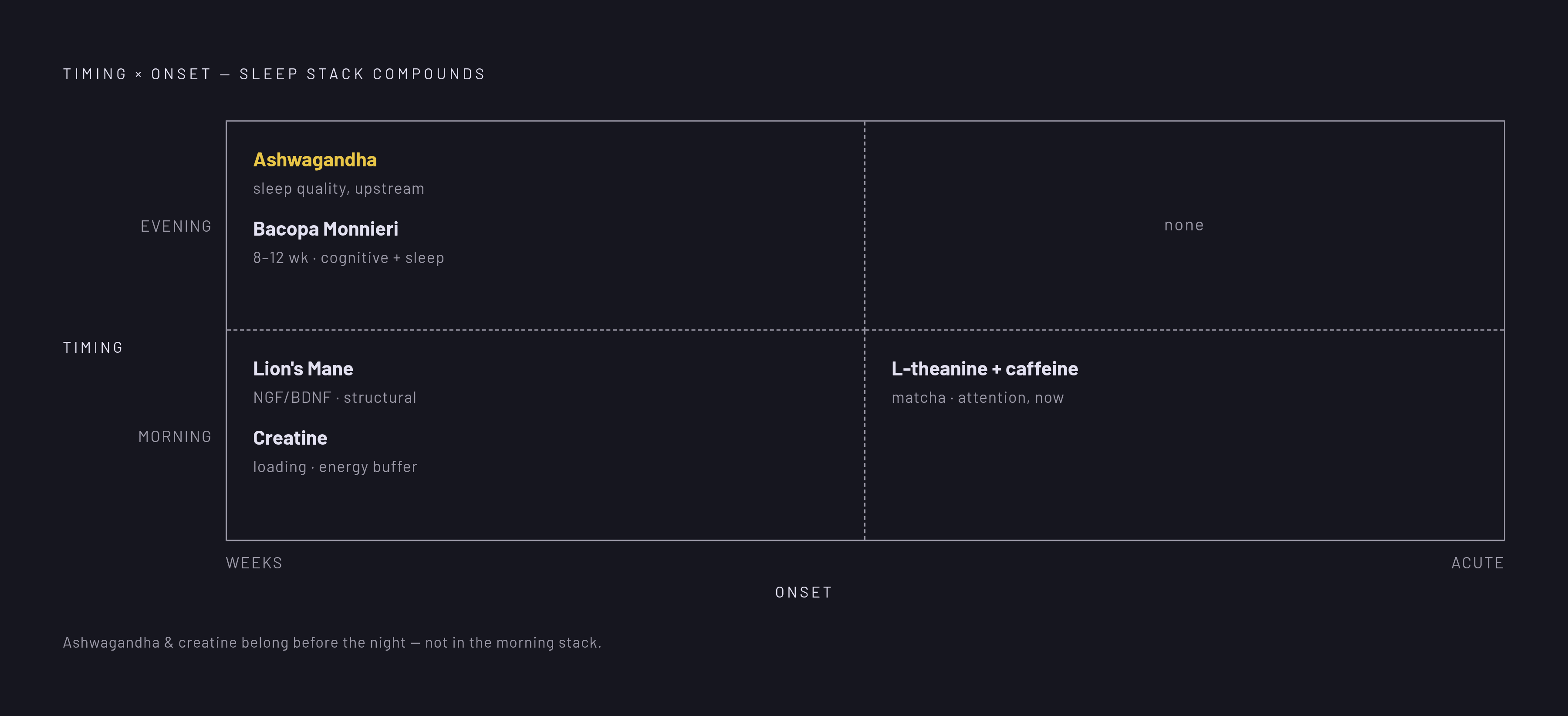
Each compound needs a job and a timescale. L-theanine with caffeine in matcha can help with acute attention in the morning, while taking Ashwagandha in the evening serves the sleep-focused part of the routine. Lion’s Mane and Bacopa belong to consistent, longer-term use. Creatine belongs to preparation for future strain.
Prioritize bioavailability, but do not mistake a delivery claim for demonstrated absorption in sleep-deprived users. An encapsulated liquid format should not be assumed to bypass digestion or reach circulation faster simply because it is liquid. With the gut environment changed, there is more reason to ask for evidence about delivery.
Sleep tracking can help keep the routine anchored to the variable it is meant to support. The University of Oulu’s 2025 study using wearable and mobile sensors found that night-time heart rate, sleep latency, restfulness, timing and overall sleep quantity had a significant effect on next-day cognitive performance. Those measures offer more context than morning tiredness alone. The goal is to use timing, mechanism and delivery to support function without letting repeated caffeine compensation prolong the deficit. When the previous night is poor, the answer is not automatically a bigger morning stack.
Sources
- Single dose creatine improves cognitive performance and induces changes in cerebral high energy phosphates during sleep deprivation
- Single-Dose Creatine Reduces Sleep Deprivation-Induced Deterioration in Cognitive Performance - PMC
- Effect of Creatine Supplementation on Sleep-Deprived Individuals: A Systematic Review
- Cognitive Performance Measurements and the Impact of Sleep Quality Using Wearable and Mobile Sensors
- Sleep deprivation impairs cognitive performance, alters task-associated cerebral blood flow and decreases cortical neurovascular coupling-related hemodynamic responses
- Sleep deprivation effects on basic cognitive processes: which components of attention, working memory, and executive functions are more susceptible to the lack of sleep?