Nootropic Stacking Strategies for Sustained Deep Work Sessions
Match each compound to its job and its onset window.

Nootropic stacking for sustained deep work matches compounds to different problems. A stack should time fast focus support, sustained energy, stress regulation, and recovery so that each has its own place. The test is simple. Each ingredient needs a distinct job, and its expected benefit needs to fit the time available for it to work.
Why deep work sessions stall — and what stacking is actually meant to fix
A long work session can break down in several ways. Adenosine builds up and suppresses alertness, while changes in acetylcholine availability can blunt attention. Sustained cognitive load can also raise cortisol, interfering with working memory. These are different bottlenecks, even when they feel like the same mid-session fog. Trouble holding a thought can have a different cause from feeling sleepy.
Blocking the fatigue signal does not, by itself, address cholinergic function or the stress response. A person can stay awake while losing the thread of the work. The familiar strong start, drift, and crash is therefore not simply a verdict on discipline. A stack needs to work across these different systems and keep working after the opening stretch.
What "stacking" actually means — complementary mechanisms, not compound count
Combining compounds makes sense for three reasons. They can address different bottlenecks, amplify each other’s useful effects, or buffer each other’s unwanted effects. A combination that does none of these has no clear purpose. Several ingredients aimed at the same pathway may be an overdose of one idea.
Timing adds another requirement to that design. Acute compounds work within a work session, while chronic compounds need to be taken over time before they can have their intended effects. One group shapes the immediate work block. The other supports the conditions under which repeated work blocks happen. Treating both groups as interchangeable makes the ingredient list look more complete than the actual system is.
The obvious objection is that more coverage provides insurance. Yet overlapping mechanisms make it harder to isolate what works and can increase tolerance pressure on pathways already being targeted. A two-compound stack can therefore be more coherent than a ten-compound regimen.
The acute layer — what fires in the first hour to trigger focus
Caffeine blocks adenosine receptors, which turns down the fatigue signal. It can improve vigilance, speed up reaction times, and help with short-term recall. That makes it a practical starting point for entering a work block. It does not make it a complete deep-work strategy. Alertness is only one requirement for sustained attention.
L-Theanine gives the acute layer a second role. In combination with caffeine, it is intended to support focus while buffering unwanted stimulation. This is the distinction between a complementary pair and two ingredients doing the same job. The rationale for combining them is a more usable state of alertness.
Matcha packages that pairing in a familiar beverage. It supplies caffeine and L-Theanine together in their natural ratio, although that is not the same as the fixed amounts used in a separately assembled combination.
The sustained layer — extending the focus window without building a tolerance spiral
Regular caffeine use presents a problem beyond the crash. Tolerance can progressively increase the amount needed to produce the same effect. Escalating the dose may preserve the feeling of stimulation without fixing the other reasons a session fades. The sustained layer is meant to extend useful performance without making “more caffeine” the answer to every slowdown.
Methylliberine, sold as Dynamine™, and theacrine have different timing roles. Methylliberine provides a faster-onset boost, while theacrine extends the tail of the energy curve. Their pairing is intended to broaden the focus window rather than pile another identical peak onto the beginning. That timing rationale is not proof that a combination eliminates tolerance. A longer window and freedom from tolerance are different claims.
Rhodiola bridges immediate and longer-term support. It can begin to reduce fatigue within a session, while taking it over time is meant to help the body adapt to demand. Still, having energy for longer leaves the stress of keeping up the effort in place. A person can have enough drive to continue while working memory and attention become less reliable.
The cortisol problem — why sustained cognitive effort suppresses the focus it requires
Sustained cognitive load can activate the body’s stress-response system. As cortisol rises, prefrontal cortex function can suffer, weakening working memory and attention. The work becomes harder to hold together. This helps explain why a later hour can feel different from the first even when stimulation remains strong.
The stress-regulation layer addresses that separate constraint. Ashwagandha is used for its influence on the body’s stress-response system, while Rhodiola contributes both fatigue resistance and support for adaptation to demand. Their intended role is to support the cognitive functions that continued effort can undermine.
That role also sets a limit on expectations. Ashwagandha’s intended chronic effects take weeks to build, so it needs to be in use well before a session starts to fade. This holds even though Rhodiola has an acute role. The architecture depends on knowing which effects may arrive today and which require continuity.
Acute versus chronic compounds — why onset windows determine whether a stack is a system or a coincidence
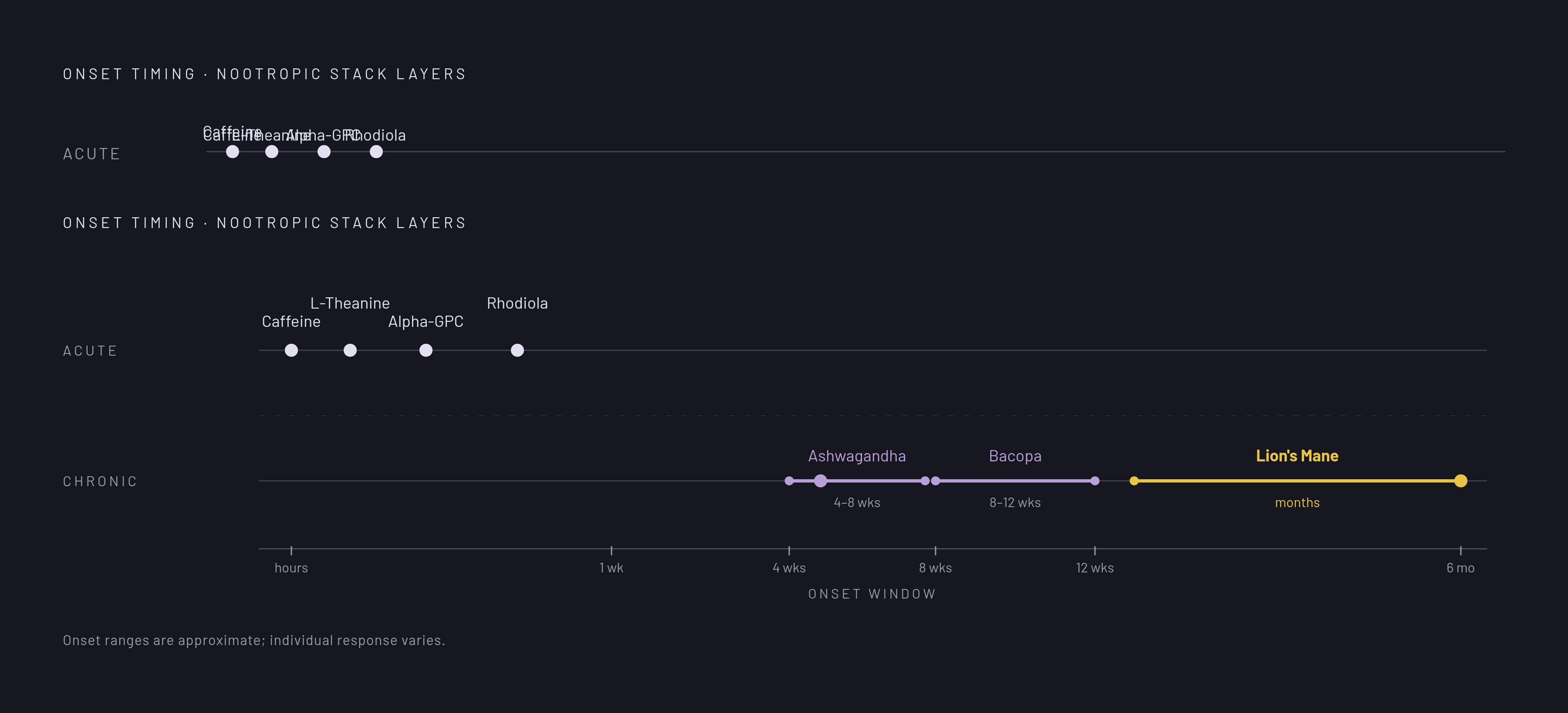
Caffeine, L-Theanine, Alpha-GPC, and Rhodiola belong to the within-session side of the design. Bacopa, Ashwagandha, and Lion’s Mane have longer-term roles. These groups cannot substitute for each other merely because all appear under the nootropic label. Their clocks are different. Trying a compound for one day gives it too little time if its intended benefit takes weeks or months.
Lion’s Mane makes that distinction especially clear. Its hericenones and erinacines are linked to nerve growth factor synthesis, so its proposed role is to support neural structure over time. A 2024 clinical trial in older adults found improved cognitive processing speed and changes in BDNF levels. Mori et al.’s 2009 trial also found that cognitive scores fell back toward baseline within 4 weeks of stopping. Those findings concern consistent use.
Chronic support needs time to build before it can play its part in the full stack. Acute ingredients can still be assessed first, but the full system develops on a different schedule. Starting everything together obscures which effect belongs to which compound. Onset is therefore a design constraint.
The sleep-performance loop — why the nightly cycle is part of the stack's architecture, not outside it
A daytime boost that degrades sleep creates a bad trade. Sleep loss impairs motor performance, cognitive processing, and emotional regulation, including functions needed for the next work session. Morning compounds do not erase that dependency. Recovery belongs inside the architecture because daytime performance draws on it.
Ashwagandha connects the chronic layer to this nightly cycle. Its influence on stress regulation is associated with improved sleep quality, and research using wrist actigraphy found increased total sleep time after treatment. Bacopa is also positioned as supporting both longer-term cognitive function and sleep, although its cognitive evidence is mixed. Stough et al.’s trial found that spatial working memory was more accurate, while Lopresti’s 2024 trial found that cognition improved no more than with placebo even though stress fell. Double duty is a useful design goal whose achievement remains uncertain.
Use of stimulating compounds should end at 2:00 PM. Caffeine’s long half-life means an afternoon dose can interfere with the sleep needed for tomorrow’s work. L-Theanine and Magnesium Glycinate belong in the calming, before-bed part of the proposed system, with L-Theanine serving a different role from its morning pairing. Omega-3s at meaningful EPA/DHA intake provide a further foundational input through support for neuronal membrane integrity and BDNF production, rather than acting as another immediate focus trigger.
Bioavailability as a stack variable — why the form of delivery changes what the stack actually does
An ingredient’s name does not describe everything the body receives. Bioavailability concerns how much of an administered compound becomes available, making form and absorption part of the design. Correct timing cannot rescue poor delivery.
Alpha-GPC provides approximately 40% choline by weight and delivers more choline per dose to brain tissue than choline bitartrate or lecithin. CDP-Choline, also called Citicoline, supplies both choline and cytidine, giving it a different profile that supports brain energy as well as acetylcholine production. These are not identical ingredients under competing labels. Their different roles may be complementary, but that does not automatically justify taking both.
Liquid and sublingual formats can reach effective concentrations faster than capsules, which can change whether an acute effect aligns with the intended work block. The size of that difference depends on the compound and formulation. A faster format is useful only when its timing serves the job.
For Bacopa Monnieri, the practical absorption instruction is daily use with breakfast and a fat-containing meal. Consistency alone is not the whole requirement. Product quality is equally basic, including third-party testing for contaminants such as heavy metals, mycotoxins, and PFAS. Efficient absorption is no achievement if the product also delivers unwanted contaminants.
Assembling the architecture — a practical sequence for building a deep-work stack from the ground up

During Week 1–2, establish the acute layer with caffeine and L-Theanine. The starting combination proposed here is 100–200 mg caffeine with 200 mg L-Theanine. Its advantage is the short feedback loop. Within days, the pairing can be judged by how well it helps with focus on the work, beyond how noticeable it feels.
During Week 3–4, the plan adds Alpha-GPC to the morning routine and starts Ashwagandha. Alpha-GPC introduces cholinergic support, while Ashwagandha starts the slower stress-regulation work. The latter takes 4–8 weeks to reach its full intended effects. An immediate verdict would confuse onset with effectiveness. This phase begins the chronic foundation without pretending that it is already complete.
During Week 5–6, the sequence introduces theacrine and/or methylliberine for a longer energy window, with Rhodiola for fatigue resistance. These additions need a reason to exist. A stack that already supports the required work block does not become better simply by following every possible phase. Where sustained performance remains the bottleneck, this stage addresses it while the cortisol-regulation layer is partly established.
From Week 7 onward, the proposed long-term layer includes daily Bacopa with fat and Lion’s Mane. Bacopa’s intended working-memory and cortisol benefits are assessed over 8–12 weeks of consistent use, with the mixed cognitive findings kept in view. Lion’s Mane belongs on a months-long horizon.
The stopping rule is as important as the sequence. Each addition must earn its place through a distinct, non-redundant role, rather than through the promise of broader coverage alone. These phases describe possible functions. If a compound cannot be matched to the specific problem it is meant to solve, it does not belong in the stack.