How Caffeine-Free Nootropic Shots Protect Sleep Architecture While Sustaining Daytime Focus
Stress-regulating herbs may sharpen focus without costing you sleep.
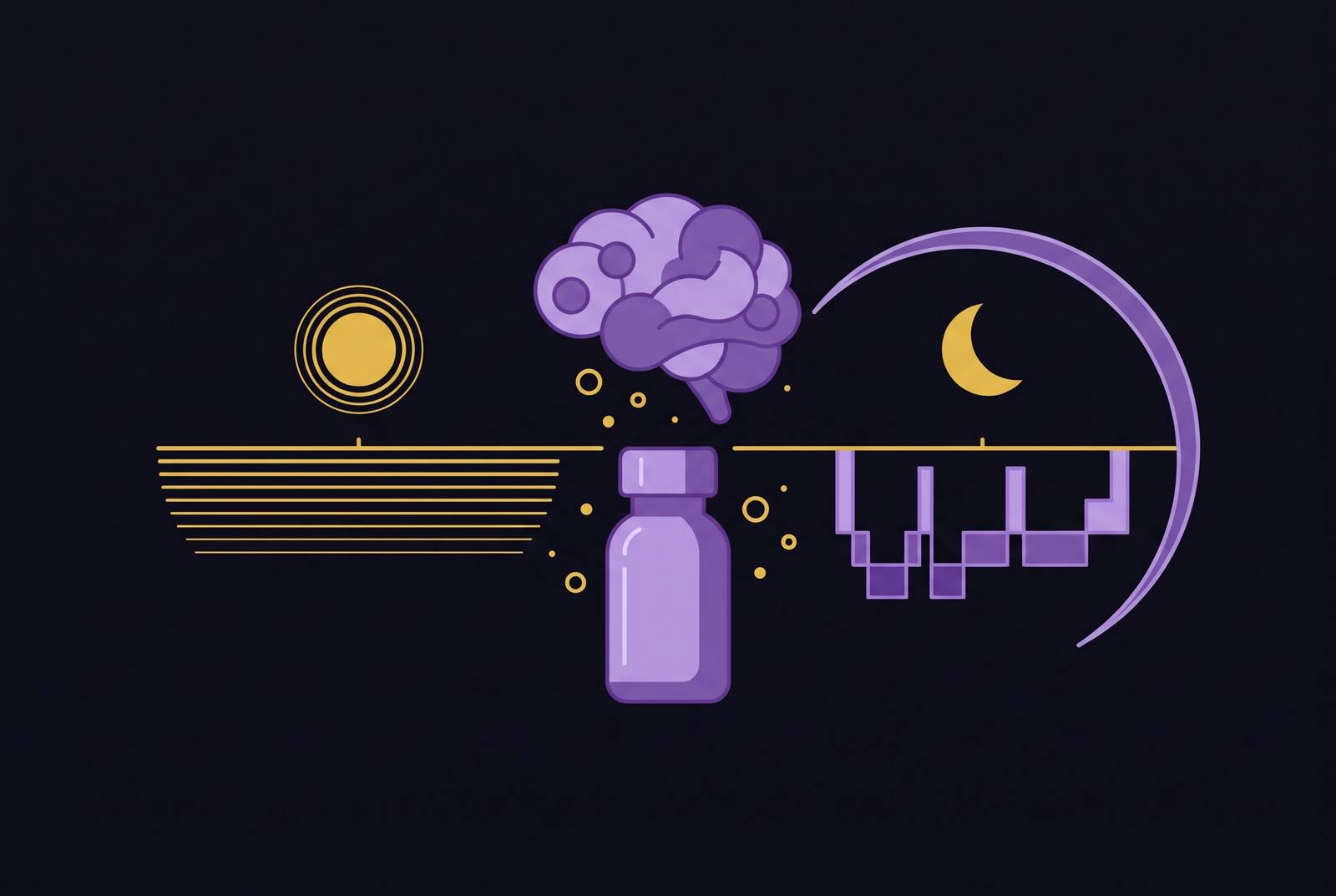
Caffeine-free nootropic shots offer a different route to daytime focus, one that need not trade tonight’s sleep for this afternoon’s output. Their strongest case is that ingredients supporting stress regulation, calm attention, and longer-term cognitive function can support a daily baseline without masking the need for sleep. That case depends on the evidence, the dose, absorption, and what people can reasonably expect.
How caffeine creates a focus-debt cycle through adenosine suppression and sleep disruption
The afternoon cup keeps the work session going. Then comes a restless night, followed by a morning that seems to demand another cup. Caffeine blocks adenosine receptors, masking the brain’s perception of sleep pressure without stopping adenosine from accumulating.
That distinction explains the focus-debt cycle. When caffeine interferes with sleep, it can both shorten the time available for recovery and disrupt the sleep that does occur. When thinking is harder the next day, another dose can seem more appealing. The same tool used to compensate for poor sleep can help prolong it.
This outcome is a risk that varies from cup to cup. Dose and timing affect the trade-off. A 2025 randomized crossover trial published in SLEEP found that a higher caffeine dose disrupted sleep initiation and architecture, while a lower dose did not produce the same significant effects. The recurring pattern of sleep-disrupting use is therefore the concern.
What sleep architecture actually does for cognitive performance, and what caffeine costs when it disrupts it
Sleep architecture is the organization of sleep into its different stages. REM sleep supports emotional regulation, creative recombination of information, and aspects of procedural memory, which NREM sleep also supports. These overnight processes help make fluid thinking possible the next morning.
Sleep disturbances can impair short-term memory, focused attention, decision-making, and problem-solving. They do not hit every task equally. Simple vigilance can remain relatively intact under moderate disruption, while complex reasoning is more sensitive to degraded sleep architecture. Feeling awake enough to monitor a screen is not the same as being ready to make a difficult judgment.
That gap is especially relevant to executives, doctors, and engineers whose work depends on more than staying alert. When caffeine compensates for sleep disruption that it helped cause, the deficit can compound across the work week. Alertness and recovery are not interchangeable.
Why cortisol sits at the center of both poor sleep and impaired prefrontal function
The prefrontal cortex supports working memory, attention regulation, and executive decision-making, and it is sensitive to elevated cortisol. Poor sleep can raise baseline cortisol, while elevated cortisol can make subsequent sleep lighter and less restorative. This creates another loop inside the focus-debt cycle. Caffeine can add to it by acutely raising cortisol after ingestion.
The target is therefore not just tiredness itself. When excessive stress activity suppresses prefrontal function, reducing that activity offers a route to better cognition without adding stimulation. Ashwagandha and Rhodiola Rosea act on this stress-response pathway, which explains their relevance beyond the loose label of “stress herbs.” Phosphatidylserine belongs in the same discussion because it supports cell membrane health and cortisol regulation through a complementary route.
How Ashwagandha and Rhodiola Rosea address the cortisol loop without caffeine
Ashwagandha and Rhodiola Rosea target the stress response. Ashwagandha has human trial evidence for stress reduction and sleep improvement, while Rhodiola has evidence for reducing stress-related mental fatigue. Their proposed route is moderation of the HPA axis, the system coordinating the body’s response to stress. That is a different job from masking sleepiness.
University of South Carolina researchers’ 2026 randomized, double-blind, placebo-controlled trial tested the two together. Taking the supplements in the morning for a short time improved perceived stress, sleep quality, and positive affect compared with placebo. The participants were healthy, physically active adults. That population makes the result relevant to everyday performance, although the reported outcomes do not by themselves prove an improvement in every aspect of cognition.
A 90-day clinical study found that sustained-release Ashwagandha improved sleep quality, memory, focus, and psychological well-being compared with placebo, with good safety and tolerability during the study. A separate randomized, double-blind, placebo-controlled study found that Rhodiola increased mental performance, particularly concentration, and reduced the cortisol response to awakening stress. That study involved people with burnout and fatigue syndrome. Its population should not be quietly treated as interchangeable with healthy workers, even though it supports the stress-fatigue mechanism.
The obvious objection is that less stress is not sharper focus. When elevated cortisol is suppressing prefrontal function, however, removing that interference can help restore concentration. The route runs through stress and recovery. It does not require the activated feeling that makes caffeine’s effects so easy to recognize.
How Lion's Mane supports neuroplasticity and long-term cognitive capacity through a different pathway entirely
Lion’s Mane takes a different route from stress regulation. Its bioactive compounds, hericenones and erinacines, have promoted nerve growth factor synthesis in preclinical studies. NGF supports the growth and maintenance of neurons, making this a plausible pathway for neuroplasticity, learning, and memory. The aim is to support underlying capacity over time. That distinction gives Lion’s Mane a different place in a daily formula.
Preclinical findings do not establish that a daily shot will produce the same effects in people. Studies of cognition in people have had mixed results, and many have followed small groups for only a short time. Larger, longer trials are needed to establish efficacy more clearly. Calling it a proven brain-building shortcut would outrun those findings.
Lion’s Mane’s proposed value develops over weeks and months. Where sleep-disrupting caffeine use borrows against recovery, Lion’s Mane is intended to support the biological foundations of cognition.
What Bacopa Monnieri and Cognizin actually do — and where their evidence holds up honestly
Bacopa Monnieri and Cognizin® citicoline address the neurochemical foundations of attention and memory. They belong in the same broad conversation, but their evidence is not interchangeable. Multiple placebo-controlled Bacopa trials have reported improvements in memory and other cognitive functions. A December 2025 randomized controlled trial in adults aged 40–70 with self-reported memory and attention problems found no cognitive improvement over placebo after 12 weeks.
That result rules out a simple promise of better memory. Bacopa’s effects on stress give stronger grounds for its use than a broad claim that it directly improves memory in healthy adults.
Cognizin is a branded form of citicoline, intended to support the neurochemical basis of sustained attention. It is not a substitute for caffeine’s immediate kick. Noticeable benefits from sustained cognitive use generally belong on a timeline of weeks of daily use. Neither its mechanism nor Bacopa’s should be used to explain away an absence of good human evidence for a specific claim.
How L-Theanine modulates alpha-wave activity to produce calm alertness without adenosine suppression
L-Theanine provides the clearest bridge between immediate experience and longer-term support. It promotes alpha-wave activity associated with relaxed alertness, creative thinking, and focused calm. This differs from caffeine’s adenosine blockade and the activated pattern associated with stimulation and stress. The intended feeling is settled attention. That makes it relevant to people who want less distractibility without feeling wound up.
Its role also changes depending on the formula. Paired with caffeine, L-Theanine can smooth the stimulant response and reduce jitteriness. Used without caffeine, it offers calm alertness without masking sleep pressure through adenosine receptor blockade. At evidence-based doses, it is compatible with evening use and does not create caffeine’s mechanism of sleep interference. That is narrower than a promise that any product containing it will improve sleep.
L-Theanine acts relatively quickly compared with Bacopa and Lion’s Mane. It is the ingredient most likely to provide a noticeable same-day benefit while slower components are still on their longer timelines.
Why ingredient quality depends on delivery architecture
A good ingredient list is only a starting point. Active compounds still have to reach circulation at useful concentrations, and digestion and first-pass liver metabolism can reduce how much becomes available. A higher dose on the label does not ensure that the body absorbs enough.
Liquid shots can offer delivery advantages because ingredients are already in solution, allowing absorption to begin without first breaking down a dry format. The extent of that advantage depends on the compound and formulation. It does not establish that every shot reaches the brain more effectively than every capsule. Liposomal encapsulation, nanoemulsification, and time-release methods are approaches intended to address delivery losses. Their names alone do not prove that they succeed.
The evidence remains limited for specific nootropic ingredients and commercial liposomal formulations. A scientifically plausible delivery method is not the same as demonstrated superior absorption in a finished product. Evaluating a label’s claim of “enhanced bioavailability” requires an explanation of the specific mechanism and its supporting evidence. A clinically studied dose in a well-supported format offers a stronger basis for comparison than an impressive dose with uncertain delivery.
The temporal mismatch between what caffeine delivers and what caffeine-free stacks build
Caffeine-free products do not match caffeine’s acute effect on demand. Caffeine delivers a rapid boost, and caffeine with L-Theanine remains an evidence-backed short-term option for an acute high-demand window, such as a one-day deadline or overnight travel. A daily caffeine-free formula’s strongest case is support for a sustained baseline.
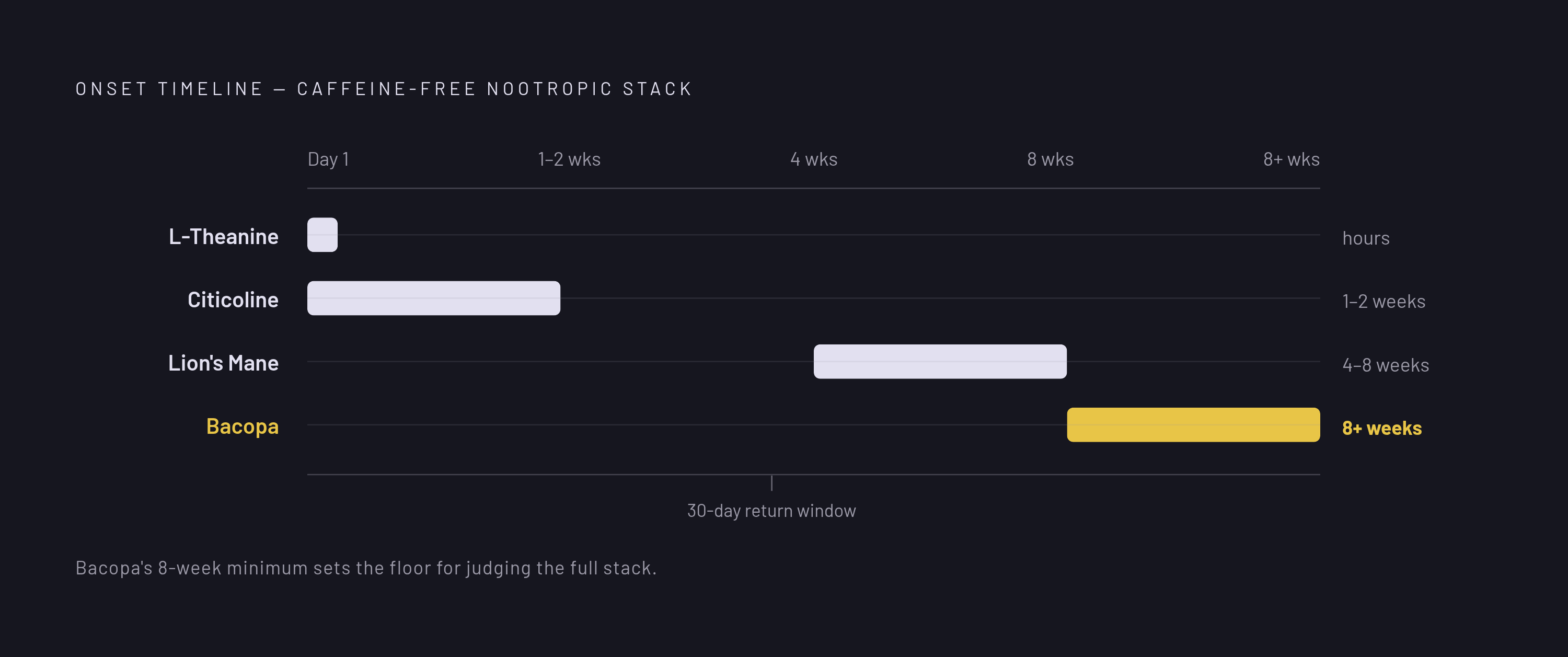
The ingredients operate on different clocks. L-Theanine can work within hours, while citicoline’s measurable benefits may emerge within one to two weeks of daily use. Lion’s Mane is commonly framed around four to eight weeks, and Bacopa around eight weeks or more. Given the mixed clinical findings, these are evaluation windows during which the extent of any benefits remains uncertain. How the formula feels right away cannot show how well the whole formula works.
The comparison changes across a 40–50 week working year. Regular caffeine use can bring tolerance, and sleep-disrupting use can erode the baseline that the next dose is meant to rescue. A caffeine-free stack instead aims to support attention without introducing that particular recovery cost. Support across repeated working days matters more in this comparison than the strongest afternoon sensation.
For a reader choosing a daily shot, credibility rests on five practical checks. Named ingredients need disclosed doses because clinical evidence is dose-specific. Human randomized trials deserve more weight than animal or laboratory findings, and third-party safety testing should address contaminants including heavy metals, mycotoxins, and plasticizers. Delivery claims need evidence specific enough to evaluate. The formula description should also account for its vitamins and amino acids alongside its marquee nootropics and adaptogenic botanicals.
The final check is enough time to judge cumulative effects. Taking the formula every day is meant to bring those benefits, though daily use does not ensure that it will work. A 30-day return window is shorter than the evaluation period for several longer-acting ingredients. A 100-day guarantee gives the daily ritual room to be assessed on its intended timescale, rather than forcing a weeks-long proposition to prove itself like a cup of coffee.